 AnatomyCompass
Axis
Axis · Cat · Skeletal system · Axial skeleton
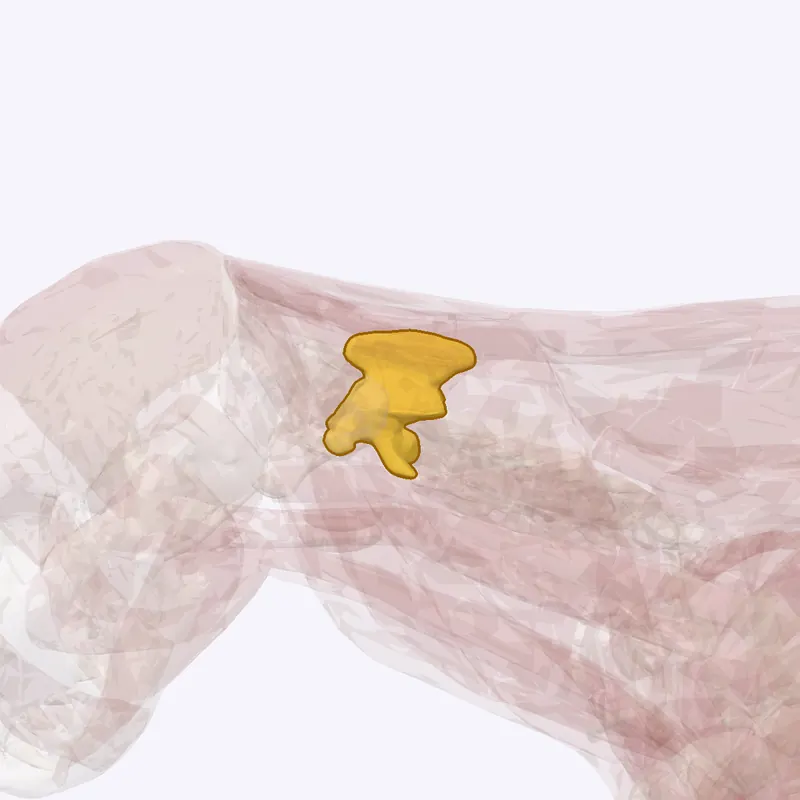
Second cervical vertebra (C2). The longest in the neck, with the dens that acts as the pivot for rotation of the head and a crest-like spinous process.
Key points
- The transverse ligament of the atlas passes over the dens and holds it in place.
- In the cat the nuchal ligament is poorly developed or absent.
- The transverse foramen, at the base of the transverse process, transmits the vertebral artery.
- Fractures of the dens and atlantoaxial subluxation are uncommon and follow severe trauma.
- Its length and the height of its spinous process help identify the other cervical vertebrae on radiographs.
Overview
The axis is the second cervical vertebra and the longest of the neck. Its defining feature is the dens, a cranial projection of the body that sits inside the ring of the atlas and serves as the pivot for rotation of the head.
Key features
- Dens. Cylindrical projection resting in the fovea of the dens of the atlas. It is held in place by the transverse ligament of the atlas, which passes over it, and by the apical and alar ligaments, which tie it to the occipital bone.
- Spinous process. A tall, elongated crest that extends cranially over the dorsal arch of the atlas and caudally over C3. In other species it gives origin to muscles and the nuchal ligament; in the cat the nuchal ligament is poorly developed or absent.
- Cranial articular surfaces. On either side of the dens, for the caudal foveae of the atlas.
- Caudal articular processes. Articulate with C3.
- Transverse processes. Small and directed caudally. Their base is pierced by the transverse foramen, which carries the vertebral artery.
Clinical relevance
- Atlantoaxial injuries. Fractures of the dens or the body of the axis and atlantoaxial subluxation are uncommon in the cat. They follow severe trauma and cause neck pain and deficits in all four limbs.
- Radiography. The length of the axis and the height of its spinous process are landmarks for identifying the remaining cervical vertebrae.
Related structures
See it in 3D on your iPhone
Peel the layers, spin the model, quiz yourself on it and stand it on your desk in AR. AnatomyCompass is coming to iPhone, iPad and Mac: get one email when it’s out.
More of the Cat: Skeletal system
Text adapted from Vet Atlas (CC BY-SA 4.0). 3D model: "Feline Skeleton Dec" by westerly (Sketchfab) (CC BY 4.0). Sources and licences. This veterinary text has not yet been reviewed by a veterinarian.