 AnatomyCompass
Fibularis longus
M. fibularis longus · Cat · Muscular system · Pelvic limb
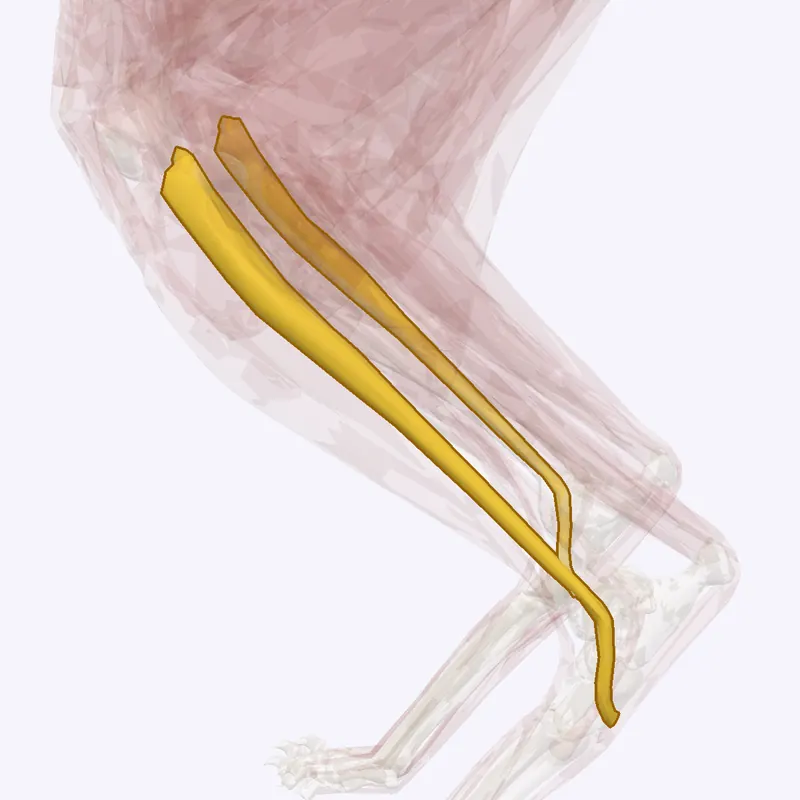
Muscle of the lateral crus whose tendon crosses the sole of the tarsus.
Key points
- It arises from the lateral condyle of the tibia and the head of the fibula.
- Its tendon turns round the lateral malleolus and crosses the plantar surface of the tarsus.
- It flexes the tarsus and rotates the paw.
- It is supplied by the fibular nerve.
Overview
A short belly on the lateral surface of the crus, between the long digital extensor and the deep flexors. Its long tendon runs in a groove of the lateral malleolus and then medially across the plantar surface of the tarsus.
Origin
Lateral condyle of the tibia, head of the fibula and lateral collateral ligament of the stifle.
Insertion
Fourth tarsal bone and the bases of the metatarsal bones, after crossing the plantar surface of the tarsus.
Action
Rotates the paw medially (pronation) and flexes the tarsus.
Innervation
Common fibular (peroneal) nerve (n. fibularis communis).
Related structures
See it in 3D on your iPhone
Peel the layers, spin the model, quiz yourself on it and stand it on your desk in AR. AnatomyCompass is coming to iPhone, iPad and Mac: get one email when it’s out.
More of the Cat: Muscular system
Text adapted from Vet Atlas (CC BY-SA 4.0). 3D model: "Feline Ecorche Dec" by westerly (Sketchfab) (CC BY 4.0). Sources and licences. This veterinary text has not yet been reviewed by a veterinarian.