 AnatomyCompass
Tarsus
Ossa tarsi · Cat · Skeletal system · Pelvic limb
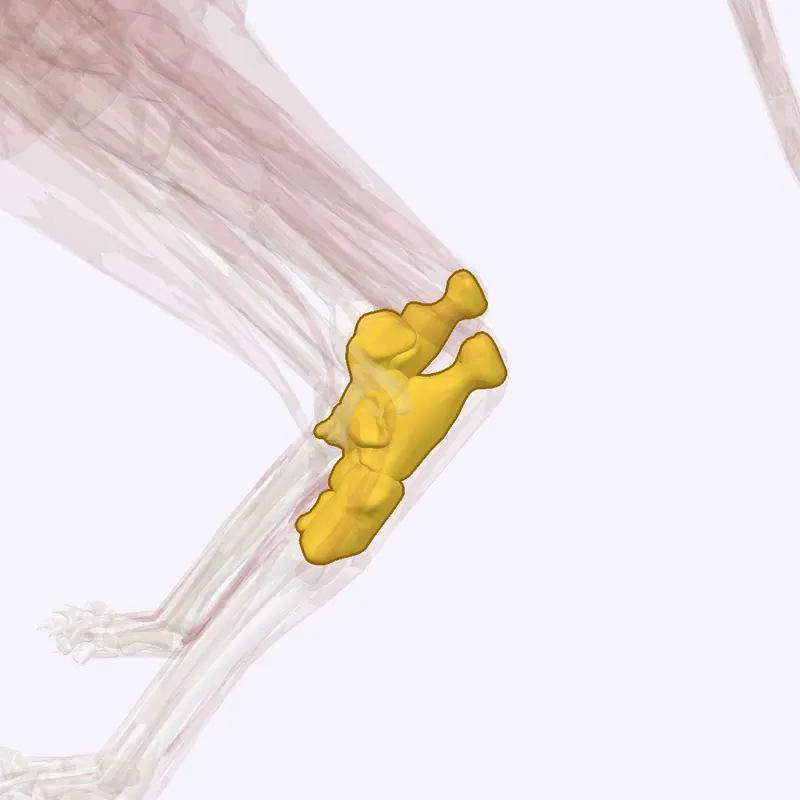
Seven short bones between the leg and the metatarsus. The calcaneus forms the point of the hock, where the common calcaneal tendon inserts.
Key points
- The trochlea of the talus forms the tarsocrural joint, where almost all tarsal movement occurs.
- The sustentaculum tali guides the tendon of the deep digital flexor.
- A plantigrade stance is a classic sign of diabetic neuropathy in the cat.
- Scottish Fold osteochondrodysplasia causes plantar exostoses on the tarsus and metatarsus.
- Shearing injuries of the tarsus after road accidents are often open.
Overview
The tarsus (ossa tarsi) is the group of short bones of the hock. It lies between the tibia and fibula proximally and the metatarsal bones distally.
The cat has seven tarsal bones, arranged in several rows.
In the normal digitigrade stance the tarsus is raised off the ground and the joint is held at an angle.
Bones
- Talus. Proximal row, medial. Its trochlea fits the cochlea of the tibia and forms the tarsocrural joint, where almost all tarsal movement takes place.
- Calcaneus. Proximal row, lateral. Its tuber (tuber calcanei) forms the point of the hock and receives the common calcaneal tendon, which extends the tarsus. The gastrocnemius, the superficial digital flexor and others contribute to that tendon. The sustentaculum tali supports the talus medially and guides the tendon of the deep digital flexor.
- Central tarsal bone. Between the proximal and distal rows, on the medial side.
- Tarsal bones I to IV. They form the distal row. Bone IV is the largest and spans two levels on the lateral side.
Clinical relevance
- Plantigrade stance. Resting the tarsus and metatarsus on the ground is a classic sign of diabetic neuropathy in the cat. It also appears with injuries of the common calcaneal tendon and the sciatic nerve.
- High-rise syndrome. The tarsus is among the limb regions injured.
- Scottish Fold osteochondrodysplasia. Exostoses form on the plantar side of the tarsus and metatarsus, with stiffness, pain and lameness.
- Fractures, luxations and shearing injuries. They follow road accidents and are often open.
Diseases
- High-rise syndromeThe set of injuries of cats that fall from windows or balconies of tall buildings. Most cats survive with…
- Scottish fold osteochondrodysplasiaInherited cartilage disorder caused by the same genetic variant that folds the Scottish fold's ears. It…
Related structures
See it in 3D on your iPhone
Peel the layers, spin the model, quiz yourself on it and stand it on your desk in AR. AnatomyCompass is coming to iPhone, iPad and Mac: get one email when it’s out.
More of the Cat: Skeletal system
Text adapted from Vet Atlas (CC BY-SA 4.0). 3D model: "Feline Skeleton Dec" by westerly (Sketchfab) (CC BY 4.0). Sources and licences. This veterinary text has not yet been reviewed by a veterinarian.