 AnatomyCompass
Urinary bladder
Vesica urinaria · Cat · Splanchnology (organs) · Urinary system
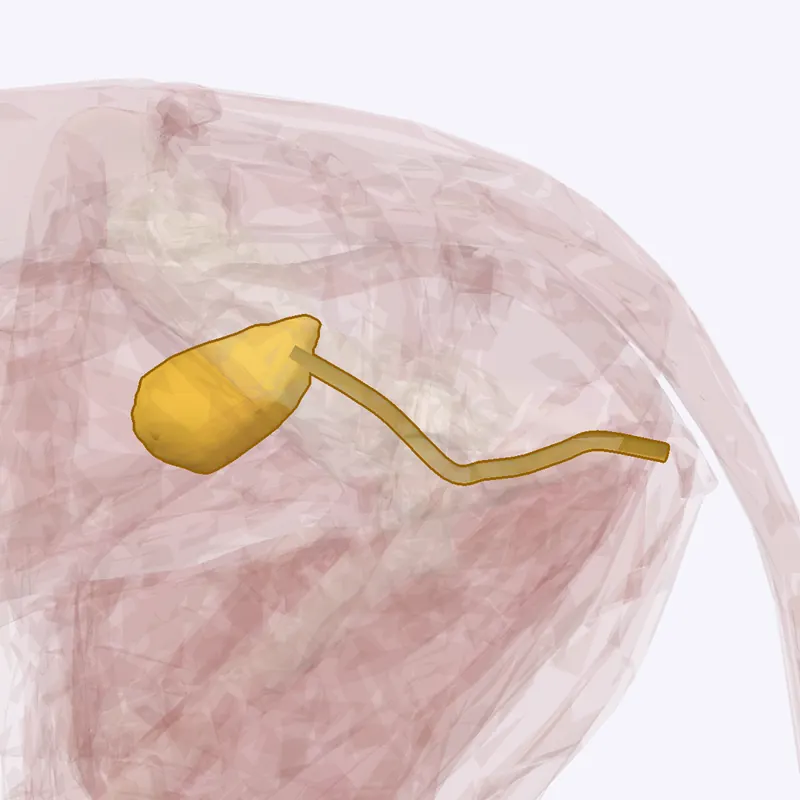
Pear-shaped urine reservoir. In the cat it stays within the abdomen even when empty, with a long neck that continues as the urethra.
Key points
- Unlike the dog's, the feline bladder is abdominal even when empty.
- The penile urethra is the narrowest part, where plugs and stones lodge.
- Feline idiopathic cystitis is the most common cause of lower urinary tract disease in young and middle-aged cats.
- Urethral obstruction produces hyperkalaemia, bradycardia and azotaemia.
- Feline struvite is usually sterile and can be dissolved by diet; oxalate cannot.
Topography
The body and apex extend cranially along the abdominal floor depending on how full it is.
Unlike the dog's, the feline bladder is abdominal even when empty, and its neck is relatively long.
The ureters arrive on the dorsal surface and open at the trigone.
Urethra
Male
- after a long preprostatic urethra, it passes through the small prostate
- it runs along the pelvic floor
- beyond the bulbourethral glands, it continues as the penile urethra, the narrowest part
Urethral plugs and stones lodge in the penile urethra.
Female
It is shorter and wider. It opens on the floor of the vestibule.
Clinical relevance
Feline idiopathic cystitis
The most common cause of lower urinary tract disease in young and middle-aged cats. It is linked to stress and indoor life.
It causes:
- pollakiuria
- stranguria
- haematuria
- urination outside the litter box
Urethral obstruction
A typical emergency of male cats. It is caused by matrix-crystalline plugs, stones or urethral spasm.
It produces hyperkalaemia, bradycardia and azotaemia.
It is relieved by catheterisation and, if it recurs, by perineal urethrostomy.
Urolithiasis
Struvite and calcium oxalate stones are the most common.
Feline struvite is usually sterile and can be dissolved by diet. Oxalate cannot.
Cystocentesis
The feline bladder is easy to palpate and immobilise, which makes ultrasound-guided or blind puncture straightforward.
Sacrocaudal luxation
Tail-pull injuries damage the pelvic and pudendal nerves and cause bladder atony.
The prognosis worsens if perineal sensation and anal tone are absent.
3D model
Segmentation from the CT of a cat (pixelbeaker model), simplified and registered to the atlas skeleton.
Diseases
- Feline idiopathic cystitisSterile inflammation of the bladder with no identifiable cause, linked to stress and an altered…
- Feline urethral obstructionBlockage of the male cat's urethra by urethral plugs, uroliths or spasm that prevents urination. Within one…
- UrolithiasisFormation of stones (uroliths) in the urinary tract, most often in the bladder. In dogs struvite and calcium…
- Sacrocaudal luxationFracture or luxation between the sacrum and the first caudal vertebrae from traction on the tail ("tail-pull…
Related structures
See it in 3D on your iPhone
Peel the layers, spin the model, quiz yourself on it and stand it on your desk in AR. AnatomyCompass is coming to iPhone, iPad and Mac: get one email when it’s out.
More of the Cat: Splanchnology (organs)
Text adapted from Vet Atlas (CC BY-SA 4.0). 3D model: "Normal Feline Anatomy – Digestive System" by pixelbeaker (Sketchfab) (CC BY 4.0). Sources and licences. This veterinary text has not yet been reviewed by a veterinarian.