 AnatomyCompass
Heart
Cor · Cow · Splanchnology (organs) · Cardiovascular system
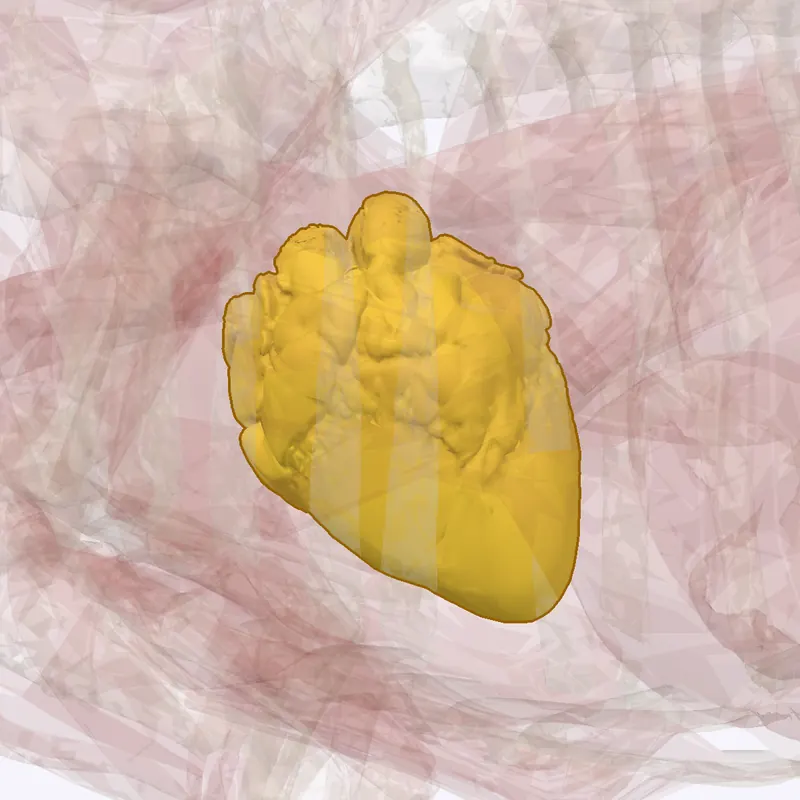
Four-chambered muscular organ in the middle mediastinum, between the 3rd and 6th intercostal spaces, mostly on the left. In cattle it has two cardiac bones and is separated from the reticulum only by the diaphragm.
Key points
- The apex lies very close to the reticulum, separated from it only by the diaphragm.
- The stethoscope is pushed under the triceps to auscultate, mainly on the left.
- The resting heart rate of the adult is around 60–80 bpm.
- Traumatic pericarditis gives muffled sounds, jugular distension and dewlap oedema.
- Bacterial endocarditis mainly affects the tricuspid valve.
Overview
The bovine heart (cor) is conical, with a relatively pointed apex formed by the left ventricle.
Wrapped in the pericardium, it fills the middle mediastinum between the 3rd and 6th intercostal spaces. It lies mostly left of the median plane.
- The base, where the great vessels leave, faces dorsally.
- The apex points ventrally, towards the sternum.
Caudally, the diaphragm separates it from the reticulum, which lies very close to the apex.
Parts
Chambers
- Right atrium and ventricle. Receive blood from the venae cavae and the coronary sinus and pump it into the pulmonary trunk. In ruminants the left azygos vein drains into the coronary sinus.
- Left atrium and ventricle. The left atrium receives the pulmonary veins. The thick-walled left ventricle forms the apex and ejects blood into the aorta.
Valves
Tricuspid, mitral, pulmonary and aortic.
Cardiac bones
The cardiac bones (ossa cordis) sit in the fibrous skeleton around the aortic orifice. Cattle have two, a larger right one and a smaller left one.
Coronary arteries
In cattle the left coronary artery is dominant. It gives both the paraconal and the subsinuosal interventricular branches.
Clinical relevance
Auscultation
The thoracic limb covers most of the cardiac area, so the stethoscope is pushed under the triceps muscle, above the elbow, mainly on the left side.
The resting heart rate of the adult is around 60–80 bpm.
Traumatic pericarditis
A metal foreign body that perforates the reticulum and diaphragm reaches the pericardium and causes fibrinopurulent pericarditis.
Its signs are:
- muffled heart sounds
- splashing or friction sounds
- tachycardia
- jugular distension
- oedema of the brisket and dewlap, from right heart failure
The prognosis is poor.
Other diseases
- Bacterial endocarditis. Mainly affects the tricuspid valve. It is associated with chronic septic foci, such as liver abscesses, mastitis or foot lesions, and with Trueperella pyogenes.
- High mountain disease (brisket disease). In cattle raised at high altitude, hypoxia causes pulmonary hypertension and right heart failure with brisket oedema.
- Lymphoma. In enzootic bovine leukosis the right atrium is a characteristic site of tumour infiltrates.
Diseases
- Enzootic bovine leukosisInfection with bovine leukaemia virus, a retrovirus that persists for life in B lymphocytes. Most infected…
- Nutritional myodegenerationNecrosis of skeletal muscle and myocardium due to deficiency of selenium, vitamin E or both, known as white…
- Traumatic reticuloperitonitisPerforation of the reticular wall by a metallic foreign body swallowed with the feed, causing local or…
Related structures
See it in 3D on your iPhone
Peel the layers, spin the model, quiz yourself on it and stand it on your desk in AR. AnatomyCompass is coming to iPhone, iPad and Mac: get one email when it’s out.
More of the Cow: Splanchnology (organs)
Text adapted from Vet Atlas (CC BY-SA 4.0). 3D model: "Whole Cow Heart Fixed" by Visible Heart Lab, University of Minnesota (Sketchfab) (CC BY 4.0). Sources and licences. This veterinary text has not yet been reviewed by a veterinarian.