 AnatomyCompass
Demodicosis
Infectious · Dog
Skin disease caused by overpopulation of Demodex mites in the hair follicles, in dogs whose immune control of the mite fails. It ranges from a few patches of alopecia in puppies to generalised disease with deep pyoderma.
Key points
- Demodex canis normally lives in the follicle and is not contagious between adult dogs.
- Adult-onset disease usually reflects an underlying condition, such as hyperadrenocorticism.
- Pruritus is absent or mild unless there is secondary infection.
- Deep skin scrapings are taken after squeezing the skin, until capillary bleeding.
- Isoxazolines are now the usual treatment for generalised disease.
What it is
Demodex canis is a normal inhabitant of the canine hair follicle in small numbers.
Puppies acquire it from their dam by direct contact during the first days of life. It is not contagious between adult dogs.
Demodicosis develops when the mites multiply uncontrollably because the host's immune control of them fails.
Other forms are recognised:
- D. injai, a long mite that lives in hair follicles and sebaceous glands and is associated with greasy skin and hair on the dorsal trunk
- a short form found in the stratum corneum
Classification
It is classified by age at onset and extent.
- Juvenile-onset disease occurs in young dogs, with a hereditary predisposition. Localised forms often resolve without treatment.
- Adult-onset disease occurs in dogs with no previous history. It usually reflects an underlying condition such as hyperadrenocorticism, hypothyroidism, neoplasia or immunosuppressive treatment.
- Localised disease has a few patches. Generalised disease has widespread lesions, often with involvement of the paws.
Who it affects
Juvenile-onset disease occurs in puppies and young dogs, often in breeds such as:
- shar-pei
- bulldogs
- pug
- Staffordshire bull terrier
- Dobermann
Adult-onset disease affects older dogs with predisposing conditions.
Anatomy involved
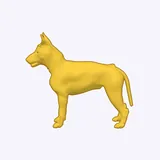
The mites live in the hair follicles of the skin (cutis). Their overgrowth damages the follicle and causes hair loss and folliculitis.
If the follicle ruptures, keratin and mites in the dermis cause furunculosis and deep pyoderma.
Early lesions are typical around the eyes, on the lips and on the forelimbs. Pododemodicosis affects the paws.
Clinical signs
- patchy alopecia
- erythema and scaling
- comedones
- hyperpigmentation
Pruritus is absent or mild unless there is secondary infection.
Generalised disease may progress to deep pyoderma with swelling, lymphadenopathy, fever and malaise.
Diagnosis
- Deep skin scrapings after squeezing the skin, until capillary bleeding, to bring mites out of the follicles.
- Trichograms (plucked hairs) and tape impressions after squeezing. They are useful in sensitive areas, such as around the eyes and the paws.
- Biopsy, when scrapings and trichograms are negative but demodicosis is still suspected.
- In adult-onset cases, investigation of underlying disease.
Treatment
Generalised demodicosis is now usually treated with isoxazolines (afoxolaner, fluralaner, sarolaner, lotilaner), which are effective and safe.
Older options include amitraz rinses and macrocyclic lactones. Ivermectin and similar drugs are dangerous at high doses in dogs with the ABCB1 (MDR1) mutation, common in collies and related herding breeds.
Treatment continues until repeated skin scrapings are negative. Also:
- secondary pyoderma is treated at the same time
- glucocorticoids are avoided
- in adults the underlying disease is managed
Dogs with juvenile-onset generalised demodicosis should not be used for breeding.
Structures affected
References
- Miller WH, Griffin CE, Campbell KL. Muller and Kirk's Small Animal Dermatology, 7th ed. Elsevier (2013)
- Mueller RS, Rosenkrantz W, Bensignor E, et al. Diagnosis and treatment of demodicosis in dogs and cats: clinical consensus guidelines of the World Association for Veterinary Dermatology. Vet Dermatol 31(1):5-27 (2020)
- Hnilica KA, Patterson AP. Small Animal Dermatology: A Color Atlas and Therapeutic Guide, 4th ed. Elsevier (2017)
- Merck Veterinary Manual: Mange in Dogs and Cats
- Thomson P, Carreño N, Núñez A. Main mites associated with dermatopathies present in dogs and other members of the Canidae family. Open Vet J 13:131-142 (2023)
- O'Neill DG, Turgoose E, Church DB, et al. Juvenile-onset and adult-onset demodicosis in dogs in the UK: prevalence and breed associations. J Small Anim Pract 61:32-41 (2020)
- Ordeix L, Bardagí M, Scarampella F, et al. Demodex injai infestation and dorsal greasy skin and hair in eight wirehaired fox terrier dogs. Vet Dermatol 20:267-272 (2009)
See it in 3D on your iPhone
Peel the layers, spin the model, quiz yourself on it and stand it on your desk in AR. AnatomyCompass is coming to iPhone, iPad and Mac: get one email when it’s out.
Text adapted from Vet Atlas (CC BY-SA 4.0). Sources and licences. This veterinary text has not yet been reviewed by a veterinarian.