 AnatomyCompass
Exertional rhabdomyolysis
Metabolic · Horse
Necrosis of muscle fibres during or after exercise, causing stiffness, muscle pain and dark urine from myoglobinuria. It can be sporadic or recurrent; recurrent forms include that of Thoroughbreds and Standardbreds and the polysaccharide storage myopathies (PSSM types 1 and 2).
Key points
- RER mainly affects young females and nervous horses among Thoroughbreds and Standardbreds.
- PSSM1 is caused by a dominant GYS1 mutation, typical of Quarter Horses and draught horses.
- Increased serum CK and AST confirm the diagnosis.
- The GYS1 genetic test is the test of choice for PSSM1; commercial PSSM2 tests are not validated.
- In an acute episode exercise is stopped, and NSAIDs are given only once the horse is well hydrated.
What it is
Exertional rhabdomyolysis (tying-up, azoturia) is the breakdown of skeletal muscle fibres associated with exercise.
As the fibres rupture they release creatine kinase (CK), aspartate aminotransferase (AST) and myoglobin into the blood. Myoglobin is excreted in the urine and can damage the kidneys.
Two broad groups are distinguished.
Sporadic rhabdomyolysis
An isolated episode in a horse with normal muscle. It can be caused by:
- exercise beyond its fitness
- exhaustion in endurance rides
- heat
- electrolyte imbalances
- possibly, vitamin E and selenium deficiency
Chronic or recurrent rhabdomyolysis
It is due to an underlying myopathy:
- Recurrent exertional rhabdomyolysis (RER) of Thoroughbreds, Standardbreds and Arabians is attributed to abnormal regulation of intracellular calcium in muscle. Episodes occur mainly in nervous horses on high-grain diets after days of rest.
- Type 1 polysaccharide storage myopathy (PSSM1) is caused by a dominantly inherited gain-of-function mutation of the GYS1 gene (glycogen synthase). Muscle accumulates glycogen and an abnormal polysaccharide.
- Type 2 PSSM (PSSM2) is diagnosed by biopsy when there is abnormal glycogen accumulation without the GYS1 mutation. It probably groups several different disorders, including the myofibrillar myopathy of Arabians and warmbloods. Its cause is unknown.
Who it affects
- The sporadic form, any horse, especially on returning to work after rest or in endurance rides.
- RER, Thoroughbreds and Standardbreds, more often young females and nervous horses, and Arabian endurance horses.
- PSSM1, Quarter Horses and related breeds, European and North American draught horses and, less often, other breeds.
- PSSM2, Quarter Horses and warmbloods.
- Myofibrillar myopathy, Arabians and warmbloods.
Anatomy involved
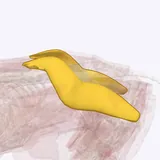
The gluteus medius is the muscle mass of the croup. With the lumbar muscles, it is one of the muscles that become hardest and most painful during an episode, and in chronic myopathies it can atrophy.
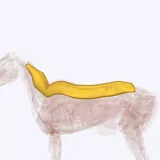
Among the epaxial muscles, the longissimus and the other muscles of the back and loins contract and become painful. The horse shows a tucked-up abdomen and a short, stiff stride.
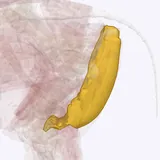
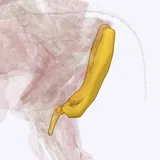
The muscles of the thigh are also involved, causing hindlimb stiffness. Samples for muscle biopsy are taken from the affected muscle groups.
The kidneys can be damaged by ischaemia and by the combined nephrotoxic effects of myoglobin, dehydration and NSAIDs.
Clinical signs
During or shortly after exercise the horse becomes stiff, shortens its stride, refuses to move and sweats excessively. The muscles of the croup and back are hard and painful on palpation.
There may also be:
- tachycardia and tachypnoea
- muscle tremors
- colic-like signs
In moderate or severe cases the urine is red or brown from myoglobin. In the most severe cases the horse becomes recumbent and may develop acute kidney injury.
In PSSM the signs may be subtler: exercise intolerance, lack of energy, muscle stiffness or atrophy, sometimes without clear increases in CK.
Diagnosis
- Increased serum CK, AST and lactate dehydrogenase activity confirm the diagnosis. In PSSM1, CK stays elevated longer than in other forms.
- An exercise test, measuring CK before and 4 hours after light exercise, detects subclinical cases.
- In horses with myoglobinuria, urea or creatinine are monitored to assess renal damage.
- The GYS1 genetic test on blood or hair is the test of choice for PSSM1 in affected breeds.
- PSSM2, myofibrillar myopathy and other myopathies need a muscle biopsy. Commercial genetic tests for PSSM2 are not validated (see "Key studies").
The differential diagnosis includes colic, atypical myopathy (pasture myopathy, linked to Acer seeds) and other causes of stiffness or dark urine.
Treatment and prevention
In an acute episode:
- stop exercise at once and move the horse to a well-bedded stall with fresh water
- fluid therapy if there is haemoconcentration or myoglobinuria, to restore fluid balance and protect the kidney
- tranquillisers with opioids, which relieve anxiety and stiffness
- NSAIDs, only once the horse is well hydrated
Most horses are fairly pain-free within 18–24 hours.
To prevent RER:
- avoid stall confinement, with turnout or a hot walker
- avoid rest days before exercise
- reduce stress and excitement
- replace part of the grain with fat and fibre
- in some horses, give dantrolene before exercise
To prevent PSSM:
- regular exercise, because a few days of rest is a common trigger
- a forage-based diet low in starch and sugar, with fat as an energy source if needed
The evidence for diet and dantrolene comes from crossover studies with very few horses.
The horse is a food-producing animal in many countries, and drug use is subject to national regulations and withdrawal periods. In the EU, the equine identification document (passport) states whether the horse is excluded from slaughter for human consumption, and this decides which medicines may be given.
Key studies
- MacLeay et al. (1999). Study of the records of 984 Thoroughbreds at a Midwestern US racetrack during one season, with a case-control study of management (59 cases and 47 controls). Exertional rhabdomyolysis affected 4.9% of horses, mainly 2-year-old females. Nervous horses were 5.4 times more likely to be affected and those with some lameness 4.2 times more likely. Episodes were associated with rest days before galloping and with more than 4.5 kg of grain a day. Management data come from retrospective questionnaires.
- Isgren et al. (2010). Case-control study in 683 Standardbred trotters from 22 yards. The annual incidence of exertional rhabdomyolysis was 6.4 per 100 horses. Females (OR 7.1; 95% CI 2.1–23.4) and nervous horses (OR 7.9; 95% CI 2.3–27.0) were at higher risk. Susceptible horses won more races than controls, and none of the 36 genotyped carried the GYS1 mutation. Confidence intervals are wide because of the small number of cases.
- Norton et al. (2016). Genomic study of 491 Thoroughbred and 196 Standardbred racehorses. The heritability of RER was estimated at about 0.34–0.46 in Thoroughbreds and 0.39–0.49 in Standardbreds, depending on the model. It indicates a moderate genetic basis, although it does not identify the causal mutation.
- McCue et al. (2008). Study of 831 horses of 36 breeds with PSSM diagnosed by biopsy. The GYS1 mutation was found in 17 breeds, and was present in 87% of draught horses and 72% of Quarter Horses with PSSM, but in only 18% of warmbloods and 24% of other light breeds. This difference led to the definition of PSSM2. Cases come from a single reference laboratory.
- Valberg et al. (2021). Cross-sectional study of the variants tested by commercial genetic tests for PSSM2 and myofibrillar myopathy, in warmblood and Arabian horses with a biopsy diagnosis and breed-matched controls (182 horses) and in 205 public genomes. No variant was associated with the histological diagnosis, and the sensitivity of all of them was below 0.33; the variants were also present in ancient domestic horses. The authors advise against using them for diagnosis, pre-purchase examination or breeding selection.
Structures affected
References
- Reed SM, Bayly WM, Sellon DC. Equine Internal Medicine, 4th ed. Elsevier (2018)
- MacLeay JM, Sorum SA, Valberg SJ, et al. Epidemiologic analysis of factors influencing exertional rhabdomyolysis in Thoroughbreds. Am J Vet Res 60:1562-6 (1999)
- McKenzie EC, Valberg SJ, Godden SM, et al. Effect of oral administration of dantrolene sodium on serum creatine kinase activity after exercise in horses with recurrent exertional rhabdomyolysis. Am J Vet Res 65:74-9 (2004)
- Ribeiro WP, Valberg SJ, Pagan JD, et al. The effect of varying dietary starch and fat content on serum creatine kinase activity and substrate availability in equine polysaccharide storage myopathy. J Vet Intern Med 18:887-94 (2004)
- McCue ME, Valberg SJ, Miller MB, et al. Glycogen synthase (GYS1) mutation causes a novel skeletal muscle glycogenosis. Genomics 91:458-66 (2008)
- McCue ME, Valberg SJ, Lucio M, et al. Glycogen synthase 1 (GYS1) mutation in diverse breeds with polysaccharide storage myopathy. J Vet Intern Med 22:1228-33 (2008)
- Isgren CM, Upjohn MM, Fernandez-Fuente M, et al. Epidemiology of exertional rhabdomyolysis susceptibility in standardbred horses reveals associated risk factors and underlying enhanced performance. PLoS One 5:e11594 (2010)
- Norton EM, Mickelson JR, Binns MM, et al. Heritability of Recurrent Exertional Rhabdomyolysis in Standardbred and Thoroughbred Racehorses Derived From SNP Genotyping Data. J Hered 107:537-43 (2016)
- Valberg SJ, Finno CJ, Henry ML, et al. Commercial genetic testing for type 2 polysaccharide storage myopathy and myofibrillar myopathy does not correspond to a histopathological diagnosis. Equine Vet J 53:690-700 (2021)
- Commission Implementing Regulation (EU) 2021/963 on the identification and registration of equine animals and establishing model identification documents for those animals (2021)
- Merck Veterinary Manual: Exertional Myopathies in Horses
- Merck Veterinary Manual: Plants Causing Myopathies in Horses
- Regulation (EU) 2019/6 on veterinary medicinal products, Article 112 (equine species declared not intended for slaughter)
See it in 3D on your iPhone
Peel the layers, spin the model, quiz yourself on it and stand it on your desk in AR. AnatomyCompass is coming to iPhone, iPad and Mac: get one email when it’s out.
Text adapted from Vet Atlas (CC BY-SA 4.0). Sources and licences. This veterinary text has not yet been reviewed by a veterinarian.