 AnatomyCompass
Feline leukaemia and immunodeficiency viruses (FeLV and FIV)
Infectious · Cat
Two feline retroviruses with very different consequences. Feline leukaemia virus greatly shortens the life of cats with progressive infection, while many cats with feline immunodeficiency virus live for years with a good quality of life.
Key points
- FIV spreads mainly by bites during fights and predominates in intact males.
- Progressive FeLV infection causes lymphoma, cytopenias and immunosuppression.
- Regressive FeLV infection is antigen-negative; the provirus is detected by PCR.
- In kittens under 6 months, a positive FIV test may be due to maternal antibodies.
- The FeLV vaccine is always given after a negative test and does not protect 100%.
What it is
Feline leukaemia virus (FeLV) and feline immunodeficiency virus (FIV) are retroviruses. They copy their RNA genome into DNA and integrate it into the DNA of the cat's cells as a provirus.
Neither infects people: they are not zoonoses.
FeLV
It is an oncogenic retrovirus. It is shed mainly in saliva. It spreads:
- by close, prolonged contact: mutual grooming, shared bowls and litter trays
- by bites
- from queen to kittens
After exposure, infection follows one of three courses:
- Abortive. The immune system eliminates the virus. The cat has no detectable antigen or provirus, only antibodies.
- Regressive. After an initial viraemia, the cat controls replication and no longer has antigen in the blood, but the provirus persists in its cells. It does not shed infectious virus, but it can reactivate, especially with immunosuppression. Its blood can transmit infection in a transfusion.
- Progressive. Viraemia is persistent, the cat sheds virus and often develops FeLV-associated diseases that shorten its life.
The typical diseases of progressive infection are:
- lymphoma, especially mediastinal, multicentric and spinal, and leukaemia
- cytopenias, particularly non-regenerative anaemia
- immunosuppression, with secondary infections
FIV
It is a lentivirus. It is transmitted mainly by bites during fights. In stable households where cats do not fight, transmission is uncommon.
It causes a progressive decline in CD4+ T lymphocytes. A brief acute phase, with fever, lymphadenomegaly and lymphopenia, is followed by an asymptomatic phase that usually lasts years.
In some cats an immunodeficiency then develops, with chronic infections, oral disease, neoplasia (mainly lymphoma) and sometimes neurological signs.
Who it affects
Cats with outdoor access.
- FIV predominates in adult intact males that fight.
- FeLV is acquired mainly when young. Kittens are much more susceptible to progressive infection than adults.
Cats living in large groups and sick cats are more likely to be infected.
Anatomy involved
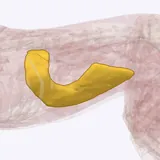
Spleen, lymph nodes and bone marrow
During the primary viraemia, FeLV spreads to the spleen, lymph nodes and bone marrow. Lymph nodes can enlarge in the acute phase of both infections.
FeLV-associated lymphoma and leukaemia can involve these organs. Immunosuppression favours anaemia from haemoplasmas (Mycoplasma haemofelis).
Infection of the bone marrow is the origin of the FeLV cytopenias and leukaemia.
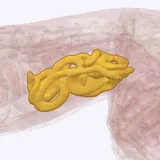
Small intestine
Diffuse alimentary lymphoma is today found mostly in FeLV-negative, middle-aged or older cats (see the atlas entry "Feline alimentary lymphoma"). FIV slightly increases the risk of lymphoma.
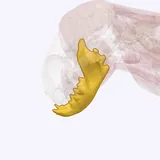
Gingiva and oral mucosa
Gingivitis and stomatitis are among the most common signs in cats with FIV, and are also seen with FeLV. The inflammation affects the gingiva and mucosa covering the mandible and maxilla. "Feline chronic gingivostomatitis" has its own entry in the atlas.
Clinical signs
FeLV
Many cats with progressive infection are healthy for a time. Later come:
- pallor and weakness from anaemia
- fever and weight loss
- recurrent infections
- stomatitis
- lymphadenomegaly
- dyspnoea and pleural effusion from mediastinal lymphoma
- reproductive problems
- neurological signs
FIV
Most infected cats have no signs for years. When signs appear they are non-specific: gingivostomatitis, fever, weight loss, lymphadenomegaly, chronic or recurrent infections, neoplasia and neurological signs.
Diagnosis
According to the AAFP guidelines, the status for both viruses should be known for every cat at risk of infection:
- when it joins a household
- after exposure to an infected cat or a cat of unknown status
- before vaccination against FeLV or FIV
- whenever it is ill
FeLV
- Point-of-care tests detect p27 antigen in blood.
- A positive in a healthy, low-risk cat is confirmed with other tests. Retesting over time helps distinguish progressive infection from the transient viraemia of regressive infection.
- Provirus PCR on blood detects regressive infections, which are negative on antigen tests.
- FeLV vaccination does not interfere with these tests.
FIV
- Point-of-care tests detect antibodies.
- In kittens under 6 months, a positive may be due to maternal antibodies and is repeated after that age.
- Cats vaccinated against FIV produce antibodies that some tests cannot distinguish from those of natural infection. In them, PCR or other tests are used, with limitations.
A single result is not always enough to know the cat's status. Sometimes the test must be repeated or methods combined.
Treatment and prevention
There is no antiviral treatment of proven efficacy, and data on antiretroviral and immunomodulatory drugs are scarce. Management relies on:
- regular check-ups, with complete blood count, biochemistry and urinalysis
- keeping the cat indoors and neutered
- good nutrition and parasite control
- prompt treatment of each intercurrent disease
Cats with progressive FeLV should not live with healthy unprotected cats. Cats with FIV can live with other cats if they do not fight. Infected cats must not be blood donors.
Vaccines
The FeLV vaccine is recommended for all kittens and for adults at risk of exposure, always after a negative test. It does not protect 100% and does not replace testing new cats.
The FIV vaccine is only available in some countries. Its protection under field conditions is doubtful and it complicates diagnosis.
The basis of prevention is testing every cat, separating FeLV-infected cats and preventing fights through neutering and indoor life.
Key studies
- AAFP feline retrovirus guidelines (Little et al., 2020). The reference consensus for diagnosis and management of FeLV and FIV. It recommends knowing the status of every cat at risk of infection and warns that a single test may not be enough. It notes that some infected cats, especially those with FIV, live for many years with good quality of life, and that there are hardly any data supporting antiretroviral or immunomodulatory treatments.
- Burling et al. (2017). Cross-sectional study of 62,301 cats tested at 1,396 clinics and 127 shelters in the United States and Canada. Seroprevalence was 3.1% for FeLV and 3.6% for FIV. Adult age, outdoor access, illness and being an intact male were risk factors for both viruses. Among cats with oral disease, 4.7% were FeLV-positive and 9.7% FIV-positive; among those with abscesses or bite wounds, 5.5% and 12.5%. 13.9% of sick cats were infected, compared with 3.6% of healthy cats. A single point-of-care test was used, without confirmation.
- Spada et al. (2018). Retrospective study of 103 seropositive cats (53 FIV, 40 FeLV and 10 with both) and 103 age- and sex-matched negative cats at a referral centre in northern Italy. Median survival was 3,960 days in negative cats, 2,040 with FIV, 714 with FeLV and 77 in coinfected cats. The hazard of death was 3.4 times higher with FeLV and 7.4 times higher with both viruses than in negative cats, whereas FIV did not significantly affect survival. A low red blood cell count at diagnosis was associated with shorter survival. It is a single-centre study.
- Liem et al. (2013). Retrospective case-control study of 520 client-owned cats tested for FIV at a university centre in Sydney (Australia). Prevalence was 14.6%; being mixed-breed, male and older were risk factors. Laboratory abnormalities were equally common in infected and uninfected cats, lymphoid neoplasms were slightly more frequent with FIV and survival did not differ significantly.
- Castillo-Aliaga et al. (2026). Retrospective cohort of 132 cats at a UK sanctuary followed over 20 years (22 uninfected, 82 with FIV, 24 with FeLV and 4 with both). Median life expectancy was 160.3 months in uninfected cats, 149.1 with FIV, 41.5 with FeLV and 74.2 with both. Both infections shortened life, although the effect of FIV was smaller. Neoplasia, especially lymphoma, was associated with FeLV, and oral disease with FIV. The groups were small, particularly the uninfected group. It qualifies the earlier studies: FIV has a small effect on survival, but perhaps not none.
- Westman et al. (2016). Case-control study in Australia of the FIV vaccine in cats with outdoor access. After applying the inclusion criteria, 89 vaccinated and 212 matched unvaccinated cats were analysed. 5 of the 89 vaccinated cats (6%) and 25 of the 212 controls (12%) were infected. The estimated protective rate was 56%, with a 95% confidence interval of −20 to 84, and the difference was not significant. It casts doubt on the vaccine's efficacy under field conditions.
Structures affected
References
- Little S, Levy J, Hartmann K, et al. 2020 AAFP Feline Retrovirus Testing and Management Guidelines. J Feline Med Surg 22:5-30 (2020)
- Burling AN, Levy JK, Scott HM, et al. Seroprevalences of feline leukemia virus and feline immunodeficiency virus infection in cats in the United States and Canada and risk factors for seropositivity. J Am Vet Med Assoc 251:187-194 (2017)
- Spada E, Perego R, Sgamma EA, et al. Survival time and effect of selected predictor variables on survival in owned pet cats seropositive for feline immunodeficiency and leukemia virus attending a referral clinic in northern Italy. Prev Vet Med 150:38-46 (2018)
- Liem BP, Dhand NK, Pepper AE, et al. Clinical findings and survival in cats naturally infected with feline immunodeficiency virus. J Vet Intern Med 27:798-805 (2013)
- Castillo-Aliaga C, Dunham S, McCallum-Chanter H, et al. Twenty-year lifetime histories of FIV- and FeLV-infected cats in a sanctuary in the UK indicate an effect of retroviral infection on longevity. Vet Rec (online ahead of print) (2026)
- Westman ME, Malik R, Hall E, et al. The protective rate of the feline immunodeficiency virus vaccine: An Australian field study. Vaccine 34:4752-4758 (2016)
- Stone AE, Brummet GO, Carozza EM, et al. 2020 AAHA/AAFP Feline Vaccination Guidelines. J Feline Med Surg 22:813-830 (2020)
- Sykes JE. Greene's Infectious Diseases of the Dog and Cat, 5th ed. Elsevier (2021)
- Merck Veterinary Manual: Feline Leukemia Virus Disease
- Merck Veterinary Manual (pet owner version): Feline Immunodeficiency Virus (FIV)
See it in 3D on your iPhone
Peel the layers, spin the model, quiz yourself on it and stand it on your desk in AR. AnatomyCompass is coming to iPhone, iPad and Mac: get one email when it’s out.
Text adapted from Vet Atlas (CC BY-SA 4.0). Sources and licences. This veterinary text has not yet been reviewed by a veterinarian.