 AnatomyCompass
Fibrotic myopathy of the gracilis and semitendinosus
Degenerative · Dog
Progressive replacement of the gracilis or semitendinosus muscle by fibrous tissue, which forms a taut band on the caudomedial thigh. It produces a characteristic non-painful gait abnormality, typically in German shepherds.
Key points
- The gracilis is the muscle most often affected; the semitendinosus less often.
- At the end of the swing phase, the paw makes a rapid, elastic medial rotation.
- Affected dogs are usually active or working young adult males.
- Biopsy confirms the replacement of muscle by connective tissue.
- After surgery, the gait abnormality usually recurs within a few months.
What it is
Fibrotic myopathy is a chronic disorder of the caudal thigh muscles. Their fibres are replaced by dense collagenous tissue, most often in the gracilis and less often in the semitendinosus.
The fibrotic muscle cannot stretch. It restricts the movement of the hip, stifle and hock during the swing phase of the stride.
The cause is unknown. Proposed causes are:
- repetitive strain or trauma in active dogs
- immune-mediated mechanisms
- neurogenic causes
Who it affects
Mainly German shepherds, usually active or working young adult males.
It has been reported in other breeds such as the Belgian Malinois, Rottweiler and Dobermann.
Anatomy involved
The gracilis (m. gracilis) and the semitendinosus (m. semitendinosus) belong to the caudal thigh, or hamstring, muscles. Through the crural fascia they contribute to the common calcaneal tendon.
They are stretched when the stifle is extended with the hip flexed, so a fibrotic muscle reduces that range of movement.
When they become fibrous, a firm band can be palpated running from the proximal inner thigh to the caudomedial stifle.
Clinical signs
The gait is characteristic. The stride of the pelvic limb is shortened and, at the end of the swing phase, there is:
- a rapid, elastic medial rotation of the paw
- external rotation of the hock
- internal rotation of the stifle
The condition is usually not painful and progresses slowly. It can be unilateral or bilateral; about half of cases are bilateral.
Diagnosis
- The gait is observed and a taut, non-painful band is palpated in the gracilis or semitendinosus.
- Ultrasound or MRI shows the fibrotic segment.
- Biopsy confirms the replacement of muscle by connective tissue.
- Other orthopaedic and neurological causes of pelvic limb lameness must be ruled out.
Treatment
Surgical excision or release of the fibrotic band improves the gait at first. But the gait abnormality usually recurs within a few months, so surgery alone is generally not recommended.
Rehabilitation, with stretching, massage and shockwave therapy, may help working dogs keep working. The evidence comes only from small case series.
Because the condition is not painful, many dogs live with it and continue moderate activity. The long-term outlook for normal gait is poor.
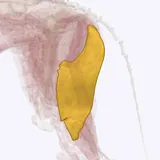
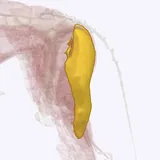
Structures affected
References
- Fossum TW. Small Animal Surgery, 5th ed. Elsevier (2018)
- Johnston SA, Tobias KM. Veterinary Surgery: Small Animal, 2nd ed. Elsevier (2018)
- Dewey CW, da Costa RC. Practical Guide to Canine and Feline Neurology, 3rd ed. Wiley-Blackwell (2016)
- Merck Veterinary Manual: Fibrotic Myopathy in Dogs and Cats
- University of Minnesota, Veterinary Anatomy: Carnivore dissection, Lab 07 (pelvic limb)
- Birdwhistell KE, Miscioscia E, Montalbano C, et al. The hamstring stretch angle: a screening and monitoring tool for canine fibrotic myopathy. Front Vet Sci 12:1600602 (2025)
- Tsai FC, Alvarez LX. Outcome of eight working dogs with fibrotic myopathy following extracorporeal shockwave and rehabilitation therapy: a case series. Front Vet Sci 10:1258319 (2023)
See it in 3D on your iPhone
Peel the layers, spin the model, quiz yourself on it and stand it on your desk in AR. AnatomyCompass is coming to iPhone, iPad and Mac: get one email when it’s out.
Text adapted from Vet Atlas (CC BY-SA 4.0). Sources and licences. This veterinary text has not yet been reviewed by a veterinarian.