 AnatomyCompass
Hyperthyroidism
Metabolic · Cat
Excess thyroid hormone produced by hyperfunctioning thyroid tissue that is almost always benign. The most common endocrine disease of older cats.
Key points
- The typical sign is weight loss with a normal or increased appetite.
- A raised total T4 with compatible signs is enough for the diagnosis.
- It can mask chronic kidney disease, which becomes evident once it is treated.
- Radioactive iodine is the treatment of choice and cures the great majority.
- The main risk of bilateral thyroidectomy is hypocalcaemia.
What it is
Feline hyperthyroidism is a state of thyrotoxicosis caused by autonomous, excessive production of thyroxine (T4) and triiodothyronine (T3).
In the great majority of cats the lesion is benign adenomatous hyperplasia or adenoma, which in many cases affects both thyroid lobes. Thyroid carcinoma is rare.
The hyperfunctioning tissue escapes regulation by pituitary TSH, which is suppressed, and the normal thyroid tissue atrophies. The excess hormone speeds up the metabolism of almost every organ.
The cause is poorly understood. Dietary and environmental factors, such as brominated flame retardants, have been studied, but none has been shown to be the single cause.
Who it affects
Middle-aged and older cats, usually over 8 years of age. It is rare in young cats.
There is no clear sex predisposition. Siamese and Himalayan cats appear to be at lower risk.
Anatomy involved
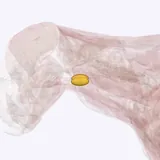
Thyroid gland
Two lobes on either side of the trachea, caudal to the larynx. In the cat they are not joined by an obvious isthmus.
As they enlarge they may descend along the neck and be felt as a mobile nodule, the "goitre". Sometimes the hyperfunctioning tissue is ectopic, anywhere from the larynx to the thoracic cavity.
The parathyroid glands lie next to the thyroid and must be preserved during surgery.
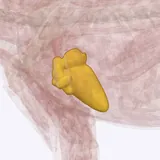
Heart
Thyrotoxicosis causes tachycardia, increased cardiac output and left ventricular hypertrophy (thyrotoxic cardiomyopathy). It usually improves once the hyperthyroidism is controlled.
Kidneys
Increased renal blood flow and glomerular filtration can mask chronic kidney disease, which becomes evident when the hyperthyroidism is treated.
Vessels and eyes
Systemic hypertension with retinal lesions may be present.
Clinical signs
The central sign is weight loss with a normal or increased appetite (polyphagia). Also:
- polyuria and polydipsia
- hyperactivity or restlessness, vocalisation
- vomiting, diarrhoea or bulky faeces
- an unkempt coat and muscle wasting
On examination there is a palpable thyroid nodule, tachycardia, a murmur, a gallop sound or arrhythmias.
A minority show the "apathetic" form, with lethargy and inappetence. Severe cases may develop heart failure or hypertensive retinopathy.
Diagnosis
- Serum total T4 is increased in most hyperthyroid cats. With compatible signs, it is enough for the diagnosis.
- If total T4 is in the upper reference range with compatible signs, the cause may be mild hyperthyroidism or a concurrent illness lowering it. Free T4 by equilibrium dialysis is then measured together with total T4, total T4 is repeated after a few weeks, or a T3 suppression test or thyroid scintigraphy is done.
- Pertechnetate scintigraphy confirms the diagnosis and locates the hyperfunctioning tissue, including ectopic tissue and metastases.
- General blood work shows increased ALT and alkaline phosphatase. Creatinine, SDMA and urine specific gravity must be interpreted with caution, because renal function is overestimated.
- Blood pressure is measured and, when there are cardiac abnormalities, echocardiography is done.
Treatment
There are four options.
Radioactive iodine (I-131)
The treatment of choice. A single injection destroys the hyperfunctioning tissue, including ectopic tissue, while sparing the atrophied normal tissue. It cures the great majority of cats.
It requires hospitalisation in licensed facilities.
Antithyroid drugs
Methimazole or its prodrug carbimazole control hormone production but do not cure, and must be given for life.
Adverse effects include vomiting, facial pruritus with excoriations, liver disease and haematological abnormalities.
Thyroidectomy
Curative if all affected tissue is removed. The main risk of bilateral thyroidectomy is hypocalcaemia from injury or removal of the parathyroid glands.
Iodine-restricted diet
It controls T4 if the cat eats no other food.
Follow-up
Iatrogenic hypothyroidism after treatment is associated with azotaemia and shorter survival. Thyroid and renal function are therefore monitored after treatment.
The prognosis of treated cats is generally good.
Key studies
- AAFP guidelines (Carney et al., 2016). The reference guideline. It proposes testing sequences to avoid misdiagnosis, divides the diagnosis into six clinical categories with their management, recommends treating every hyperthyroid cat regardless of comorbidities and explains how to monitor treated cats so as not to worsen concurrent disease.
- Peterson and Broome (2015). Thyroid scintigraphy of 2096 consecutive hyperthyroid cats. Disease was unilateral in 31.7%, bilateral in 62.9% (asymmetric in 50.6%, symmetric in 12.3%) and multifocal in 3.9%. Ectopic thyroid tissue was found in 3.9% of cats, tissue in the thoracic cavity in 5.5%, and carcinoma was suspected in 1.7%.
- Peterson et al. (2001). 917 untreated hyperthyroid cats, 221 cats with non-thyroidal illness and 172 healthy cats. Free T4 by equilibrium dialysis was more sensitive than total T4 or T3, but was high in 14 of the 221 cats with non-thyroidal illness, so it should not be used on its own to diagnose hyperthyroidism.
- Peterson and Becker (1995). Prospective series of 524 cats treated with subcutaneous radioiodine, with the dose adjusted to severity. By 6 months only 8 cats (1.5%) remained hyperthyroid; 2.1% developed clinical hypothyroidism needing thyroxine and 2.5% relapsed 1.1 to 6.5 years later. There was no comparison group.
- Peterson et al. (2018). Prospective study of 262 hyperthyroid cats treated with radioiodine and 206 healthy cats of similar age. None was azotaemic before treatment, but 16% became azotaemic afterwards. A high SDMA before treatment predicted this with 97.7% specificity but only 33.3% sensitivity. A high value is a warning; a normal one does not rule out masked kidney disease.
- Williams et al. (2010). Retrospective study of 75 treated cats. Azotaemia was more frequent in cats with iatrogenic hypothyroidism (16 of 28) than in euthyroid cats (14 of 47), and hypothyroid cats that became azotaemic lived less (median 456 versus 905 days).
Structures affected
References
- Carney HC, Ward CR, Bailey SJ, et al. 2016 AAFP Guidelines for the Management of Feline Hyperthyroidism. J Feline Med Surg 18:400-416 (2016)
- Peterson ME, Becker DV. Radioiodine treatment of 524 cats with hyperthyroidism. J Am Vet Med Assoc 207:1422-1428 (1995)
- Feldman EC, Nelson RW, Reusch CE, Scott-Moncrieff JCR, Behrend EN. Canine and Feline Endocrinology, 4th ed. Elsevier (2015)
- Peterson ME, Broome MR. Thyroid scintigraphy findings in 2096 cats with hyperthyroidism. Vet Radiol Ultrasound 56:84-95 (2015)
- Peterson ME, Melián C, Nichols R. Measurement of serum concentrations of free thyroxine, total thyroxine, and total triiodothyronine in cats with hyperthyroidism and cats with nonthyroidal disease. J Am Vet Med Assoc 218:529-536 (2001)
- Peterson ME, Varela FV, Rishniw M, et al. Evaluation of Serum Symmetric Dimethylarginine Concentration as a Marker for Masked Chronic Kidney Disease in Cats With Hyperthyroidism. J Vet Intern Med 32:295-304 (2018)
- Williams TL, Elliott J, Syme HM. Association of iatrogenic hypothyroidism with azotemia and reduced survival time in cats treated for hyperthyroidism. J Vet Intern Med 24:1086-1092 (2010)
- Merck Veterinary Manual: Hyperthyroidism in Animals
- Merck Veterinary Manual: Overview of the Thyroid Gland in Animals
- van Zuiden B, Santarelli G, Galac S, et al. Cardiac Abnormalities in Feline Hyperthyroidism. Vet Sci 12:1115 (2025)
- Yu L, Lacorcia L, Johnstone T. Hyperthyroid cats and their kidneys: a literature review. Aust Vet J 100:415-432 (2022)
- Jones B, Engdahl JN, Weiss J. Are persistent organic pollutants important in the etiology of feline hyperthyroidism? A review. Acta Vet Scand 61:45 (2019)
- Candellone A, Saettone V, Badino P, et al. Management of Feline Hyperthyroidism and the Need to Prevent Oxidative Stress: What Can We Learn from Human Research? Antioxidants (Basel) 10:1496 (2021)
See it in 3D on your iPhone
Peel the layers, spin the model, quiz yourself on it and stand it on your desk in AR. AnatomyCompass is coming to iPhone, iPad and Mac: get one email when it’s out.
Text adapted from Vet Atlas (CC BY-SA 4.0). Sources and licences. This veterinary text has not yet been reviewed by a veterinarian.