 AnatomyCompass
Canine leishmaniosis
Infectious · Dog
Chronic systemic disease caused by the protozoan Leishmania infantum, transmitted by sand flies. It is a zoonosis and the dog is the main reservoir.
Key points
- Many infected dogs remain subclinical for years or for life.
- Immune-complex glomerulonephritis leads to kidney disease, the main cause of death.
- Quantitative serology is the basis of diagnosis; low titres are not enough.
- First line is meglumine antimoniate or miltefosine with allopurinol.
- Prevention relies on pyrethroid repellents, most of them toxic to cats.
What it is
Canine leishmaniosis is caused by Leishmania infantum, a protozoan transmitted by female sand flies that bite at dusk and at night: Phlebotomus in the Old World and Lutzomyia in the Americas.
There is also non-vectorial transmission:
- through blood transfusions
- transplacentally
- venereally
In the dog, the parasite lives as an amastigote inside macrophages of the skin, bone marrow, spleen, liver and lymph nodes.
Infection and disease
Infection does not equal disease. Many infected dogs remain subclinical for years or for life.
The course depends on the immune response. An effective cell-mediated (Th1-type) response controls the parasite. A predominantly humoral (Th2-type) response, with abundant non-protective antibodies, allows it to multiply.
Much of the damage is caused by circulating immune complexes, which deposit in glomeruli, vessels, joints and the uvea.
Distribution
It is endemic in the Mediterranean basin and in Latin America, especially Brazil, and also in the Middle East and Asia.
It has spread to areas further north and is diagnosed in dogs that travel to or are imported from endemic areas.
Zoonosis
L. infantum causes human visceral leishmaniasis, which is severe especially in children and immunocompromised people. The dog is the main domestic reservoir.
The One Health approach relies on protecting dogs from sand fly bites, controlling vectors and diagnosing and treating sick dogs.
Who it affects
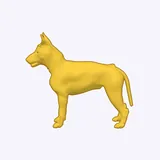
Dogs in endemic areas or that have travelled to them, especially those that spend the night outdoors.
Disease is more common in young adult dogs and in older dogs.
Some breeds appear more predisposed: Boxer, Cocker Spaniel, Rottweiler and German Shepherd. The Ibizan Hound, by contrast, usually mounts an effective immune response.
Cats are also infected but become ill much less often.
Anatomy involved
Skin
It is the most frequently affected organ.
- The typical form is exfoliative dermatitis with silvery-white scales, mainly on the head, around the eyes ("spectacles") and on the ears, often with alopecia.
- There are ulcerative forms over bony prominences, ear margins and mucocutaneous junctions.
- There are nodular forms.
- A mild papular dermatitis at bite sites is typical of dogs with a good immune response.
There may be hyperkeratosis of the nasal planum and footpads.
Kidneys
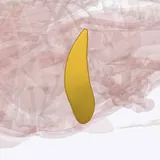
Immune-complex deposition causes glomerulonephritis with proteinuria, which can progress to nephrotic syndrome and chronic kidney disease.
Kidney disease is the main cause of death in dogs with leishmaniosis.
Spleen, bone marrow and lymph nodes
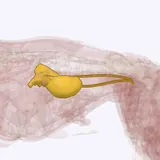
There is splenomegaly from proliferation of parasitised macrophages. The lymph nodes are often enlarged generally.
The spleen, bone marrow and lymph nodes are good sites to look for the parasite by cytology or PCR.
Eyes
Blepharitis, conjunctivitis, keratoconjunctivitis (including keratoconjunctivitis sicca) and anterior uveitis.
Claws
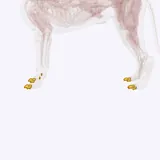
Onychogryphosis, an excessive, curved growth of the claws, is very characteristic. Occasionally there is onychomadesis and onychodystrophy.
Clinical signs
They are highly variable and develop gradually:
- weight loss, with preserved or reduced appetite
- muscle atrophy, especially of the temporal muscles
- lethargy
- generalised lymphadenomegaly and splenomegaly
- skin lesions
- onychogryphosis
- epistaxis
- ocular lesions
- lameness from polyarthritis
- polyuria, polydipsia and vomiting, when the kidney is affected
Laboratory findings include non-regenerative anaemia, hyperglobulinaemia with hypoalbuminaemia and proteinuria, with or without azotaemia.
Diagnosis
- Quantitative serology (indirect immunofluorescence or ELISA) is the basis of diagnosis. High titres in a dog with compatible signs confirm the disease. Low titres are not enough and require further tests. In-clinic rapid tests are only screening tests, with variable performance.
- Cytology of lymph node, bone marrow or spleen aspirates, or of skin lesions, shows the amastigotes but is insensitive.
- PCR, preferably quantitative, on bone marrow, lymph node, spleen, skin or conjunctival swabs detects infection. A positive result in a healthy dog does not mean disease.
- Histopathology with immunohistochemistry of skin or other organ lesions.
- Renal assessment: biochemistry, urinalysis, urine protein-to-creatinine ratio and IRIS staging.
LeishVet staging
It classifies the dog into four stages (mild, moderate, severe and very severe disease) according to serology, signs, laboratory abnormalities and renal function.
It guides treatment and prognosis, which worsens with proteinuria and kidney disease.
Treatment and prevention
Treatment
First line combines an antimonial (meglumine antimoniate) or miltefosine with allopurinol, which is continued for months and sometimes for life. Aminosidine with allopurinol is a second-line alternative.
The availability and legal status of these drugs for dogs vary between countries.
Adverse effects:
- allopurinol can cause xanthine urolithiasis
- antimonials can be nephrotoxic
Proteinuria and kidney disease are managed according to IRIS guidelines.
Treatment usually achieves clinical improvement but rarely eliminates the parasite, and relapses are possible. Regular clinical, laboratory and serological follow-up is therefore needed.
Treating infected dogs without signs or abnormalities with anti-Leishmania drugs is not recommended.
Prevention
In endemic areas several measures are combined:
- Pyrethroid repellents and insecticides, as collars (deltamethrin, or flumethrin with imidacloprid) or spot-ons (permethrin with imidacloprid), maintained throughout the sand fly season. Most pyrethroid-based products, including permethrin, are toxic to cats.
- Reducing exposure to the vector, for example by keeping dogs indoors from dusk to dawn.
- Vaccines for seronegative dogs, as a complement to repellents, not instead of them.
- Domperidone, an immunomodulator, in seronegative dogs.
- Not using blood from infected dogs for transfusion and not breeding from infected bitches.
Key studies
- LeishVet guidelines (Solano-Gallego et al., 2011). The reference consensus for clinical management of canine leishmaniosis. It combines review of the evidence, clinical experience and expert consensus, and proposes the four-stage system used to choose treatment, estimate prognosis and plan follow-up.
- World Association for Veterinary Dermatology consensus (Saridomichelakis et al., 2025). A guideline based on a search for randomised trials, systematic reviews and meta-analyses. It recommends meglumine antimoniate or miltefosine with allopurinol as first line and aminosidine with allopurinol as second line; it advises against euthanasia as a public health measure and against anti-Leishmania drugs in subclinically infected dogs. For prevention it recommends deltamethrin or flumethrin-imidacloprid collars, the permethrin-imidacloprid spot-on and domperidone in seronegative dogs; it considers the excreted-secreted protein (LiESP) vaccine optional and recommends the protein Q vaccine in areas with very high seroconversion. All authors declare ties with industry.
- Wylie et al. (2014). Systematic review of topical repellents and drug prophylaxis against natural infection. It included 11 studies; all but one were at high risk of methodological shortcomings, and heterogeneity prevented a meta-analysis. Deltamethrin collars, permethrin spot-ons alone or with imidacloprid, and domperidone tended to significantly reduce the proportion of infected dogs.
- Oliva et al. (2014). Randomised, double-blind trial of the LiESP/QA-21 vaccine in 90 dogs exposed for two transmission seasons in two highly endemic Mediterranean areas. The vaccine reduced the risk of progressing to active infection or disease, with an efficacy of 68.4%, but the probability of becoming PCR positive was similar in both groups: it does not prevent infection. It was funded by the manufacturer and several authors were its employees.
- Sabaté et al. (2014). Randomised, open-label, single-centre trial in 90 seronegative dogs in Valencia (Spain), with periodic courses of domperidone or no treatment. At 12 months 7% of treated dogs had developed disease versus 35% of controls, and at 21 months 11% versus 48%, with a prevention rate of 77% over the whole follow-up. Being open-label and single-centre, the result needs confirmation.
- Gavgani et al. (2002). Cluster-randomised trial in 18 villages in Iran, in which all dogs in the intervention villages were fitted with deltamethrin collars. Seroconversion in children was 1.49% versus 2.41% in control villages (OR 0.57), and seroconversion in dogs was also reduced (OR 0.46). It supports that protecting dogs also reduces human infection, although it lasted a single transmission season in one region.
Structures affected

References
- Sykes JE. Greene's Infectious Diseases of the Dog and Cat, 5th ed. Elsevier (2021)
- Solano-Gallego L, Miró G, Koutinas A, et al. LeishVet guidelines for the practical management of canine leishmaniosis. Parasit Vectors 4:86 (2011)
- Saridomichelakis MN, Baneth G, Colombo S, et al. World Association for Veterinary Dermatology Consensus Statement for Diagnosis, and Evidence-Based Clinical Practice Guidelines for Treatment and Prevention of Canine Leishmaniosis. Vet Dermatol 36:723-787 (2025)
- Wylie CE, Carbonell-Antoñanzas M, Aiassa E, et al. A systematic review of the efficacy of prophylactic control measures for naturally occurring canine leishmaniosis. Part II: topically applied insecticide treatments and prophylactic medications. Prev Vet Med 117:19-27 (2014)
- Oliva G, Nieto J, Foglia Manzillo V, et al. A randomised, double-blind, controlled efficacy trial of the LiESP/QA-21 vaccine in naïve dogs exposed to two leishmania infantum transmission seasons. PLoS Negl Trop Dis 8:e3213 (2014)
- Sabaté D, Llinás J, Homedes J, et al. A single-centre, open-label, controlled, randomized clinical trial to assess the preventive efficacy of a domperidone-based treatment programme against clinical canine leishmaniasis in a high prevalence area. Prev Vet Med 115:56-63 (2014)
- Gavgani AS, Hodjati MH, Mohite H, et al. Effect of insecticide-impregnated dog collars on incidence of zoonotic visceral leishmaniasis in Iranian children: a matched-cluster randomised trial. Lancet 360:374-9 (2002)
- Merck Veterinary Manual: Leishmaniosis in Dogs
- Merck Veterinary Manual: Leishmaniosis in Cats
See it in 3D on your iPhone
Peel the layers, spin the model, quiz yourself on it and stand it on your desk in AR. AnatomyCompass is coming to iPhone, iPad and Mac: get one email when it’s out.
Text adapted from Vet Atlas (CC BY-SA 4.0). Sources and licences. This veterinary text has not yet been reviewed by a veterinarian.