 AnatomyCompass
Pituitary pars intermedia dysfunction
Degenerative · Horse
Neurodegenerative disease of older horses. Loss of dopaminergic control from the hypothalamus makes the pars intermedia of the pituitary enlarge and oversecrete; it causes a long coat that does not shed, laminitis, muscle loss and infections.
Key points
- Age is the only demonstrated risk factor; the disease is rare under 10 years.
- Laminitis is mainly due to the insulin dysregulation that accompanies many cases.
- Basal ACTH rises physiologically in autumn, so it is read against seasonal reference intervals.
- In a young horse without signs, a positive result is probably false.
- Pergolide, a dopamine agonist, is given orally once a day for life.
What it is
Pituitary pars intermedia dysfunction (PPID, formerly called "equine Cushing's disease") is an age-related neurodegenerative disease.
Dopaminergic neurons of the hypothalamus send their axons to the pars intermedia of the pituitary and restrain its activity with dopamine. When those neurons degenerate, the brake is lost. The cells of the pars intermedia multiply, first as hyperplasia and over time as an adenoma, and overproduce hormones such as α-MSH and ACTH.
The signs are not explained by excess cortisol alone, which is often not consistently raised. Other factors play a part:
- the other pars intermedia peptides
- compression of the hypothalamus by the adenoma
- the insulin dysregulation that accompanies many cases, which is mainly responsible for laminitis
Who it affects
Older horses, ponies and donkeys. It is rare under 10 years of age and its frequency rises with age. It is estimated to affect about one in five equids aged 15 years or more.
Age is the only consistently demonstrated risk factor. Data on breed and sex are conflicting.
Anatomy involved
The pituitary is not represented in the model; the brain and the organs where the consequences are seen are highlighted instead.
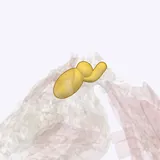
- Brain. The pituitary gland lies just below the hypothalamus. A large pars intermedia adenoma compresses the pars nervosa and the overlying hypothalamus, which regulates body temperature, appetite and the seasonal shedding of hair. Blindness is an uncommon sign.
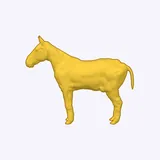
- Skin. The most characteristic sign is hypertrichosis, a long, often curly coat that does not shed in spring or sheds late and incompletely. There is also excessive or reduced sweating and a greater tendency to skin infections.
- Hooves. Laminitis, due to the associated insulin dysregulation, is the most serious complication. Hoof abscesses are also common.
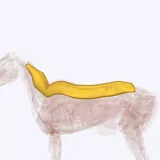
- Epaxial muscles. Muscle atrophy is seen first along the topline (longissimus and the other epaxial muscles), which makes the spine prominent. There may also be abnormal fat distribution, especially above the eyes and at the tailhead.
Clinical signs
- hypertrichosis or delayed shedding
- laminitis, sometimes as the first sign
- loss of muscle along the topline and over the rump, with a pendulous abdomen
- lethargy and reduced performance
- polyuria and polydipsia
- abnormal sweating
- recurrent infections, particularly dental infections and hoof abscesses
- higher faecal parasite egg counts
Diagnosis
It is based on the combination of age, clinical signs and endocrine tests. The pre-test probability decides how the result is interpreted. In a young horse without signs, a positive result is probably false.
Basal plasma ACTH
The most widely used test. ACTH rises physiologically in autumn, so seasonal reference intervals are used. Breed, latitude, feeding, transport and severe illness also influence it.
TRH stimulation test
ACTH is measured before and 10 or 30 minutes after injecting TRH. It is considered the most sensitive test, but healthy horses can show an exaggerated response in autumn.
Insulin
Insulin is also worth measuring, basal or after an oral sugar test, because insulin dysregulation is what predicts the risk of laminitis.
Treatment and prevention
Pergolide
Pergolide is a dopamine agonist that replaces the lost brake. It is given orally once a day, for life.
It improves most signs in most horses and lowers ACTH, but does not usually correct insulin dysregulation. It can cause a transient loss of appetite at the start. The dose is adjusted to the clinical response and ACTH.
Management
- clipping horses with hypertrichosis
- hoof and dental care
- parasite control guided by faecal egg counts
Key studies
- BEVA primary care guidelines (Menzies-Gow et al., 2024). Developed with the GRADE method. Prevalence in equids aged 15 years or more is between 21 and 27%, and hypertrichosis or delayed shedding gives a high clinical suspicion. Diagnostic accuracy of basal ACTH was 88–92% in autumn and 70–86% outside autumn, depending on pre-test probability. That of ACTH after TRH was 92–98% and 90–94%, although based on a single study. Pergolide improves most signs but does not alter insulin dysregulation in most cases, and chasteberry provides no benefit. The guideline itself acknowledges that the available evidence is limited.
- Ireland and McGowan (2018). Systematic review of 29 publications, almost all case series or cross-sectional studies. The most robust prevalence estimates were 21.2% in equids aged 15 years or more and 2.9% in the general equine population. The most frequent signs were hypertrichosis, laminitis and epaxial muscle atrophy. Only age was confirmed as a risk factor.
- Meyer et al. (2022). Systematic review and meta-analysis of 11 diagnostic accuracy studies of basal ACTH. Sensitivity was 0.72 (95% CI 0.62–0.82) and specificity 0.88 (0.79–0.93); with the usual cut-off of 35 pg/mL, 0.66 and 0.87. The authors conclude that ACTH can confirm the disease in horses with high clinical suspicion, but should not be used to screen horses without signs. The included studies had a substantial risk of bias.
- Tatum et al. (2020). Systematic review of 28 publications on the efficacy of pergolide. Most reported overall clinical improvement in more than 75% of cases. ACTH fell in 44–74% of horses and normalised in 28–74%. Most were case series or field trials without a control group, so a meta-analysis was not possible.
- Horn et al. (2019). Retrospective study of 274 equids with PPID from 8 centres in Australia. Laminitis was diagnosed in 89.9% and insulin dysregulation in 76.5% of the horses in which they were investigated. Being a pony, having better body condition and receiving pergolide were associated with longer survival. Testing was not uniform across centres.
Structures affected

References
- Reed SM, Bayly WM, Sellon DC. Equine Internal Medicine, 4th ed. Elsevier (2018)
- Menzies-Gow NJ, Banse HE, Duff A, et al. BEVA primary care clinical guidelines: Diagnosis and management of equine pituitary pars intermedia dysfunction. Equine Vet J 56:220-242 (2024)
- Ireland JL, McGowan CM. Epidemiology of pituitary pars intermedia dysfunction: A systematic literature review of clinical presentation, disease prevalence and risk factors. Vet J 235:22-33 (2018)
- Meyer JC, Hunyadi LM, Ordóñez-Mena JM. The accuracy of ACTH as a biomarker for pituitary pars intermedia dysfunction in horses: A systematic review and meta-analysis. Equine Vet J 54:457-466 (2022)
- Tatum RC, McGowan CM, Ireland JL. Efficacy of pergolide for the management of equine pituitary pars intermedia dysfunction: A systematic review. Vet J 266:105562 (2020)
- Horn R, Bamford NJ, Afonso T, et al. Factors associated with survival, laminitis and insulin dysregulation in horses diagnosed with equine pituitary pars intermedia dysfunction. Equine Vet J 51:440-445 (2019)
- McGowan TW, Pinchbeck GP, McGowan CM. Prevalence, risk factors and clinical signs predictive for equine pituitary pars intermedia dysfunction in aged horses. Equine Vet J 45:74-9 (2013)
- Merck Veterinary Manual: Hypertrichosis Associated With Adenomas of the Pars Intermedia in Horses
See it in 3D on your iPhone
Peel the layers, spin the model, quiz yourself on it and stand it on your desk in AR. AnatomyCompass is coming to iPhone, iPad and Mac: get one email when it’s out.
Text adapted from Vet Atlas (CC BY-SA 4.0). Sources and licences. This veterinary text has not yet been reviewed by a veterinarian.