 AnatomyCompass
Serratus ventralis
M. serratus ventralis · Dog · Muscular system · Trunk
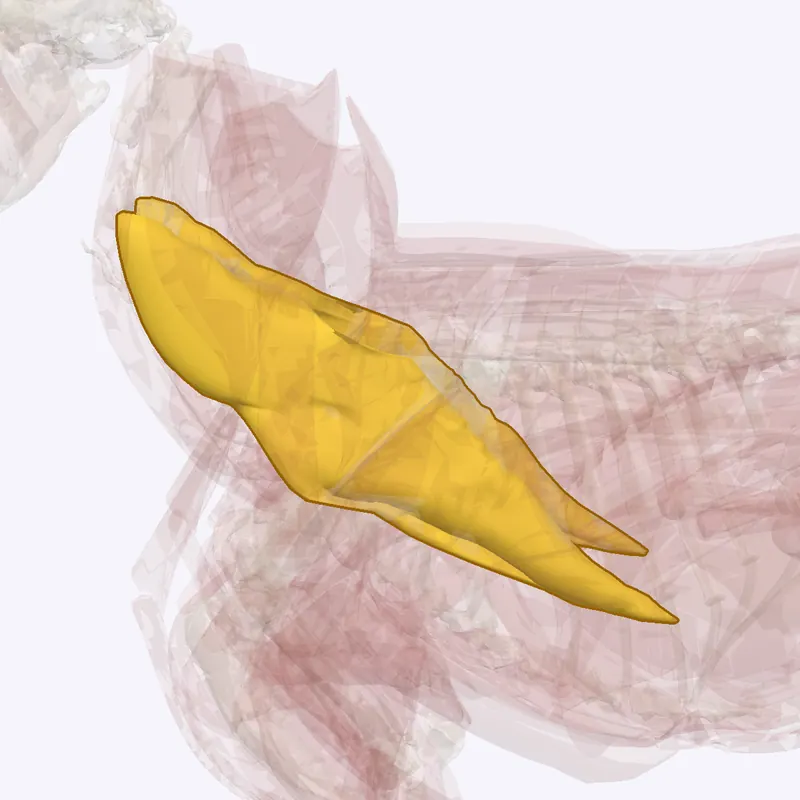
Large fan-shaped muscle that suspends the trunk between the thoracic limbs.
Key points
- It is the main component of the thoracic limb synsarcosis.
- The thoracic part arises from the first seven or eight ribs, by digitations.
- It inserts on the serrated face, on the dorsal part of the medial surface of the scapula.
- With the limb fixed, the thoracic part assists inspiration.
- The thoracic part is supplied by the long thoracic nerve.
Overview
It has a cervical and a thoracic part.
It is the main component of the thoracic limb synsarcosis. Since the dog has no functional clavicle, the trunk hangs between the two scapulae, held by these muscles.
Origin
- Cervical part. Transverse processes of the last five cervical vertebrae.
- Thoracic part. First seven or eight ribs, by digitations.
Insertion
Serrated face (facies serrata), on the dorsal part of the medial surface of the scapula.
Action
Supports the trunk and moves the scapula.
The cervical part draws the dorsal angle of the scapula cranially and the thoracic part caudally.
With the limb fixed, the thoracic part assists inspiration.
Innervation
- Cervical part. Ventral branches of the cervical nerves.
- Thoracic part. Long thoracic nerve (n. thoracicus longus).
Related structures
See it in 3D on your iPhone
Peel the layers, spin the model, quiz yourself on it and stand it on your desk in AR. AnatomyCompass is coming to iPhone, iPad and Mac: get one email when it’s out.
More of the Dog: Muscular system
Text adapted from Vet Atlas (CC BY-SA 4.0). 3D model: Vet Atlas procedural musculature (CC BY-SA 4.0). Sources and licences. This veterinary text has not yet been reviewed by a veterinarian.