 AnatomyCompass
Sternocephalicus
M. sternocephalicus · Dog · Muscular system · Neck
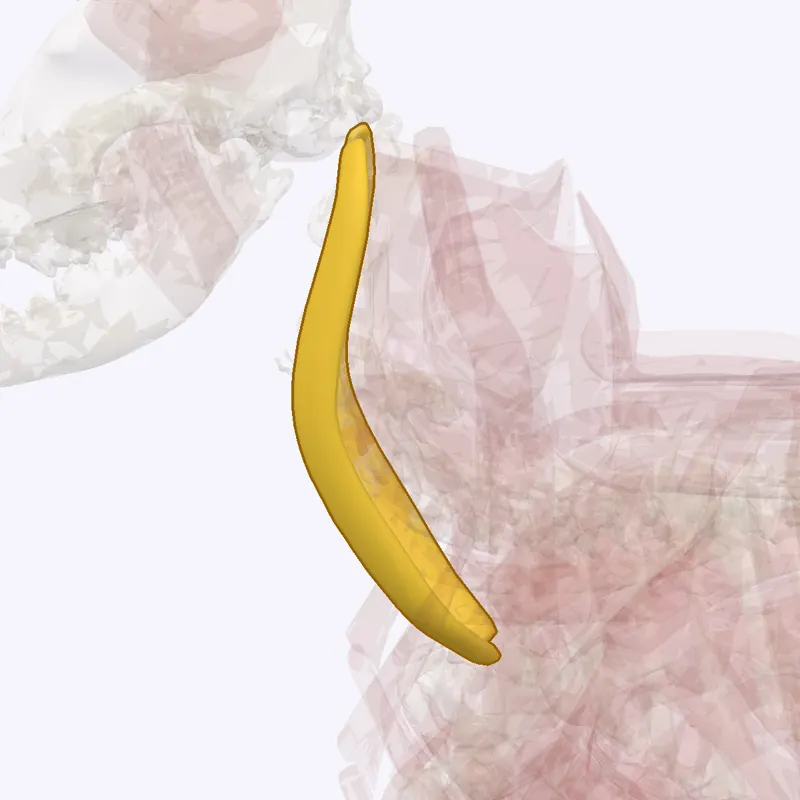
Long muscle of the ventrolateral neck, from the sternum to the head.
Key points
- It has two parts, mastoid and occipital.
- It forms the ventral border of the jugular groove, where the external jugular vein is punctured.
- It draws the head and neck ventrally or to the same side.
- It is supplied by the ventral branch of the accessory nerve.
Overview
It has two parts, mastoid and occipital.
Origin
Manubrium of the sternum.
Insertion
- Mastoid part. Mastoid process of the temporal bone.
- Occipital part. Nuchal crest of the occipital bone.
Action
Draws the head and neck ventrally or to the same side.
Innervation
Ventral branch of the accessory nerve (n. accessorius).
Clinical relevance
It forms the ventral border of the jugular groove. The groove is used to locate and puncture the external jugular vein.
Related structures
See it in 3D on your iPhone
Peel the layers, spin the model, quiz yourself on it and stand it on your desk in AR. AnatomyCompass is coming to iPhone, iPad and Mac: get one email when it’s out.
Text adapted from Vet Atlas (CC BY-SA 4.0). 3D model: Vet Atlas procedural musculature (CC BY-SA 4.0). Sources and licences. This veterinary text has not yet been reviewed by a veterinarian.