 AnatomyCompass
Triceps brachii
M. triceps brachii · Dog · Muscular system · Thoracic limb
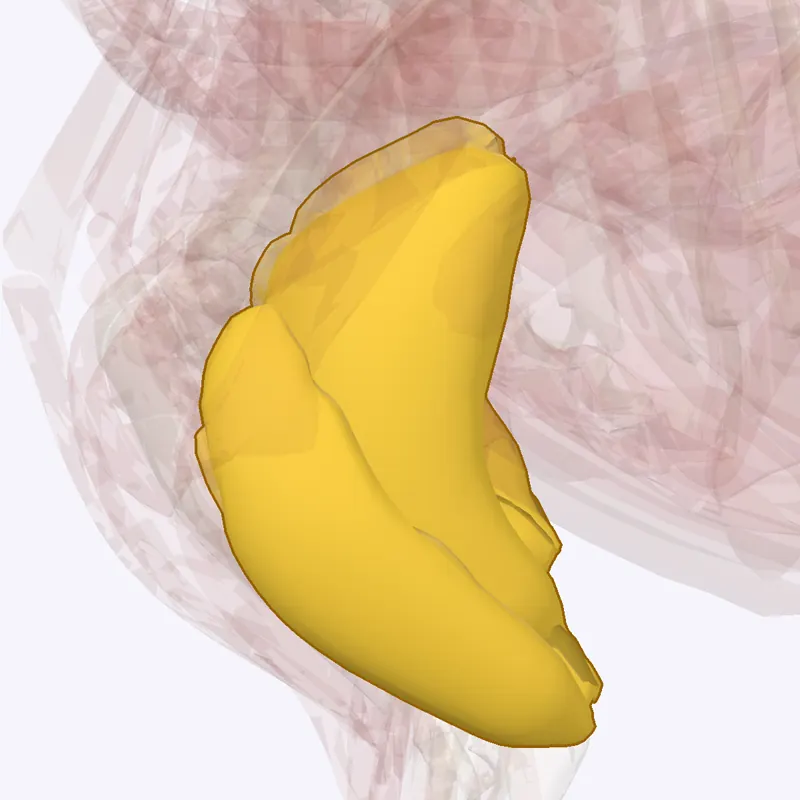
Large muscle mass caudal to the humerus; the main extensor of the elbow.
Key points
- In the dog it has four heads, all ending on the olecranon.
- The long head, the only one crossing the shoulder, also flexes it.
- It inserts on the olecranon tuber of the ulna.
- It is supplied by the radial nerve.
- After radial nerve injury the dog cannot bear weight on the limb and drags it.
Overview
In the dog it has four heads ending on the olecranon: long, lateral, medial and accessory.
The model shows the first three. The accessory head is deep and hidden between them.
Origin
- Long head (caput longum). Caudal border of the scapula. The only head that crosses the shoulder.
- Lateral head (caput laterale). Tricipital line on the lateral surface of the proximal humerus.
- Medial head (caput mediale). Medial surface of the humerus, in its proximal third.
Insertion
Olecranon tuber (tuber olecrani) of the ulna.
Action
Extends the elbow and supports body weight when standing.
The long head also flexes the shoulder.
Innervation
Radial nerve (n. radialis).
Clinical relevance
Radial nerve injury prevents elbow extension. The dog cannot bear weight on the limb and drags it.
The long head is an intramuscular injection site. The distal arm is avoided because the radial nerve lies close to the humerus there.
Related structures
See it in 3D on your iPhone
Peel the layers, spin the model, quiz yourself on it and stand it on your desk in AR. AnatomyCompass is coming to iPhone, iPad and Mac: get one email when it’s out.
More of the Dog: Muscular system
Text adapted from Vet Atlas (CC BY-SA 4.0). 3D model: Vet Atlas procedural musculature (CC BY-SA 4.0). Sources and licences. This veterinary text has not yet been reviewed by a veterinarian.