 AnatomyCompass
Caecum
Caecum · Horse · Splanchnology (organs) · Digestive system
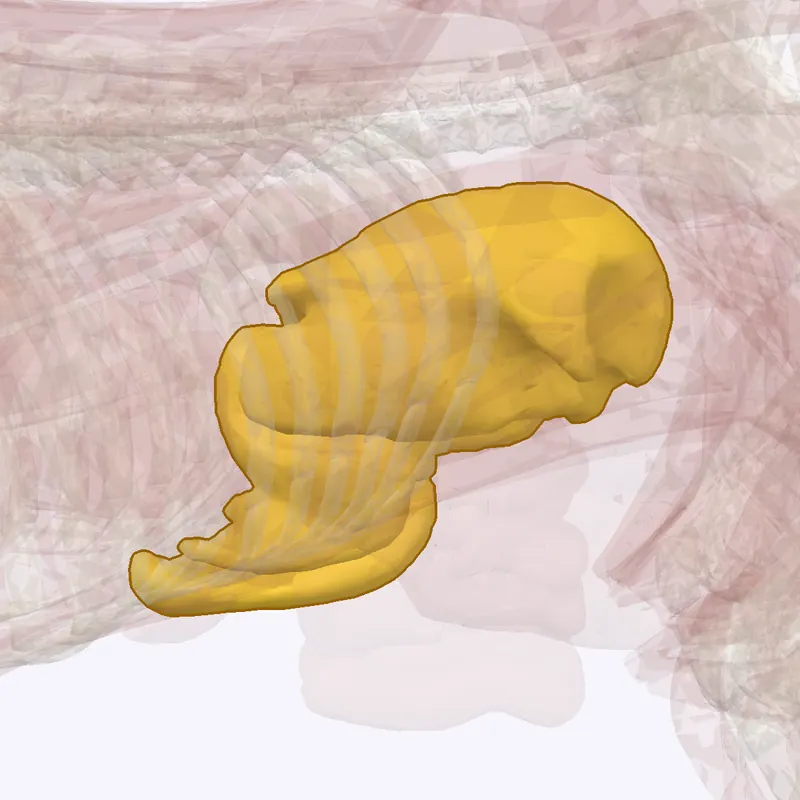
Large comma-shaped fermentation chamber, close to a metre long, filling the right half of the abdomen from the flank to the floor near the xiphoid cartilage. It receives the ileum and empties into the right ventral colon.
Key points
- It has four taeniae that gather the wall into four rows of sacculations.
- The ileal orifice and the caecocolic orifice lie close together on the lesser curvature of the base.
- Caecal impaction can end in rupture with little warning.
- Tympany is decompressed through the right paralumbar fossa.
- Caecocaecal and caecocolic intussusception is associated with Anoplocephala perfoliata.
Overview
The equine caecum is huge compared with that of ruminants or carnivores.
Together with the ascending colon it is where microorganisms ferment plant fibre. They produce volatile fatty acids, the horse's main energy source.
It has four taeniae (dorsal, ventral, medial and lateral). They gather the wall into four rows of sacculations (haustra).
Parts
- Base (basis caeci). The dorsal, widest, curved part, in the right paralumbar fossa. It is attached to the abdominal roof, next to the right kidney and the pancreas. Its lesser curvature carries, close together, the ileal orifice and the caecocolic orifice. Through the latter, ingesta passes into the right ventral colon.
- Body (corpus caeci). Runs cranially down the right side and then along the abdominal floor.
- Apex (apex caeci). Free, on the abdominal floor near the xiphoid cartilage.
Folds
- The ileocaecal fold joins the ileum to the dorsal taenia.
- The caecocolic fold joins the lateral taenia to the right ventral colon.
Clinical relevance
Caecal impaction
It may cause only mild pain and end in rupture with little warning. It has been described in horses hospitalised for other problems, after anaesthesia or on anti-inflammatory drugs.
On rectal palpation, the taut ventral taenia and the full caecum are felt in the right caudal quadrant.
Caecal tympany
It is decompressed with a cannula or trocar through the right paralumbar fossa, at the point of greatest resonance on percussion.
Caecocaecal and caecocolic intussusception
It is associated with Anoplocephala perfoliata at the ileocaecal junction. It requires surgery.
Auscultation
Caecal borborygmi are heard in the right paralumbar fossa. Their absence is an important finding in a horse with colic.
Diseases
- Colic (equine acute abdomen)Acute abdominal pain, usually of gastrointestinal origin. Most colics resolve with medical treatment, but…
Related structures
See it in 3D on your iPhone
Peel the layers, spin the model, quiz yourself on it and stand it on your desk in AR. AnatomyCompass is coming to iPhone, iPad and Mac: get one email when it’s out.
More of the Horse: Splanchnology (organs)
Text adapted from Vet Atlas (CC BY-SA 4.0). 3D model: Vet Atlas procedural organs (CC BY-SA 4.0). Sources and licences. This veterinary text has not yet been reviewed by a veterinarian.