 AnatomyCompass
Humerus
Humerus · Horse · Skeletal system · Thoracic limb
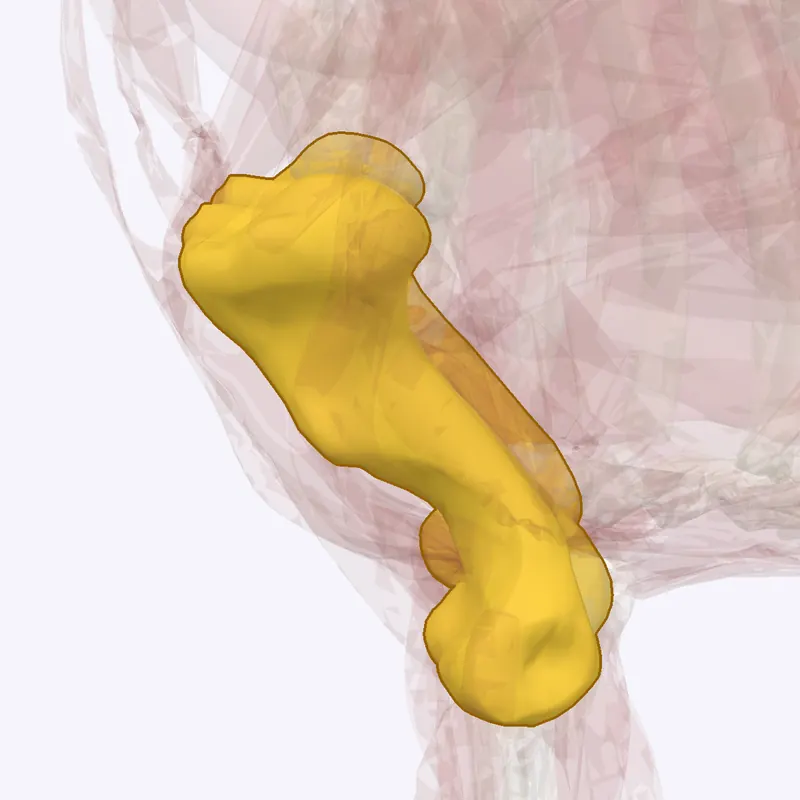
The bone of the arm, short and stout in the horse. Its proximal end has an intermediate tubercle that splits the groove for the biceps tendon in two.
Key points
- The caudal part of the greater tubercle forms the palpable point of the shoulder.
- The deltoid tuberosity is large and palpable on the lateral surface.
- The brachial groove holds the brachialis and the radial nerve.
- The intertubercular bursa cushions the tendon of origin of the biceps.
- A dropped elbow is seen with humeral or olecranon fractures and radial nerve paralysis.
Overview
The humerus (humerus) is the bone of the arm. It articulates:
- proximally with the scapula, at the shoulder joint
- distally with the radius and ulna, at the elbow joint
In the horse it is short and thick. Its shaft looks twisted because of the spiral groove of the brachialis, and it is almost entirely covered by muscle.
Proximal end
- Head (caput humeri). Caudal, articulates with the glenoid cavity.
- Greater and lesser tubercles. Lateral and medial, each divided into a cranial and a caudal part. The caudal part of the greater tubercle forms the palpable point of the shoulder.
- Intermediate tubercle (tuberculum intermedium). Unique to the horse, between the other two. It divides the intertubercular groove into two channels through which the tendon of origin of the biceps passes, cushioned by the intertubercular bursa (bursa intertubercularis).
Shaft and distal end
- Deltoid tuberosity (tuberositas deltoidea). Large and palpable on the lateral surface of the shaft. The deltoideus inserts here.
- Teres major tuberosity. On the medial surface. The teres major and latissimus dorsi insert here.
- Brachial groove. Spirals across the lateral surface and holds the brachialis and the radial nerve.
- Condyle (condylus humeri). Trochlea-shaped distal articular surface for the radius and ulna.
- Olecranon fossa. Caudal and deep. It receives the anconeal process of the ulna when the elbow is extended.
- Lateral and medial epicondyles. Origin of the extensors and flexors of the carpus and digits, respectively.
Clinical relevance
- Stress fractures. They affect the neck and shaft of the humerus in young racehorses in training. If missed, they can become complete.
- Complete fractures. They follow falls or kicks. The limb takes on a dropped elbow posture, also seen in radial nerve paralysis and olecranon fractures.
- Intertubercular bursitis. Inflammation or infection of the bursa of the biceps tendon. It causes weight-bearing lameness and pain on pressure over the point of the shoulder.
Related structures
See it in 3D on your iPhone
Peel the layers, spin the model, quiz yourself on it and stand it on your desk in AR. AnatomyCompass is coming to iPhone, iPad and Mac: get one email when it’s out.
More of the Horse: Skeletal system
Text adapted from Vet Atlas (CC BY-SA 4.0). 3D model: "Horse Skeleton" by Diego Luján García (diegoluga on Sketchfab) (CC BY 4.0). Sources and licences. This veterinary text has not yet been reviewed by a veterinarian.