 AnatomyCompass
Masseter
M. masseter · Horse · Muscular system · Head
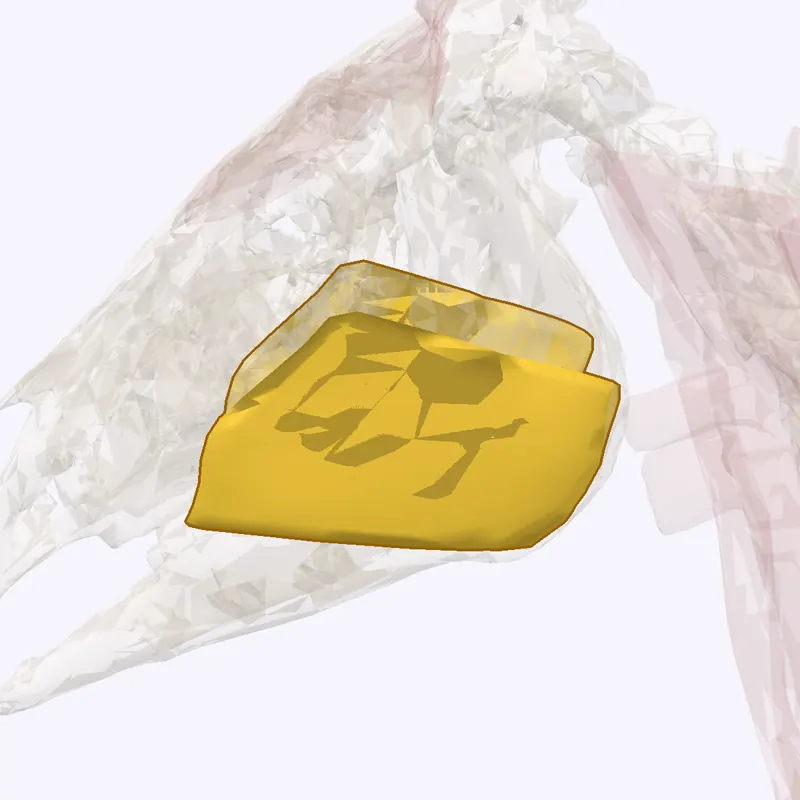
Large, multilayered chewing muscle of the cheek; it shapes the lateral surface of the equine head.
Key points
- It arises from the facial crest of the maxilla and the zygomatic arch.
- It is supplied by the masseteric nerve, a branch of the mandibular nerve (cranial nerve V).
- Because of anisognathia, the cheek teeth meet on one side at a time.
- Sharp enamel points injure the cheek and tongue and are rasped at dental checks.
- Unilateral atrophy suggests a lesion of the mandibular nerve on that side.
Overview
In the horse the masseter is very large and forms the rounded surface of the cheek.
It is made up of several layers separated by tendinous sheets, grouped into a superficial and a deep part.
The equine mandible is narrower than the maxilla. Because of this anisognathia, the cheek teeth meet on one side at a time.
Chewing is a side-to-side grinding movement, and the masseter plays the main role in it.
Origin
Facial crest (crista facialis) of the maxilla and zygomatic arch.
Insertion
Lateral surface of the mandibular ramus, as far as its ventral border and the angle.
Action
Raises the mandible and closes the mouth. Contraction on one side shifts the mandible towards that side and produces the grinding stroke.
Innervation
Masseteric nerve, a branch of the mandibular nerve (cranial nerve V).
Clinical relevance
- Sharp enamel points. Because of anisognathia and the lateral stroke, wear leaves points on the buccal edge of the upper cheek teeth and the lingual edge of the lower ones. They injure the cheek and tongue. They are rasped, or "floated", at routine dental checks.
- Pulse. The facial artery, with the facial vein and parotid duct, crosses the ventral border of the mandible at the rostral edge of the masseter. This is the usual place to take the pulse in the horse.
- Unilateral atrophy. Suggests a lesion of the mandibular nerve on that side.
Related structures
See it in 3D on your iPhone
Peel the layers, spin the model, quiz yourself on it and stand it on your desk in AR. AnatomyCompass is coming to iPhone, iPad and Mac: get one email when it’s out.
More of the Horse: Muscular system
Text adapted from Vet Atlas (CC BY-SA 4.0). 3D model: Vet Atlas procedural musculature (CC BY-SA 4.0). Sources and licences. This veterinary text has not yet been reviewed by a veterinarian.