 AnatomyCompass
Epaxial muscles
M. iliocostalis, M. longissimus et M. transversospinalis (musculi epaxiales) · Cow · Muscular system · Trunk
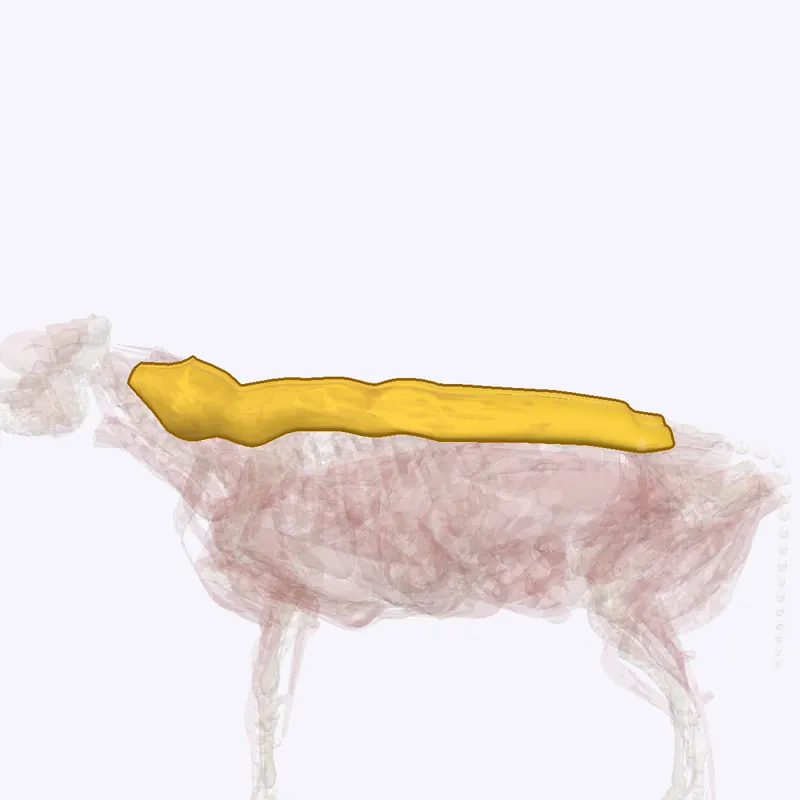
Muscle mass dorsal to the transverse processes along the vertebral column; the longissimus forms the loin and the rib eye.
Key points
- They form three columns, and the longissimus is the largest.
- The bovine nuchal ligament passively carries the weight of the head.
- Paravertebral anaesthesia blocks T13, L1 and L2 through these muscles.
- Rib eye area is measured between ribs 12 and 13.
- Blackleg can affect the back and loin of young cattle.
Overview
The epaxial muscles form three parallel columns, from lateral to medial:
- Iliocostalis (m. iliocostalis). From the ilium and lumbar vertebrae to the ribs.
- Longissimus (m. longissimus). The largest, from the ilium to the skull, between the transverse and spinous processes.
- Transversospinalis (m. transversospinalis). Short bundles next to the spinous processes: spinalis, semispinalis, multifidus and rotatores.
The model shows the three columns as a single mass, from the sacrum to the axis.
Cattle have a well developed nuchal ligament. It passively carries the weight of the head and relieves the dorsal neck muscles.
Meat science
The longissimus thoracis et lumborum, the "longissimus dorsi", is the most valuable cut of the carcass:
- it forms the rib eye in the thoracic region
- it forms the striploin in the lumbar region
Origin and insertion
Ilium, sacrum, vertebral processes and ribs. Each bundle spans one or several segments.
Action
- Extend and stabilise the vertebral column.
- Acting on one side only, they bend it laterally.
- Raise the head and neck.
Innervation
Dorsal branches of the spinal nerves.
Clinical relevance
- In paravertebral anaesthesia of the flank, spinal nerves T13, L1 and L2 are blocked next to the lumbar transverse processes. The needle passes through these muscles.
- The inverted-L block infiltrates along the caudal border of the last rib and ventral to the lumbar transverse processes.
- Rib eye area, measured at the cut between ribs 12 and 13, is used in carcass grading to estimate lean meat yield.
- Blackleg (Clostridium chauvoei) can affect the large muscle masses of the back and loin in young cattle, as well as those of the hindquarter and shoulder.
Related structures
See it in 3D on your iPhone
Peel the layers, spin the model, quiz yourself on it and stand it on your desk in AR. AnatomyCompass is coming to iPhone, iPad and Mac: get one email when it’s out.
More of the Cow: Muscular system
Text adapted from Vet Atlas (CC BY-SA 4.0). 3D model: Vet Atlas procedural musculature (CC BY-SA 4.0). Sources and licences. This veterinary text has not yet been reviewed by a veterinarian.