 AnatomyCompass
Ribs
Costae · Cow · Skeletal system · Axial skeleton
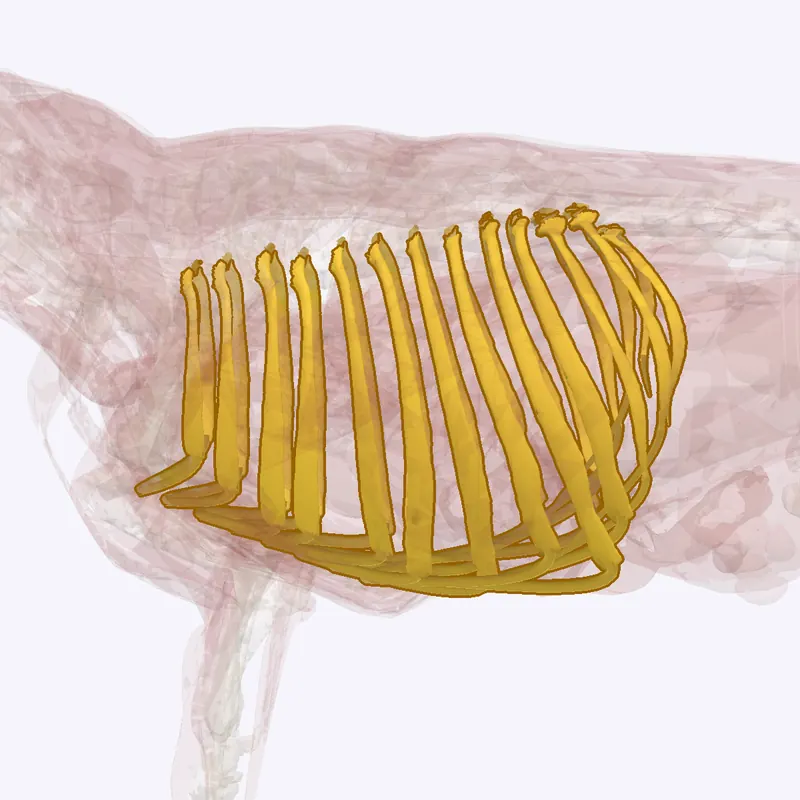
Thirteen pairs of curved bones forming the lateral walls of the thorax. Eight sternal and five asternal pairs; in cattle they are broad and flat.
Key points
- The cartilages of the five asternal ribs form the costal arch.
- The intercostal vessels and nerve run along the caudal border of each rib.
- The last ribs cover abdominal organs because the diaphragm attaches far cranially.
- In calves, rib fractures follow dystocia with forced traction.
- The "ping" of a left displaced abomasum is heard over the last left ribs.
Overview
Cattle have thirteen pairs of ribs (costae), one for each thoracic vertebra. Each rib has a dorsal bony part and a ventral costal cartilage.
- Sternal, or true, ribs. These are the first eight pairs, and their cartilage articulates directly with the sternum.
- Asternal, or false, ribs. These are the last five. They do not reach the sternum and their cartilages form the costal arch (arcus costalis).
Compared with those of the dog and cat, bovine ribs are broad and flat, and the intercostal spaces are relatively narrow.
Key features
- Head (caput costae). Articulates with the costal foveae of two consecutive vertebrae.
- Neck and tubercle. The tubercle articulates with the transverse process of the vertebra of the same number.
- Body. Long, curved and broad. The intercostal vein, artery and nerve run along its caudal border.
- Angle. Point of greatest curvature, where the rib changes direction.
- Costochondral junction. Between the bony part and the cartilage.
Thorax and abdomen
The diaphragm attaches far cranially. For this reason the last ribs cover abdominal organs:
- on the left, the reticulum and rumen
- on the right, the liver and omasum
Clinical relevance
Rib fractures in calves
Common after dystocia with forced traction, especially in large calves.
They can cause respiratory distress and injure the lung or heart.
Left displaced abomasum
The characteristic "ping" is heard by simultaneous auscultation and percussion over the last left ribs.
Rib resection
Gives access to the thoracic cavity, for example for pericardiotomy in traumatic pericarditis.
Related structures
See it in 3D on your iPhone
Peel the layers, spin the model, quiz yourself on it and stand it on your desk in AR. AnatomyCompass is coming to iPhone, iPad and Mac: get one email when it’s out.
More of the Cow: Skeletal system
Text adapted from Vet Atlas (CC BY-SA 4.0). 3D model: "Skelet jonge koe | skeleton young cow (800-1000)" by Archeologiemuseum Huis van Hilde (Sketchfab) (CC BY-SA 4.0). Sources and licences. This veterinary text has not yet been reviewed by a veterinarian.