 AnatomyCompass
Ovaries
Ovaria · Cow · Splanchnology (organs) · Genital system
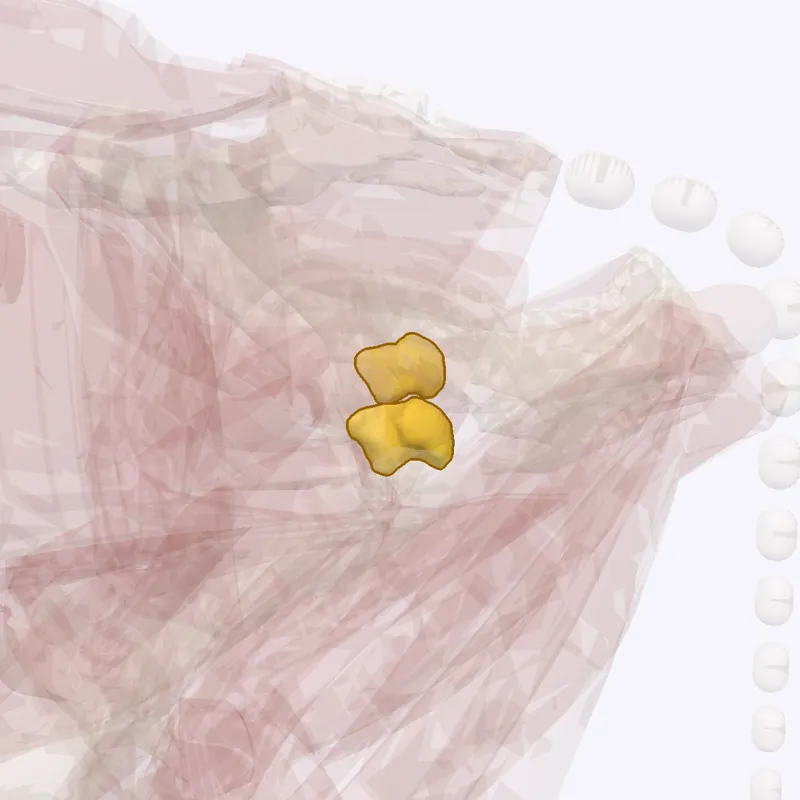
Female gonads, small and almond-shaped. In the heifer they lie near the pelvic inlet, next to the tips of the uterine horns, and their follicles and corpus luteum can be palpated per rectum.
Key points
- In multiparous cows the heavier uterus pulls the ovaries into the abdomen.
- Follicles grow in waves, and the dominant follicle of the last wave ovulates.
- The corpus luteum is firm, often protrudes from the surface and maintains pregnancy.
- Ovarian cysts are most common in high-yielding dairy cows after calving.
- Manual enucleation of the corpus luteum is discouraged because of the risk of haemorrhage and adhesions.
Overview
The cow's ovaries (ovaria) are oval, flattened and almond-shaped, small relative to the size of the animal.
They are suspended by the mesovarium, part of the broad ligament. They lie on either side of the pelvic inlet, next to the tips of the horns. In multiparous cows the heavier uterus pulls them cranially and ventrally into the abdomen.
The ovarian bursa, formed by the mesosalpinx, is wide and open. The oviduct runs along its edge.
Structure and cycle
- Follicles. They develop in waves, several per cycle, and the dominant follicle of the last wave ovulates. They bulge from the surface and feel like soft, fluctuant areas.
- Corpus luteum (corpus luteum). It forms after ovulation. It often protrudes from the surface with a crown and is firm. It secretes progesterone and maintains pregnancy.
- Oestrous cycle. It lasts about three weeks. If there is no pregnancy, prostaglandin F2α from the uterus destroys the corpus luteum.
Clinical relevance
- Rectal palpation and ultrasound identify follicles and the corpus luteum, establish the stage of the cycle and diagnose anoestrus or ovarian disorders.
- In cystic ovarian disease there are anovulatory structures, larger than a preovulatory follicle, that persist in the absence of a corpus luteum. They may be thin-walled follicular cysts or thick-walled luteal cysts. They are most common in high-yielding dairy cows after calving and cause anoestrus or irregular heats.
- Oestrus synchronisation protocols with GnRH and prostaglandin F2α act on the follicles and the corpus luteum.
- Manual enucleation of the corpus luteum is discouraged because of the risk of haemorrhage and adhesions.
- In freemartinism, the female twin of a male has hypoplastic gonads.
Diseases
- Cystic ovarian diseaseFollicles that fail to ovulate and persist on the ovary in the absence of a corpus luteum, as follicular or…
Related structures
See it in 3D on your iPhone
Peel the layers, spin the model, quiz yourself on it and stand it on your desk in AR. AnatomyCompass is coming to iPhone, iPad and Mac: get one email when it’s out.
More of the Cow: Splanchnology (organs)
Text adapted from Vet Atlas (CC BY-SA 4.0). 3D model: Vet Atlas procedural organs (CC BY-SA 4.0). Sources and licences. This veterinary text has not yet been reviewed by a veterinarian.