 AnatomyCompass
Temporalis
M. temporalis · Cow · Muscular system · Head
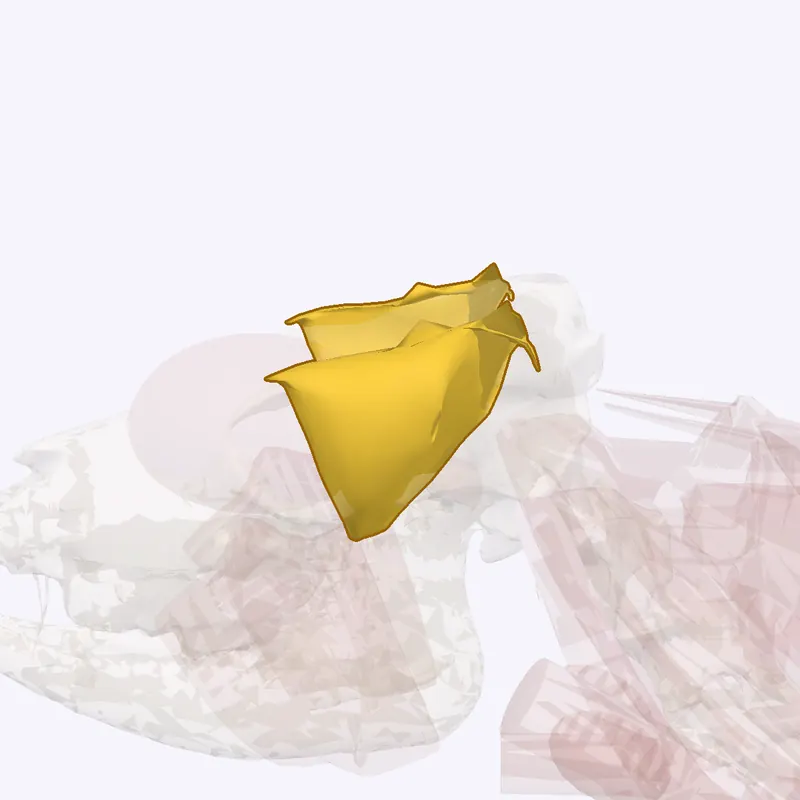
Masticatory muscle that fills the temporal fossa and closes the mouth; in cattle it is much smaller than the masseter.
Key points
- In ruminants chewing relies mainly on the masseter, not the temporalis.
- In cattle the temporal fossa lies on the lateral side of the skull, below the temporal line.
- It inserts on the coronoid process of the mandible.
- The cornual nerve runs along the temporal line and is blocked there for dehorning.
Overview
Unlike in carnivores, in ruminants it is a relatively small muscle. Chewing relies mainly on the masseter.
In cattle the temporal fossa lies on the lateral side of the skull, caudal to the orbit and below the temporal line. This line separates it from the frontal roof of the skull.
The muscle passes medial to the zygomatic arch to the mandible.
Origin
Temporal fossa, bounded dorsally by the temporal line.
Insertion
Coronoid process of the mandible.
Action
Elevates the mandible and closes the mouth.
Innervation
Mandibular nerve (n. mandibularis), a branch of the trigeminal nerve (cranial nerve V).
Clinical relevance
The cornual nerve, which supplies the horn, runs along the temporal line at the dorsal border of the temporal fossa. It is blocked there with local anaesthetic for dehorning.
Related structures
See it in 3D on your iPhone
Peel the layers, spin the model, quiz yourself on it and stand it on your desk in AR. AnatomyCompass is coming to iPhone, iPad and Mac: get one email when it’s out.
More of the Cow: Muscular system
Text adapted from Vet Atlas (CC BY-SA 4.0). 3D model: Vet Atlas procedural musculature (CC BY-SA 4.0). Sources and licences. This veterinary text has not yet been reviewed by a veterinarian.