 AnatomyCompass
Skull
Cranium · Cow · Skeletal system · Axial skeleton
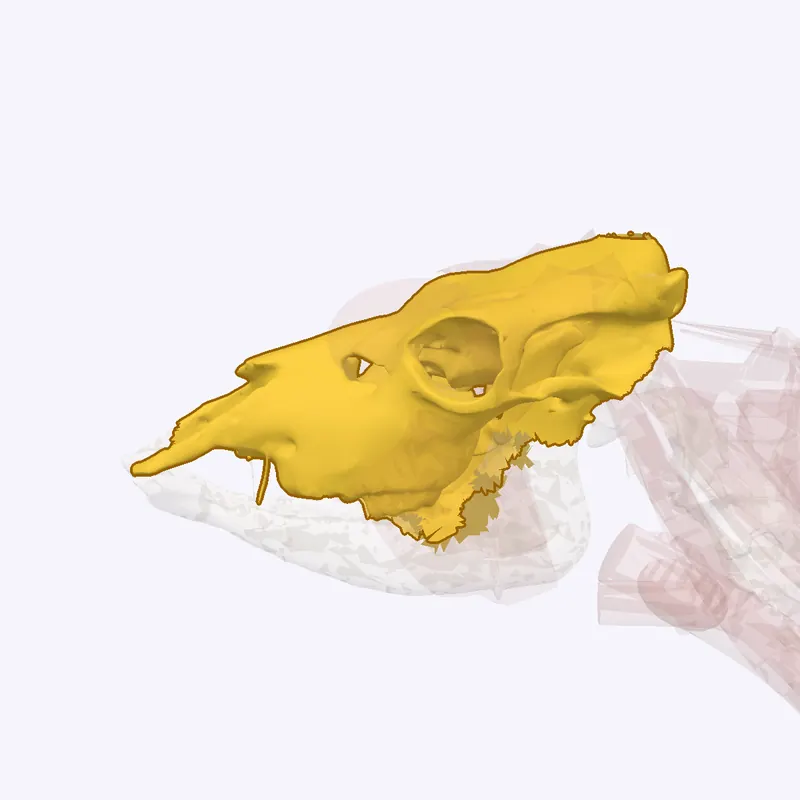
The bones of the head without the mandible. In cattle the frontal bone forms the whole roof of the skull and the poll, carries the cornual processes and holds a very large frontal sinus.
Key points
- The frontal bone covers the whole roof of the skull and pushes the parietals caudally.
- A dental pad takes the place of the upper incisors.
- The adult dental formula is 2 × (I 0/3, C 0/1, P 3/3, M 3/3) = 32.
- Disbudding young calves is preferred, before the horn core becomes pneumatised.
- The cornual nerve is blocked along the temporal line before dehorning.
Overview
The bovine skull has two parts:
- the braincase (neurocranium), which protects the brain
- the facial skeleton (viscerocranium), which forms the nose, the orbits and the mouth
It is long, wide and heavy. The braincase is small relative to the size of the head.
Its most typical feature is the huge frontal bone (os frontale). It covers the whole dorsal surface back to the poll and pushes the parietal bones onto the caudal surface of the skull.
Frontal region and horns
- Intercornual protuberance (protuberantia intercornualis). Transverse ridge between the horns that forms the poll. It is the highest point of the skull.
- Cornual process (processus cornualis). Bony extension of the frontal bone that forms the horn core, covered by the corium and the horny sheath. Its shape and size vary with breed, sex and age. It is absent in polled breeds such as the Aberdeen Angus.
- Frontal sinus (sinus frontalis). Very large. In the adult it surrounds the cranial cavity dorsally and caudally and extends into the cornual process.
- Temporal line (linea temporalis). Ridge running from the orbit to the base of the horn. It separates the frontal surface from the temporal fossa, which in cattle lies on the lateral side of the skull.
Face
- Orbits. Directed laterally, with a complete bony orbital rim.
- Facial tuber (tuber faciale). Prominence on the lateral surface of the maxilla, rostral to the orbit and dorsal to the cheek teeth. It is the origin of the masseter muscle.
- Incisive bone (os incisivum). It has no alveoli. Instead of upper incisors there is a dental pad (pulvinus dentalis), a horny plate against which the lower incisors press the grass that the tongue wraps around and tears off.
- Temporomandibular joint. Allows the wide side-to-side movements of chewing and rumination.
Upper teeth
- There are no incisors or canines.
- Each side has three premolars (P2–P4) and three molars.
- They are selenodont, with crescent-shaped enamel ridges on the occlusal surface.
- The upper arcades are set wider apart than the lower ones. Because of this anisognathism, the animal chews on one side at a time.
The adult dental formula is 2 × (I 0/3, C 0/1, P 3/3, M 3/3) = 32.
Clinical relevance
- Dehorning. In older animals the cut opens the frontal sinus that fills the horn core. For this reason disbudding of young calves, before the core becomes pneumatised, is preferred.
- Cornual nerve block. The cornual nerve runs along the temporal line, between the lateral canthus of the eye and the base of the horn. It is anaesthetised there before dehorning.
- Frontal sinusitis. A complication of dehorning or horn fractures. It causes nasal discharge, often unilateral, and pain on percussion over the sinus.
- Actinomycosis (lumpy jaw). Osteomyelitis caused by Actinomyces bovis. It affects the mandible more often, but also the maxilla.
Diseases
- ActinomycosisChronic pyogranulomatous osteomyelitis of the mandible or maxilla caused by Actinomyces bovis, which enters…
Related structures
See it in 3D on your iPhone
Peel the layers, spin the model, quiz yourself on it and stand it on your desk in AR. AnatomyCompass is coming to iPhone, iPad and Mac: get one email when it’s out.
More of the Cow: Skeletal system
Text adapted from Vet Atlas (CC BY-SA 4.0). 3D model: "Skelet jonge koe | skeleton young cow (800-1000)" by Archeologiemuseum Huis van Hilde (Sketchfab) (CC BY-SA 4.0). Sources and licences. This veterinary text has not yet been reviewed by a veterinarian.