 AnatomyCompass
Rabies
Infectious · Dog, Cat, Cow, Horse
Acute viral encephalitis caused by a lyssavirus and transmitted mainly by bites. Once signs appear it is almost always fatal.
Key points
- The animal can shed virus in saliva a few days before showing signs.
- In the paralytic form, examining the mouth by hand is a classic route of exposure.
- There is no reliable ante-mortem test; diagnosis is the direct fluorescent antibody test on brain.
- A healthy dog or cat that has bitten a person is observed for 10 days.
- Mass dog vaccination is the most effective way to reduce human cases.
What it is
Rabies is an acute encephalitis caused by rabies virus, of the genus Lyssavirus (family Rhabdoviridae). Other related lyssaviruses circulate in bats.
The virus is shed in saliva and transmitted mainly by bites. Less often, it spreads by contamination of wounds or mucous membranes with saliva.
At the bite site the virus multiplies in muscle and enters peripheral nerve endings. From there it travels up by retrograde axonal transport to the spinal cord and brain: this is centripetal spread.
After replicating in the brain, it travels down the nerves to other tissues, especially the salivary glands: this is centrifugal spread.
The incubation period is very variable, from weeks to months, depending on the bite site, the viral dose and the strain. The animal can shed virus in saliva a few days before showing signs.
It is an almost always fatal zoonosis. The dog is the source of the vast majority of human cases worldwide, mainly in Asia and Africa. WHO, WOAH, FAO and their partners hold the "Zero by 30" goal: no human deaths from dog-mediated rabies by 2030.
It is a WOAH-listed disease. Suspected cases must be reported, and its control follows official programmes.
Who it affects
All mammals are susceptible.
Where canine rabies is endemic, the main reservoir is the dog, especially the stray or free-roaming owned population that is not vaccinated. Unvaccinated dogs that roam freely are at greatest risk.
In other regions it is maintained by wildlife, which transmits it to dogs, cats, livestock and people: foxes, raccoons, skunks, jackals and bats, including vampire bats in Latin America.
Anatomy involved
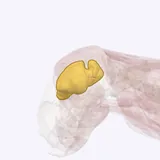
The brain is the target organ. The virus causes progressive encephalomyelitis, with microscopic lesions that are often mild for the severity of the disease.
For diagnosis the brainstem, specifically the medulla oblongata, is sampled together with the cerebellum.
Clinical signs
In dogs the course usually lasts less than 10 days from the first signs to death. Three overlapping phases are described.
Prodromal phase
It lasts a few days. The typical sign is a behavioural change: a friendly dog becomes withdrawn, or a shy one seeks contact. There is also anorexia, nervousness or irritability, and a tendency to seek solitude.
Furious form
- restlessness and irritability
- unprovoked aggression and biting at objects
- disorientation
- a hoarse bark
- seizures
Paralytic or dumb form
There is jaw paralysis, with a dropped jaw, dysphagia and hypersalivation. Paralysis spreads rapidly through the body and is followed by coma and death.
Drooling saliva and dysphagia make the owner think the dog has something stuck in its throat. Examining the mouth by hand is a classic route of exposure.
Diagnosis
There is no reliable ante-mortem test in animals. Signs only allow the disease to be suspected.
Diagnosis is post mortem, on the brain:
- The test of choice is the direct fluorescent antibody test (FAT) on brain tissue impressions.
- Molecular tests such as real-time PCR are also becoming standard.
- The head or brain is sent to the official laboratory chilled, not fixed in formalin, on ice or cold packs. It is handled by trained and vaccinated staff.
Animal that has bitten a person
A healthy dog or cat that has bitten a person is kept under observation for 10 days.
If it is still healthy at the end of that period, it was not shedding virus in saliva at the time of the bite. If it becomes ill, it is euthanised and the brain is tested.
Treatment and prevention
There is no treatment in animals. An animal with signs of rabies is euthanised and its brain tested.
Management of exposed animals is set by each country's regulations. In general:
- vaccinated animals receive an immediate booster and are kept under observation
- unvaccinated animals undergo prolonged quarantine or euthanasia
Dog vaccination and control
Rabies vaccination is effective, and essential in endemic areas and where required by law.
Mass dog vaccination that achieves high coverage and maintains it with regular campaigns is the most effective way to reduce human cases. It eliminated canine rabies from Western Europe and North America and has drastically reduced it in Latin America.
It is completed by dog population management, responsible ownership and integrated bite surveillance between veterinary and public health services, within a One Health approach.
In people
The wound is washed immediately and thoroughly with soap and water, and post-exposure prophylaxis is given: vaccine and, depending on the exposure, rabies immunoglobulin. It is highly effective if given in time.
Veterinarians and laboratory staff at risk receive pre-exposure prophylaxis.
In the cat
Cats are infected mainly by bites from wildlife or rabid dogs. In some countries they are the domestic species with the most reported cases, so their vaccination is just as important.
Cats often show the furious form: sudden behavioural changes, intense aggression with unprovoked attacks, abnormal vocalisation and dilated pupils. Incoordination, paralysis and death follow.
A rabid cat is very dangerous because it bites and scratches quickly.
The brain lesions and post-mortem diagnosis are the same as in the dog. A cat that has bitten a person is also observed for 10 days.
In cattle
Transmission
In Latin America bovine rabies is transmitted mainly by the common vampire bat, Desmodus rotundus, which feeds on cattle blood. It causes major economic losses in tropical and subtropical areas.
In other regions cattle are infected by bites from dogs or wild carnivores.
Signs
- behavioural changes
- a characteristic abnormal bellowing
- abrupt cessation of lactation
- hypersalivation and difficulty swallowing
- ataxia and paresis of the hind limbs, progressing to recumbency and death within a few days
Some show a furious form, with aggression and charging.
Hypersalivation and dysphagia resemble oesophageal obstruction. This is why examining the mouth or pharynx without protection exposes farmers and veterinarians.
Diagnosis and control
Diagnosis is made on the brain with the same tests as in dogs.
Control relies on official programmes: vaccination of cattle in risk areas, and surveillance and notification of outbreaks.
In the horse
Horses are infected by bites from wild carnivores or rabid dogs and, in Latin America, also from vampire bats.
The species is rarely affected in countries free of terrestrial rabies, but in endemic areas cases occur regularly. Handling the mouth and the neurological examination expose owners and veterinarians.
Signs
Signs are highly variable and non-specific. Rabies can begin as:
- lameness
- colic
- ataxia and paresis of the hindquarters
- difficulty swallowing
It progresses to hyperaesthesia, loss of tail and anal tone, fever and recumbency, with death in less than a week. Some horses show a furious form, with aggression, biting and self-mutilation.
Rabies must always be considered in a horse with acute, progressive neurological disease. Until it has been ruled out, the horse is handled with gloves and protection.
Diagnosis and prevention
Diagnosis is made on the brain with the same tests as in other species. Vaccines for horses are available and are used in endemic areas.
Horse-specific evidence is weak. The clinical description comes mainly from case series, such as Green et al. (1992), with 21 horses that died a mean of 4.47 days after the first signs.
Key studies
- Hampson et al. (2015). Model of the global impact of dog-mediated rabies, built from literature searches and country questionnaires. It estimated about 59,000 human deaths per year (95% CI 25,000–159,000), more than 3.7 million disability-adjusted life years and 8.6 billion US dollars in annual losses. Dog vaccination accounted for only 1.5% of the costs and livestock losses for 6%. It concludes that dog vaccination is the most effective way to reduce the burden and that investment in it has been inadequate. Uncertainty is wide and several authors worked for vaccine manufacturers.
- Hampson et al. (2009). Transmission study based on detailed tracing of rabid animals in Tanzania. The basic reproductive number of canine rabies was about 1.2 in the study area and below 2 throughout its historical range, which makes control by vaccination feasible. Rapid turnover of the dog population was the main obstacle, so regular campaigns are needed to maintain immunity between them. It is based on a single study area.
- Rattanavipapong et al. (2019). Systematic review of 19 transmission modelling studies, carried out for the WHO vaccine advisory group. The basic reproductive number was below 2 in all studies but one. All concluded that dog vaccination reduces rabies in dogs or people, and most considered 70% annual coverage adequate. Coverage, dog density and birth rate were the decisive factors. These are model results, not trials.
- Tepsumethanon et al. (2004). Cohort of 1,820 dogs and 332 cats that were ill or had bitten, observed for at least 10 days in Thailand. All 957 dogs and 94 cats with confirmed rabies died within 10 days of admission. It supports the 10-day observation of biting animals. It is a single centre and time was counted from admission, not from the bite.
- Soler-Tovar and Escobar (2025). Analysis of Pan American Health Organization data on vampire-bat-transmitted bovine rabies from 1970 to 2023. There was an average of 450 outbreaks per year in countries where D. rotundus lives, with at least 6 animals dying per outbreak; Brazil, Colombia, Peru and Mexico were the most affected. Outbreaks were more frequent between 2000 and 2020 than in earlier decades, although smaller. These are passive surveillance data, subject to under-reporting.
- Oliveira et al. (2022). Analysis of surveillance data on rabies in horses in Brazil from 2010 to 2019. 1,290 cases were reported, mainly in São Paulo (21.7%) and Mato Grosso (13.3%). Espírito Santo had the highest incidence, at 139.7 cases per 100,000 horses, and three high-risk clusters were found in the southeast and centre-west. There were cases in every region of the country and a rising trend in the northeast. These are passive surveillance data, subject to under-reporting.
Structures affected



References
- Sykes JE. Greene's Infectious Diseases of the Dog and Cat, 5th ed. Elsevier (2021)
- Constable PD, Hinchcliff KW, Done SH, et al. Veterinary Medicine: A textbook of the diseases of cattle, horses, sheep, pigs, and goats, 11th ed. Elsevier (2017)
- Hampson K, Coudeville L, Lembo T, et al. Estimating the global burden of endemic canine rabies. PLoS Negl Trop Dis 9:e0003709 (2015)
- Hampson K, Dushoff J, Cleaveland S, et al. Transmission dynamics and prospects for the elimination of canine rabies. PLoS Biol 7:e53 (2009)
- Rattanavipapong W, Thavorncharoensap M, Youngkong S, et al. The impact of transmission dynamics of rabies control: Systematic review. Vaccine 37 Suppl 1:A154-A165 (2019)
- Tepsumethanon V, Lumlertdacha B, Mitmoonpitak C, et al. Survival of naturally infected rabid dogs and cats. Clin Infect Dis 39:278-80 (2004)
- Soler-Tovar D, Escobar LE. Rabies transmitted from vampires to cattle: An overview. PLoS One 20:e0317214 (2025)
- Oliveira FAS, Castro RJS, de Oliveira JF, et al. Geographical and temporal spread of equine rabies in Brazil. Acta Trop 227:106302 (2022)
- Green SL, Smith LL, Vernau W, et al. Rabies in horses: 21 cases (1970-1990). J Am Vet Med Assoc 200:1133-7 (1992)
- Merck Veterinary Manual: Rabies in Animals
- World Health Organization. Rabies (fact sheet)
- Verdes JM, de Sant'Ana FJ, Sabalsagaray MJ, et al. Calbindin D28k distribution in neurons and reactive gliosis in cerebellar cortex of natural Rabies virus-infected cattle. J Vet Diagn Invest 28:361-368 (2016)
See it in 3D on your iPhone
Peel the layers, spin the model, quiz yourself on it and stand it on your desk in AR. AnatomyCompass is coming to iPhone, iPad and Mac: get one email when it’s out.
Text adapted from Vet Atlas (CC BY-SA 4.0). Sources and licences. This veterinary text has not yet been reviewed by a veterinarian.