 AnatomyCompass
Brain
Encephalon · Cow · Splanchnology (organs) · Nervous system
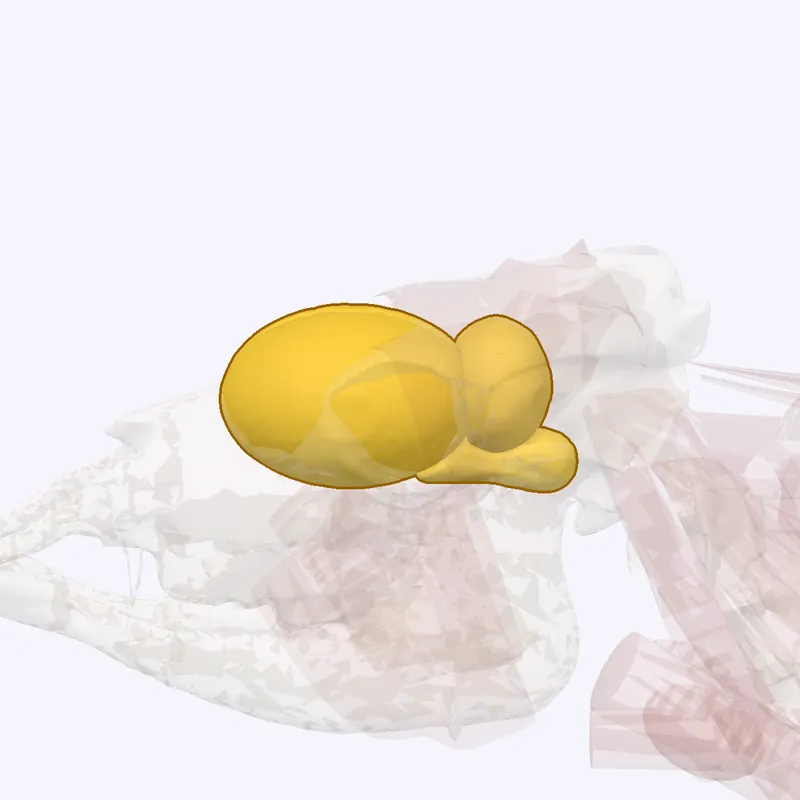
Part of the central nervous system housed in the cranial cavity. In cattle it is small relative to the size of the head and is surrounded dorsally and caudally by the large frontal sinus.
Key points
- In the adult, arterial blood arrives mainly through the rostral epidural rete mirabile.
- Polioencephalomalacia causes cortical blindness and responds to thiamine in the early stages.
- Listeriosis, linked to poorly fermented silage, causes asymmetric cranial nerve deficits.
- The obex is the reference sample for diagnosing bovine spongiform encephalopathy.
- The captive bolt is aimed where the lines cross from each eye to the opposite horn.
Overview
The bovine brain (encephalon) fills a relatively small cranial cavity. It is protected by the frontal bone and, in the adult, by the frontal sinus, which surrounds it dorsally and caudally.
It continues into the spinal cord through the foramen magnum.
Parts
- Cerebrum (cerebrum). Two hemispheres with gyri, separated by the longitudinal fissure. The cortex integrates vision, behaviour and voluntary movement.
- Cerebellum (cerebellum). Caudal to the cerebrum, over the fourth ventricle. It coordinates movement and balance.
- Brainstem. Midbrain, pons and medulla oblongata. Most cranial nerves emerge from it.
Blood supply
In the adult bovine, arterial blood reaches the brain mainly through the rostral epidural rete mirabile (rete mirabile epidurale rostrale) at the base of the skull.
Clinical relevance
- Polioencephalomalacia is a necrosis of the cerebral cortex associated with thiamine deficiency or excess dietary sulphur. It causes cortical blindness, head pressing, opisthotonus and seizures. In the early stages it responds to thiamine.
- In listeriosis, Listeria monocytogenes, often from poorly fermented silage, forms microabscesses in the brainstem. It causes asymmetric cranial nerve deficits, such as facial paralysis or head tilt, and circling.
- Bovine spongiform encephalopathy is a prion disease spread by meat and bone meal. It causes vacuolation in the brainstem, and the obex is the reference sample for diagnosis. It is now rare thanks to the ban on feeding those meals to ruminants.
- Rabies must be considered in any bovine with rapidly progressive neurological signs. Necropsy and sample handling require precautions.
- For stunning and euthanasia, the captive bolt is aimed at the crossing of the lines running from the lateral canthus of each eye to the base of the opposite horn.
Diseases
- PolioencephalomalaciaLaminar necrosis of the cerebral cortex of ruminants, associated with disturbed thiamine metabolism and…
- RabiesAcute viral encephalitis caused by a lyssavirus and transmitted mainly by bites. Once signs appear it is…
- Bovine viral diarrhoeaPestivirus infection that causes immunosuppression, reproductive losses, congenital malformations and…
Related structures
See it in 3D on your iPhone
Peel the layers, spin the model, quiz yourself on it and stand it on your desk in AR. AnatomyCompass is coming to iPhone, iPad and Mac: get one email when it’s out.
Text adapted from Vet Atlas (CC BY-SA 4.0). 3D model: Vet Atlas procedural organs (CC BY-SA 4.0). Sources and licences. This veterinary text has not yet been reviewed by a veterinarian.