 AnatomyCompass
Brachiocephalicus
M. brachiocephalicus · Horse · Muscular system · Thoracic limb
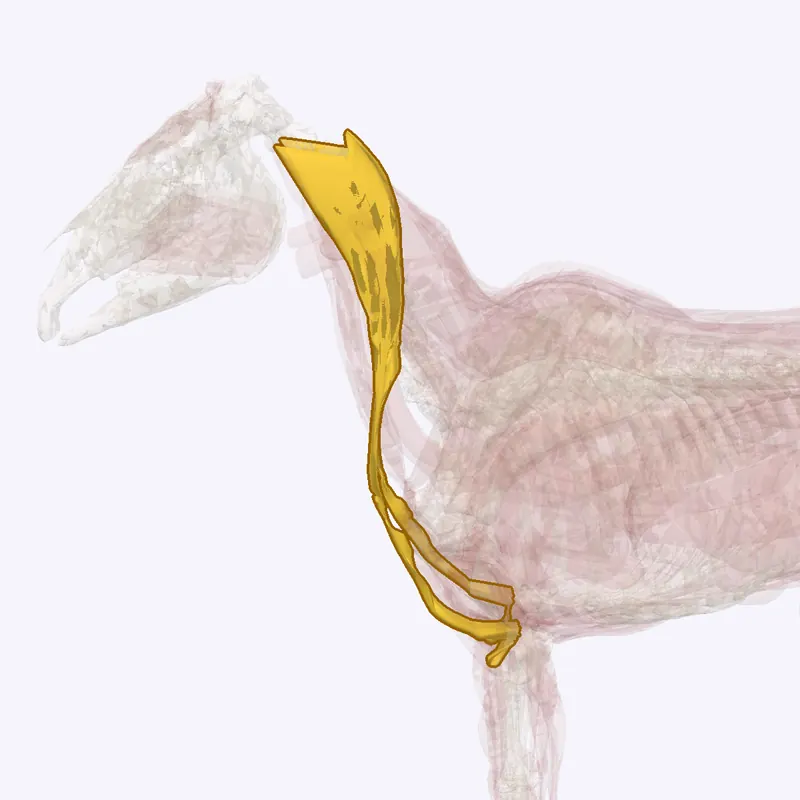
Long muscle joining the arm to the head that forms the dorsal border of the jugular groove; it is the main protractor of the thoracic limb.
Key points
- In place of a clavicle, a clavicular intersection crosses it cranial to the shoulder.
- In the horse the cleidocephalicus has only a mastoid part, with no cleido-occipitalis.
- It forms the dorsal border of the jugular groove, the usual venepuncture route.
- A shortened cranial phase of the stride can reflect neck or shoulder pain, not only distal lameness.
Overview
The horse has no clavicle. Cranial to the shoulder joint, the muscle is crossed by a clavicular intersection (intersectio clavicularis), a faint tendinous sheet. It divides the muscle into two:
- Cleidobrachialis (m. cleidobrachialis). Runs from the clavicular intersection to the arm.
- Cleidocephalicus (m. cleidocephalicus). Runs from the clavicular intersection to the head. In the horse it has only a mastoid part (cleidomastoideus); there is no cleido-occipitalis.
In the neck, the brachiocephalicus is partly fused with the omotransversarius, which lies deep to it.
Origin and insertion
- The cleidobrachialis runs from the clavicular intersection to the crest of the humerus, distal to the deltoid tuberosity, and to the brachial fascia.
- The cleidomastoideus runs from the clavicular intersection to the mastoid process of the temporal bone.
Action
- It is the main muscle that advances the thoracic limb, by extending the shoulder.
- With the limb fixed, it draws the head and neck ventrally and laterally.
Innervation
- Cleidomastoideus: accessory nerve and ventral branches of the cervical nerves.
- Cleidobrachialis: axillary nerve.
Clinical relevance
Jugular groove
It forms the dorsal border of the jugular groove. The external jugular vein, in this groove, is the usual route for blood sampling, intravenous medication and catheter placement in the horse.
Stride length
Its action sets the length of the cranial phase of the forelimb stride. A shortened cranial phase can reflect pain in the neck or shoulder region, as well as distal lameness.
Related structures
See it in 3D on your iPhone
Peel the layers, spin the model, quiz yourself on it and stand it on your desk in AR. AnatomyCompass is coming to iPhone, iPad and Mac: get one email when it’s out.
More of the Horse: Muscular system
- Biceps brachii
- Brachialis
- Accessory ligaments of the digital flexors (check ligaments)
- Deltoideus
- Extensor carpi radialis
- Common digital extensor
- Flexor carpi ulnaris
- Deep digital flexor (thoracic limb)
- Superficial digital flexor (thoracic limb)
- Infraspinatus
- Interosseus medius (suspensory ligament)
- Latissimus dorsi
- Omotransversarius
- Pectoral muscles
- Supraspinatus
- Trapezius
- Triceps brachii
Text adapted from Vet Atlas (CC BY-SA 4.0). 3D model: Vet Atlas procedural musculature (CC BY-SA 4.0). Sources and licences. This veterinary text has not yet been reviewed by a veterinarian.