 AnatomyCompass
Ovaries
Ovaria · Horse · Splanchnology (organs) · Genital system
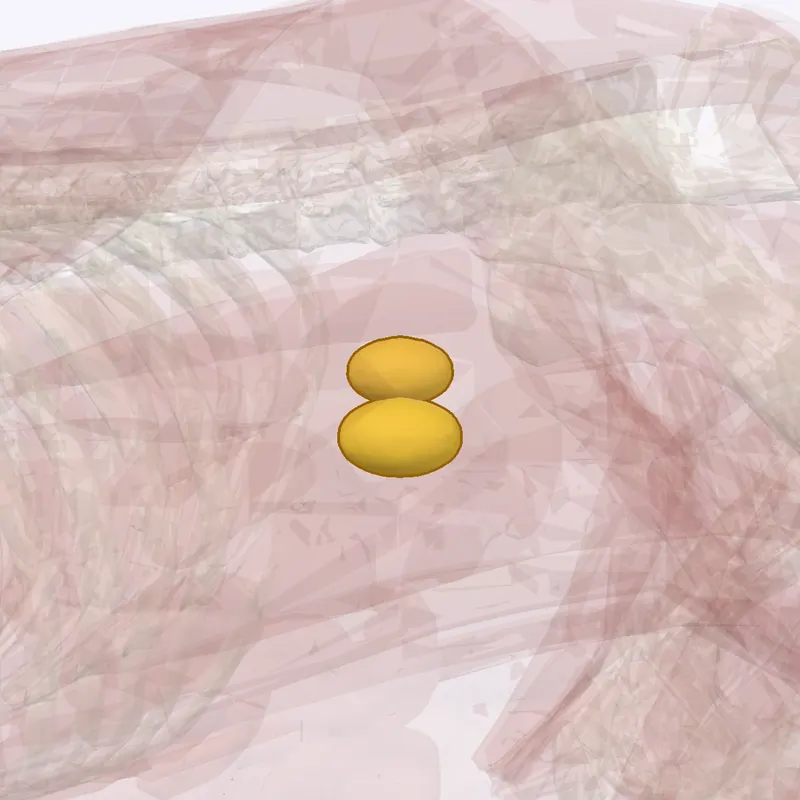
Large, bean-shaped female gonads lying in the sublumbar region, caudal to the kidneys. In the mare the cortex lies inside and ovulation only occurs through the ovulation fossa.
Key points
- The mare's ovaries are the largest among domestic animals.
- They lie far from the pelvic inlet and are reached per rectum with the arm stretched.
- The corpus luteum barely protrudes and is identified by ultrasound.
- The mare is a seasonally polyoestrous long-day breeder, with inactive ovaries in winter.
- Granulosa cell tumour is the most common ovarian tumour in the mare.
Overview
The mare's ovaries (ovaria) are the largest among domestic animals and are bean-shaped.
They hang from the mesovarium in the sublumbar region, caudal to the kidneys and far from the pelvic inlet. They are therefore reached per rectum with the arm stretched cranially.
Each relates to the tip of the uterine horn of its side.
Structure and cycle
- Inverted organisation. The vascular zone (medulla) forms the surface, covered by peritoneum. The parenchymatous zone (cortex), with the follicles and corpora lutea, lies inside.
- Ovulation fossa (fossa ovarii). A depression on the free border, the only part of the surface not covered by peritoneum. All follicles ovulate through it.
- Corpus luteum. Forms within the ovary and barely protrudes, so it is hard to feel on palpation. It is identified by ultrasound.
Seasonality
The mare is a seasonally polyoestrous long-day breeder.
- In winter the ovaries are small and inactive (anoestrus).
- In the spring transition many follicles grow without ovulating.
- In the breeding season the preovulatory follicle grows large and softens before ovulation.
Clinical relevance
- Cycle monitoring. Rectal palpation and ultrasound assess follicle size, shape and consistency, together with endometrial oedema. This is used to time mating or insemination and the induction of ovulation (hCG, deslorelin).
- Lighting programmes. Artificially extending daylight from winter brings forward the start of the breeding season.
- Granulosa cell tumour. The most common ovarian tumour in the mare. It is usually unilateral and multicystic. It causes anoestrus, persistent oestrus or stallion-like behaviour, and the contralateral ovary becomes small and inactive. Raised blood inhibin and anti-Müllerian hormone support the diagnosis. Treatment is ovariectomy.
- Ovarian haematoma and haemorrhagic anovulatory follicles. The ovary enlarges, but these are benign and resolve on their own.
Related structures
See it in 3D on your iPhone
Peel the layers, spin the model, quiz yourself on it and stand it on your desk in AR. AnatomyCompass is coming to iPhone, iPad and Mac: get one email when it’s out.
More of the Horse: Splanchnology (organs)
Text adapted from Vet Atlas (CC BY-SA 4.0). 3D model: Vet Atlas procedural organs (CC BY-SA 4.0). Sources and licences. This veterinary text has not yet been reviewed by a veterinarian.