 AnatomyCompass
Uterus
Uterus · Horse · Splanchnology (organs) · Genital system
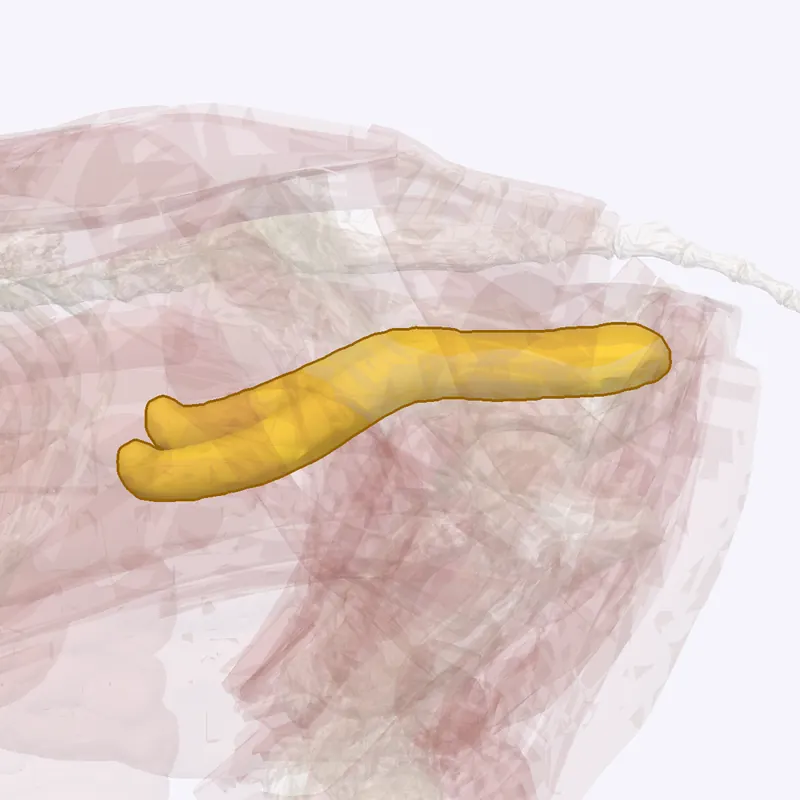
Organ of pregnancy. In the mare it is T- or Y-shaped, with a large body and short, straight horns.
Key points
- With no caruncles, its placenta is diffuse and epitheliochorial.
- The endometrial cups produce equine chorionic gonadotropin (eCG).
- The embryonic vesicle becomes fixed around day 16 at the base of one horn.
- A twin pregnancy is looked for at the first scans and one vesicle is reduced.
- The placenta counts as retained if the membranes are not passed within about 3 hours of foaling.
Overview
The mare's uterus (uterus) hangs from the roof of the abdomen and pelvis by the broad ligament (mesometrium). It attaches to the dorsal curvature of the horns; the ventral curvature is free.
Outside pregnancy, the body and horns lie mainly in the abdomen, in front of the pelvic inlet, resting on the intestinal loops. The small colon and rectum lie dorsally.
Parts
- Horns (cornua uteri). Relatively short. They diverge from the body almost straight towards the ovaries, without coiling. Their base is where the embryo becomes fixed.
- Body (corpus uteri). Long and wide, nearly as long as the horns. This is the most visible difference from the cow.
- Endometrium. With longitudinal folds and no caruncles. The placenta is diffuse and epitheliochorial, with microcotyledons spread over the whole chorion.
- Endometrial cups. Early in pregnancy, trophoblast cells invade the endometrium and form them. They produce equine chorionic gonadotropin (eCG).
- Cervix (cervix uteri). Short and soft-walled, with longitudinal folds that continue into the vagina. It relaxes in oestrus and admits one or more fingers, which makes transcervical techniques easy.
Clinical relevance
- Pregnancy diagnosis. Transrectal ultrasound detects the embryonic vesicle from two weeks. The vesicle is mobile until it becomes fixed at around day 16 at the base of one horn.
- Twin pregnancy. The mare tolerates it poorly: abortion or weak foals. It is therefore looked for at the first scans and one vesicle is reduced, ideally before fixation.
- Endometritis. Persistent post-breeding endometritis affects mares with poor uterine clearance and is treated with lavage and oxytocin. Endometrial biopsy grades fibrosis and inflammation and guides the fertility prognosis.
- Ascending placentitis. Enters through the cervix and causes abortion or weak foals.
- Retained placenta. If the membranes are not passed within about 3 hours of foaling they are considered retained. It may be followed by metritis, endotoxaemia and laminitis.
- Uterine torsion. In late pregnancy. It causes colic and is diagnosed by rectal palpation of the taut, crossed broad ligaments.
Diseases
- Equine herpesvirus 1Virus that infects most horses early in life and can stay latent. It usually causes mild respiratory disease…
- LeptospirosisBacterial infection with pathogenic leptospires transmitted through the urine of carrier animals. It is a…
Related structures
See it in 3D on your iPhone
Peel the layers, spin the model, quiz yourself on it and stand it on your desk in AR. AnatomyCompass is coming to iPhone, iPad and Mac: get one email when it’s out.
More of the Horse: Splanchnology (organs)
Text adapted from Vet Atlas (CC BY-SA 4.0). 3D model: Vet Atlas procedural organs (CC BY-SA 4.0). Sources and licences. This veterinary text has not yet been reviewed by a veterinarian.