Femur
Femur · Lower limb · Bone
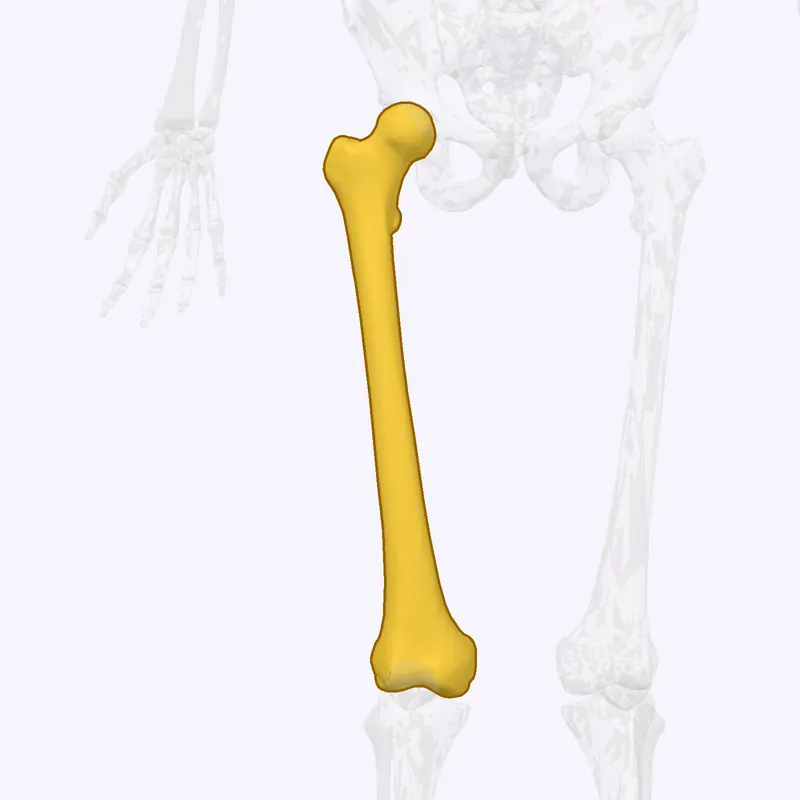
The thigh bone: the longest and strongest bone in the body.
Quick facts
- Latin name
- Femur
- Also called
- thigh bone, femurs, femora
- Type
- Bone
- Body area
- Lower limb
Landmarks of the femur
- Head
- Ball of the hip joint; its ligament carries a small artery.
- Neck
- Angled about 125° to the shaft; a common fracture site in older people.
- Greater trochanter
- Felt on the side of the hip: gluteus medius and minimus and the deep rotators insert.
- Lesser trochanter
- Iliopsoas inserts.
- Linea aspera
- Ridge down the back of the shaft for the adductors, vasti and short head of biceps femoris.
- Gluteal tuberosity
- Gluteus maximus inserts.
- Medial and lateral condyles
- Rounded lower ends that roll on the tibia; gastrocnemius arises above them.
- Adductor tubercle
- Top of the medial condyle: adductor magnus inserts.
Joints of the femur
- Hip joint
- Tibiofemoral (knee) joint
- Patellofemoral joint
3D views
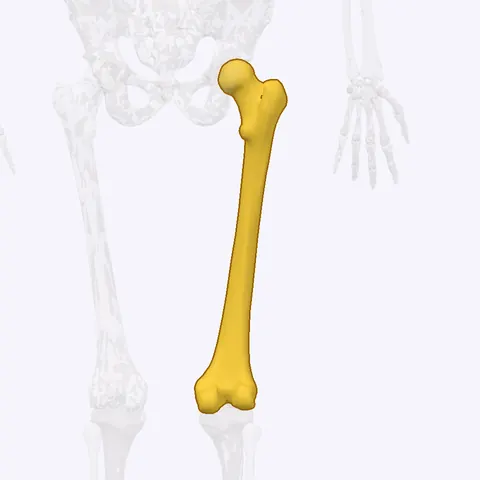
Muscles that attach to the femur
From the origin and insertion on each muscle’s page.
- Gluteus maximus
- Gluteus medius
- Gluteus minimus
- Piriformis
- Gemellus superior
- Gemellus inferior
- Obturator internus
- Obturator externus
- Quadratus femoris
- Iliacus
- Psoas major
- Vastus lateralis
- Vastus medialis
- Vastus intermedius
- Pectineus
- Adductor longus
- Adductor brevis
- Adductor magnus
- Adductor minimus
- Biceps femoris
- Gastrocnemius
- Plantaris
- Popliteus
Questions about the femur
What is the femur?
The thigh bone: the longest and strongest bone in the body.
See the femur in 3D
Peel the layers, spin the model, quiz yourself on it and stand it on your desk in AR. AnatomyCompass is coming to iPhone, iPad and Mac: get one email when it’s out.
Other bones: lower limb
Spotted something wrong? Tell us and we’ll fix it. This page is a study reference, not medical advice.