 AnatomyCompass
Internal oblique
Musculus obliquus internus abdominis · Abdominal muscles · Trunk
Internal oblique (Musculus obliquus internus abdominis) is one of the abdominal muscles. Below: its origin and insertion, what it does, its nerve and blood supply, how to find it, a stretch and an exercise, with 3D views.
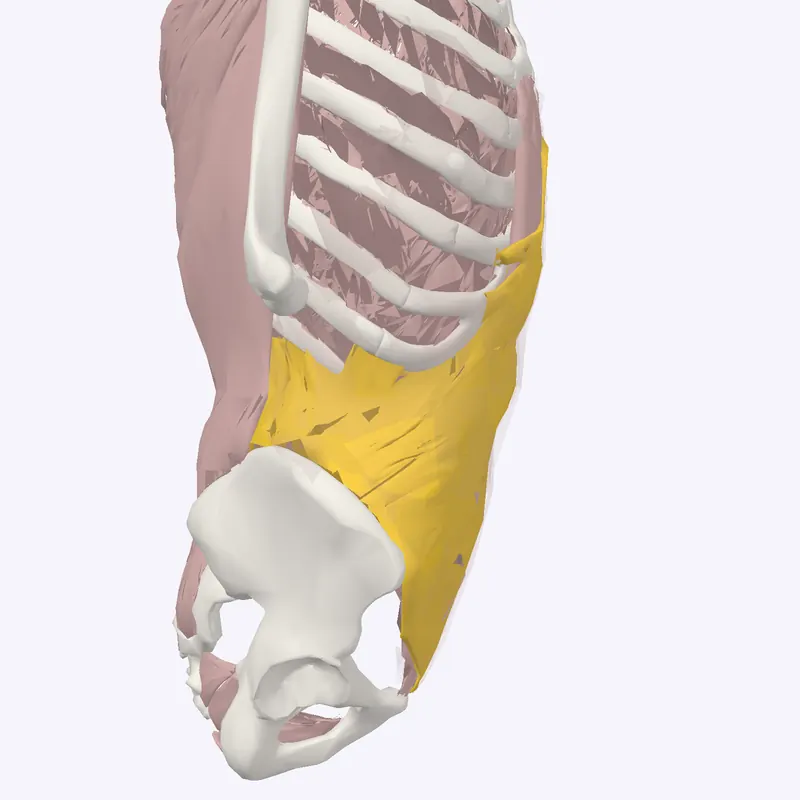
Quick facts
- Latin name
- Musculus obliquus internus abdominis
- Also called
- Abdominal internal oblique muscle
- Muscle group
- Abdominal muscles
- Body region
- Trunk
- Bones it attaches to
- Hip bone, Lumbar vertebrae, Ribs
Internal oblique: origin and insertion
- Origin
- Thoracolumbar fascia, front two-thirds of the iliac crest and the lateral half of the inguinal ligament.
- Insertion
- Lower borders of ribs 10–12, the linea alba, and the pubic crest and pecten pubis through the conjoint tendon.
Internal oblique: function and action
Flexes the trunk and bends it to the same side; turns the trunk to the same side; compresses the abdomen.
- Trunk flexion Synergist
- Trunk extension Antagonist
- Trunk lateral flexion Prime mover
- Trunk rotation Prime mover
Internal oblique: nerve supply (innervation)
Thoraco-abdominal nerves (T7–T11), subcostal nerve (T12), iliohypogastric and ilioinguinal nerves (L1).
Internal oblique: blood supply
Lower posterior intercostal and subcostal arteries; superior and inferior epigastric and deep circumflex iliac arteries.
3D views
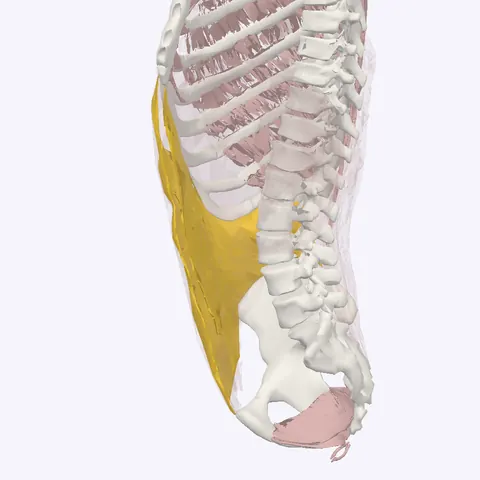
Watch the video guide
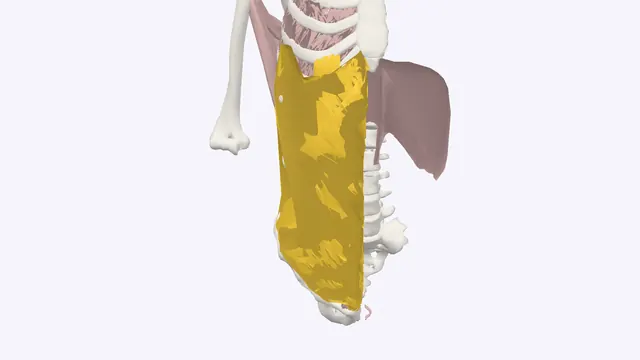
Internal oblique: stretch
Lying on your back, knees bent, let both knees drop to one side.
Internal oblique: exercises to strengthen it
Side plank, Pallof press, bicycle crunch.
Questions about the internal oblique
How do you strengthen the internal oblique?
Side plank, Pallof press, bicycle crunch.
Where does the internal oblique attach?
It arises from: Thoracolumbar fascia, front two-thirds of the iliac crest and the lateral half of the inguinal ligament. It inserts into: Lower borders of ribs 10–12, the linea alba, and the pubic crest and pecten pubis through the conjoint tendon.
What does the internal oblique do?
Flexes the trunk and bends it to the same side; turns the trunk to the same side; compresses the abdomen.
How do you stretch the internal oblique?
Lying on your back, knees bent, let both knees drop to one side.
See the internal oblique in 3D
Peel the layers, spin the model, quiz yourself on it and stand it on your desk in AR. AnatomyCompass is coming to iPhone, iPad and Mac: get one email when it’s out.
Other muscles in this group: Abdominal muscles
Spotted something wrong? Tell us and we’ll fix it. This page is a study reference, not medical advice.