 AnatomyCompass
Splenius cervicis
Musculus splenius cervicis · Back of the neck muscles · Head and neck
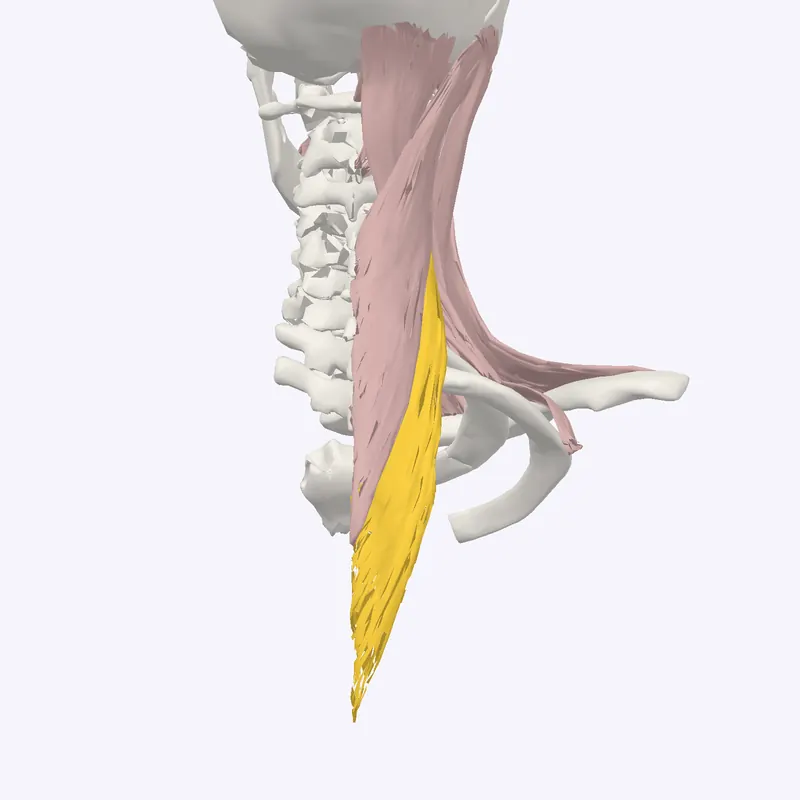
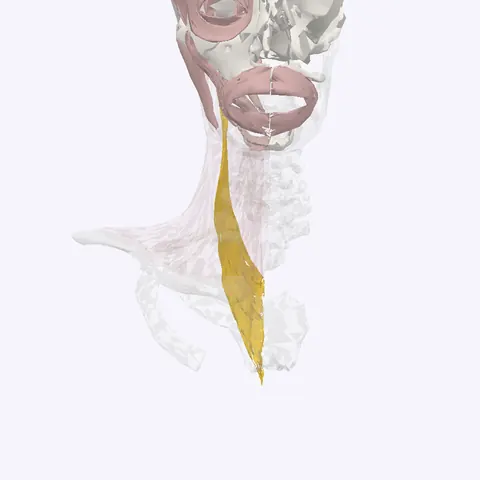
Splenius cervicis (Musculus splenius cervicis) is one of the back of the neck muscles. Below: its origin and insertion, what it does, its nerve and blood supply, how to find it, a stretch and an exercise, with 3D views.
Quick facts
- Latin name
- Musculus splenius cervicis
- Muscle group
- Back of the neck muscles
- Body region
- Head and neck
- Movements
- Neck flexion, Neck extension, Neck rotation
- Bones it attaches to
- Thoracic vertebrae, Atlas, Cervical vertebrae
Splenius cervicis: origin and insertion
- Origin
- Spinous processes of T3–T6.
- Insertion
- Posterior tubercles of the transverse processes of C1–C3.
Splenius cervicis: nerve supply (innervation)
Posterior rami of the lower cervical nerves.
Splenius cervicis: function and action
Both sides: extend the neck. One side: bends the neck to the same side and turns it to the same side.
- Neck flexion Antagonist
- Neck extension Prime mover
- Neck rotation Synergist
Splenius cervicis: blood supply
Occipital and transverse cervical arteries.
3D views
Splenius cervicis: stretch
Tuck the chin, then bring the nose towards the opposite armpit.
Questions about the splenius cervicis
Where does the splenius cervicis attach?
It arises from: Spinous processes of T3–T6. It inserts into: Posterior tubercles of the transverse processes of C1–C3.
How do you stretch the splenius cervicis?
Tuck the chin, then bring the nose towards the opposite armpit.
Which nerve supplies the splenius cervicis?
Posterior rami of the lower cervical nerves.
What does the splenius cervicis do?
Both sides: extend the neck. One side: bends the neck to the same side and turns it to the same side.
See the splenius cervicis in 3D
Peel the layers, spin the model, quiz yourself on it and stand it on your desk in AR. AnatomyCompass is coming to iPhone, iPad and Mac: get one email when it’s out.
Other muscles in this group: Back of the neck muscles
Spotted something wrong? Tell us and we’ll fix it. This page is a study reference, not medical advice.