 AnatomyCompass
Oculomotor nerve
Nervus oculomotorius · Head and neck · Nerve
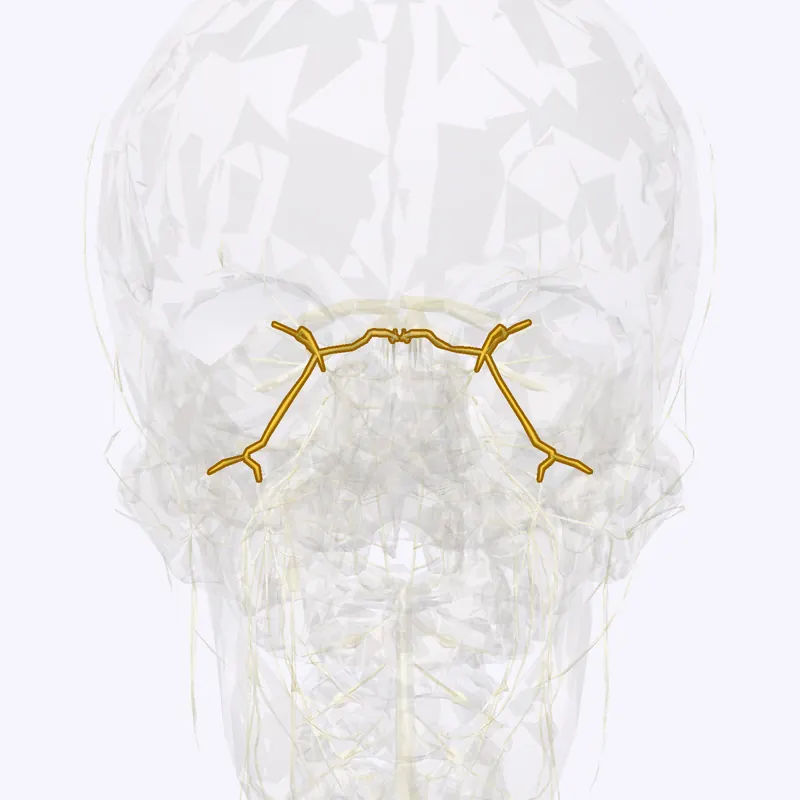
Moves most of the eye muscles, lifts the eyelid and constricts the pupil.
Quick facts
- Latin name
- Nervus oculomotorius
- Also called
- cranial nerve III
- Type
- Nerve
- Body area
- Head and neck
Oculomotor nerve: roots
Oculomotor and Edinger–Westphal nuclei in the midbrain.
Oculomotor nerve: course
Out into the interpeduncular fossa, between the posterior cerebral and superior cerebellar arteries, through the lateral wall of the cavernous sinus and the superior orbital fissure; divides into superior and inferior branches.
Oculomotor nerve: motor
Superior, inferior and medial recti, inferior oblique, levator palpebrae superioris; parasympathetic to sphincter pupillae and ciliary muscle (via the ciliary ganglion).
Oculomotor nerve: sensory
None.
Oculomotor nerve: injury sign
Eye 'down and out', drooping lid, dilated pupil that doesn't react.
3D views
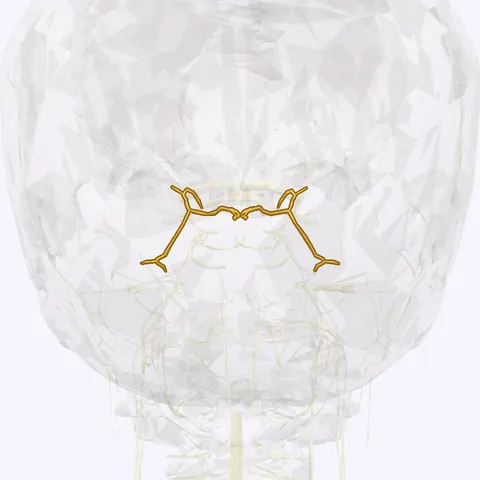
Oculomotor nerve: clinical note
A painful third nerve palsy with a dilated pupil suggests a compressing aneurysm (posterior communicating artery) until proved otherwise.
Muscles supplied by the oculomotor nerve
- Superior rectusOculomotor nerve (CN III), superior branch
- Inferior rectusOculomotor nerve (CN III), inferior branch
- Medial rectusOculomotor nerve (CN III), inferior branch
- Inferior obliqueOculomotor nerve (CN III), inferior branch
- Levator palpebrae superiorisOculomotor nerve (CN III), superior branch; the superior tarsal muscle is sympathetic
Questions about the oculomotor nerve
What is the oculomotor nerve?
Moves most of the eye muscles, lifts the eyelid and constricts the pupil.
See the oculomotor nerve in 3D
Peel the layers, spin the model, quiz yourself on it and stand it on your desk in AR. AnatomyCompass is coming to iPhone, iPad and Mac: get one email when it’s out.
Other nerves: head and neck
Spotted something wrong? Tell us and we’ll fix it. This page is a study reference, not medical advice.