 AnatomyCompass
Pancreas
Pancreas · Cow · Splanchnology (organs) · Digestive system
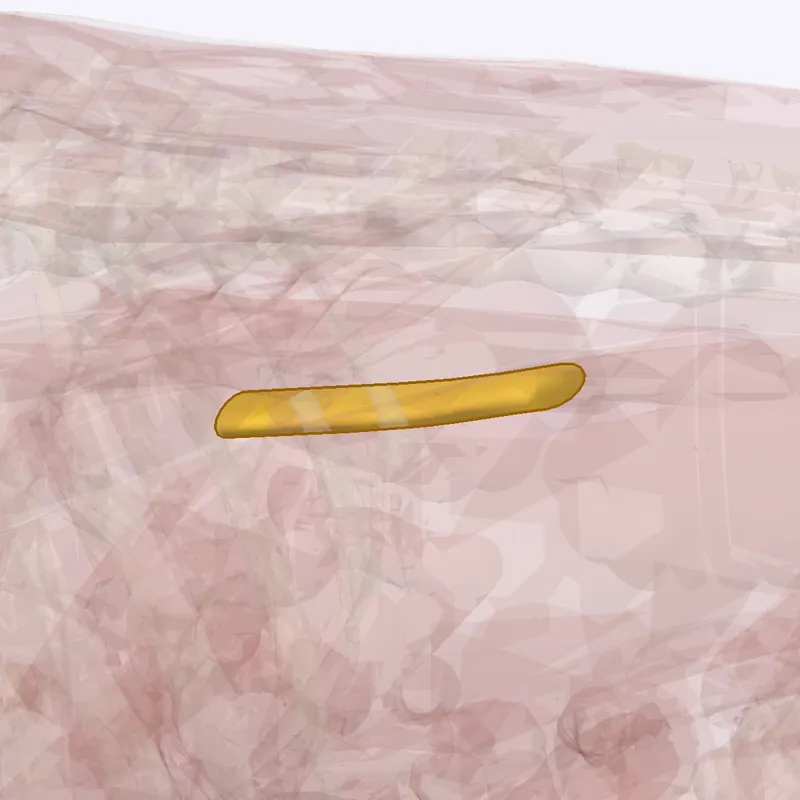
Mixed exocrine and endocrine gland in the dorsal abdomen on the right, between the duodenum, liver and rumen. In cattle its duct opens into the duodenum separately from the bile duct.
Key points
- In cattle usually only the accessory pancreatic duct persists.
- That duct opens at the minor duodenal papilla, caudal to the bile duct.
- The left lobe rests on the dorsal sac of the rumen and is partly attached to it.
- In the adult it mainly digests microbial protein and what escapes fermentation.
- Pancreatitis and pancreatic neoplasms are uncommon in cattle.
Overview
The pancreas (pancreas) is a lobulated, pale yellowish gland.
Its exocrine part produces pancreatic juice. This contains digestive enzymes and bicarbonate, which neutralises the acid contents arriving from the abomasum.
The pancreatic islets, scattered through the parenchyma, form the endocrine part, which produces insulin and glucagon.
Topography and parts
- Body. Close to the cranial part of the duodenum and the liver, next to the notch through which the portal vein passes.
- Right lobe. It extends caudally in the mesoduodenum, along the descending duodenum, on the right side of the dorsal abdomen.
- Left lobe. It crosses the median plane and rests on the dorsal sac of the rumen, to which it is partly attached.
- Pancreatic duct. In cattle usually only the accessory pancreatic duct persists. It opens at the minor duodenal papilla, caudal to the opening of the bile duct.
Function in the ruminant
Much of the dietary carbohydrate is fermented in the forestomachs before reaching the intestine. So the pancreas of the adult ruminant mainly digests microbial protein and the nutrients that escape fermentation.
In the suckling calf it digests the components of milk that reach the intestine.
Clinical relevance
- Pancreatitis and pancreatic neoplasms are uncommon in cattle.
- Diabetes mellitus is rare. It has been linked to islet destruction in some viral infections, such as bovine viral diarrhoea and foot-and-mouth disease.
- In some regions the fluke Eurytrema pancreaticum lives in the pancreatic ducts and can cause fibrosis.
- In a right flank laparotomy it lies deep, next to the descending duodenum. Adhesions from peritonitis or nearby abscesses can involve it.
Related structures
See it in 3D on your iPhone
Peel the layers, spin the model, quiz yourself on it and stand it on your desk in AR. AnatomyCompass is coming to iPhone, iPad and Mac: get one email when it’s out.
More of the Cow: Splanchnology (organs)
Text adapted from Vet Atlas (CC BY-SA 4.0). 3D model: Vet Atlas procedural organs (CC BY-SA 4.0). Sources and licences. This veterinary text has not yet been reviewed by a veterinarian.