 AnatomyCompass
Reticulum
Reticulum · Cow · Splanchnology (organs) · Digestive system
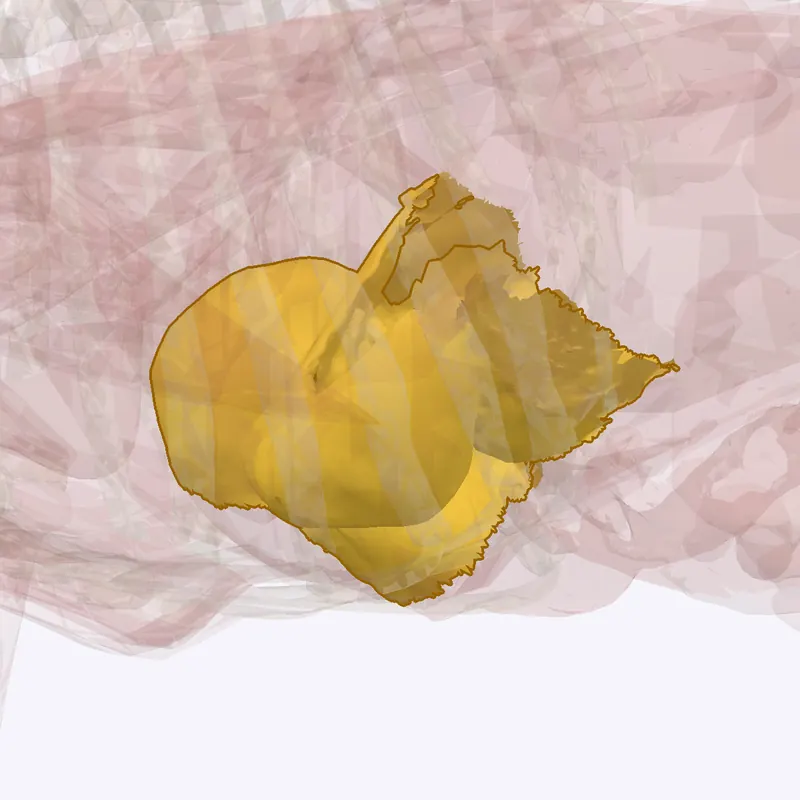
The most cranial forestomach and the smallest in the adult. It lies against the diaphragm opposite the 6th to 8th ribs, separated from the heart and liver only by the diaphragm; its mucosa forms honeycomb cells.
Key points
- Sucking closes the reticular groove, which carries milk to the omasum and abomasum.
- If that reflex fails, milk ferments in the rumen and causes ruminal acidosis in the calf.
- In traumatic reticuloperitonitis metal objects penetrate almost always cranioventrally.
- A pain grunt when the withers are pinched or the ventral cranial abdomen pressed is typical.
- Oral magnets settle in the reticulum and hold ferrous objects.
Overview
The reticulum (reticulum) forms the reticulorumen with the rumen, a functional unit where the contents are mixed and fermented.
It lies ventrally in the cranial abdomen, mostly left of the median plane. It rests against the abdominal surface of the diaphragm, opposite the 6th to 8th ribs.
Its relations are:
- cranially, on the other side of the diaphragm, the heart and pericardium
- to the right, the liver and omasum
- caudally, the ruminal atrium, from which the ruminoreticular fold separates it
Mucosa and openings
- Honeycomb mucosa. Mucosal crests (cristae reticuli) outline polygonal cells (cellulae reticuli), subdivided by smaller crests bearing horny papillae.
- Cardia. The esophagus opens at the junction of the reticulum and the ruminal atrium.
- Reticulo-omasal orifice. In the right wall. It only lets small, well-fermented particles pass on to the omasum.
- Reticular groove (sulcus reticuli). Channel with two lips running from the cardia to the reticulo-omasal orifice along the right wall of the reticulum.
Reticular groove in the calf
In the suckling calf, sucking triggers a reflex that closes the lips of the reticular groove into a tube.
Milk thus passes from the esophagus to the omasum and abomasum without entering the rumen.
If the reflex fails, for example with bucket feeding or forced tube feeding, milk ferments in the rumen and causes ruminal acidosis in the calf.
Clinical relevance
Traumatic reticuloperitonitis
Also called "hardware disease". Metal objects swallowed with the feed collect in the reticulum. Its contractions drive them into its wall, almost always cranioventrally.
They cause local or diffuse peritonitis and can reach the diaphragm, liver, spleen or pericardium.
Signs:
- anorexia
- a sudden drop in milk yield
- fever
- an arched back and reluctance to move
- a pain grunt when the withers are pinched or the ventral cranial abdomen is pressed
Traumatic pericarditis
If the foreign body crosses the diaphragm, it reaches the pericardium. It causes:
- muffled heart sounds
- splashing or friction sounds
- jugular distension
- brisket oedema
Prevention and diagnosis
Magnets given by mouth settle in the reticulum and hold ferrous objects.
Radiography and ultrasound of the reticulum, through the ventral thoracic wall, show the foreign body, adhesions and motility.
Vagal indigestion
Adhesions and abscesses from reticuloperitonitis can damage the vagus nerve and impair the passage of forestomach contents.
Diseases
- Ruminal tympanyDistension of the reticulorumen by fermentation gas that the animal cannot eructate. It can be frothy or…
- Traumatic reticuloperitonitisPerforation of the reticular wall by a metallic foreign body swallowed with the feed, causing local or…
Related structures
See it in 3D on your iPhone
Peel the layers, spin the model, quiz yourself on it and stand it on your desk in AR. AnatomyCompass is coming to iPhone, iPad and Mac: get one email when it’s out.
More of the Cow: Splanchnology (organs)
Text adapted from Vet Atlas (CC BY-SA 4.0). 3D model: "Bovine Rumen" by OVCanatomy, Ontario Veterinary College (Sketchfab) (CC BY 4.0). Sources and licences. This veterinary text has not yet been reviewed by a veterinarian.