 AnatomyCompass
Small intestine
Intestinum tenue · Cow · Splanchnology (organs) · Digestive system
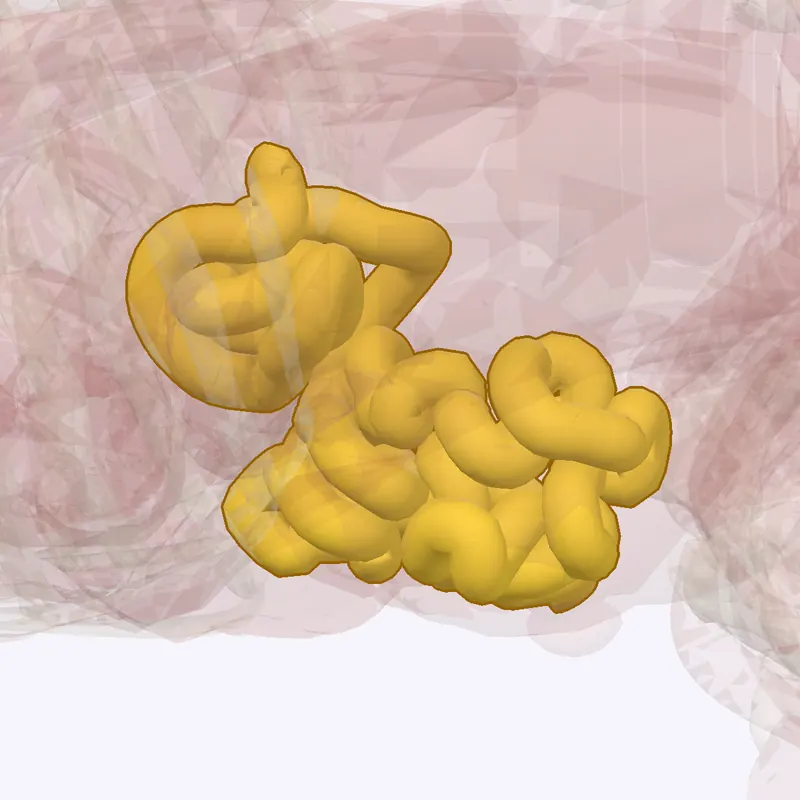
Long part of the digestive tube between the pylorus and the ileal orifice. In cattle it lies mostly in the right half of the abdomen, in the supraomental recess, because the rumen fills the left.
Key points
- The descending duodenum runs along the right flank to the caudal flexure, near the tuber coxae.
- The jejunal coils sit in the supraomental recess, which is open caudally.
- Intussusception is resolved through a right flank laparotomy.
- In paratuberculosis the ileum and ileocaecal lymph nodes are sampled for diagnosis.
- In neonatal calf diarrhoea, dehydration and acidosis are the main causes of death.
Overview
The bovine small intestine (intestinum tenue) is very long and narrow.
It receives acid contents from the abomasum and neutralises them with bile and pancreatic juice. It then digests and absorbs microbial protein, lipids and the carbohydrates that escaped ruminal fermentation.
Because the rumen fills the left half, almost all the loops lie right of the median plane.
Duodenum
- The cranial part leaves the pylorus next to the liver and forms a sigmoid loop.
- The descending duodenum runs dorsally along the right flank to the caudal flexure, near the tuber coxae.
- The ascending duodenum returns cranially, attached to the descending colon by the duodenocolic fold.
The bile duct and, further caudally, the pancreatic duct open into the duodenum.
Jejunum
It is the longest part. Its many coils hang from the edge of the mesentery, around the disc of the spiral colon.
They sit in the supraomental recess (recessus supraomentalis), the space enclosed laterally and ventrally by the greater omentum and open caudally.
The jejunal lymph nodes form a long chain in the mesentery.
Ileum
Short final segment, attached to the caecum by the ileocaecal fold. It opens at the junction of the caecum and colon through the ileal orifice.
Clinical relevance
- Intussusception. Mostly of the jejunum, in calves and adults. It causes abdominal pain followed by scant faeces with mucus and dark blood. The distended loops can be palpated per rectum or seen by ultrasound on the right flank. It is resolved through a right flank laparotomy.
- Haemorrhagic bowel syndrome, or jejunal haemorrhage syndrome. Intraluminal bleeding with clots that obstruct the jejunum, in adult dairy cows. It has been linked to Clostridium perfringens type A. The prognosis is guarded.
- Paratuberculosis, or Johne's disease. Mycobacterium avium subsp. paratuberculosis thickens and folds the ileal mucosa and causes chronic diarrhoea and weight loss in adults. The ileum and ileocaecal lymph nodes are sampled for diagnosis.
- Neonatal calf diarrhoea. Enterotoxigenic Escherichia coli, rotavirus, coronavirus and Cryptosporidium parvum damage the villi. Dehydration and acidosis are the main causes of death.
- Mesenteric volvulus. Twisting of the loops around the root of the mesentery cuts off the blood supply and requires urgent surgery.
Diseases
- Neonatal calf diarrhoeaDiarrhoea of calves in their first month of life caused by rotavirus, coronavirus, Cryptosporidium parvum and…
- Bovine viral diarrhoeaPestivirus infection that causes immunosuppression, reproductive losses, congenital malformations and…
- Paratuberculosis (Johne's disease)Chronic granulomatous enteritis caused by Mycobacterium avium subsp. paratuberculosis. Calves are infected in…
Related structures
See it in 3D on your iPhone
Peel the layers, spin the model, quiz yourself on it and stand it on your desk in AR. AnatomyCompass is coming to iPhone, iPad and Mac: get one email when it’s out.
More of the Cow: Splanchnology (organs)
Text adapted from Vet Atlas (CC BY-SA 4.0). 3D model: Vet Atlas procedural organs (CC BY-SA 4.0). Sources and licences. This veterinary text has not yet been reviewed by a veterinarian.