 AnatomyCompass
Axis
Axis · Horse · Skeletal system · Axial skeleton
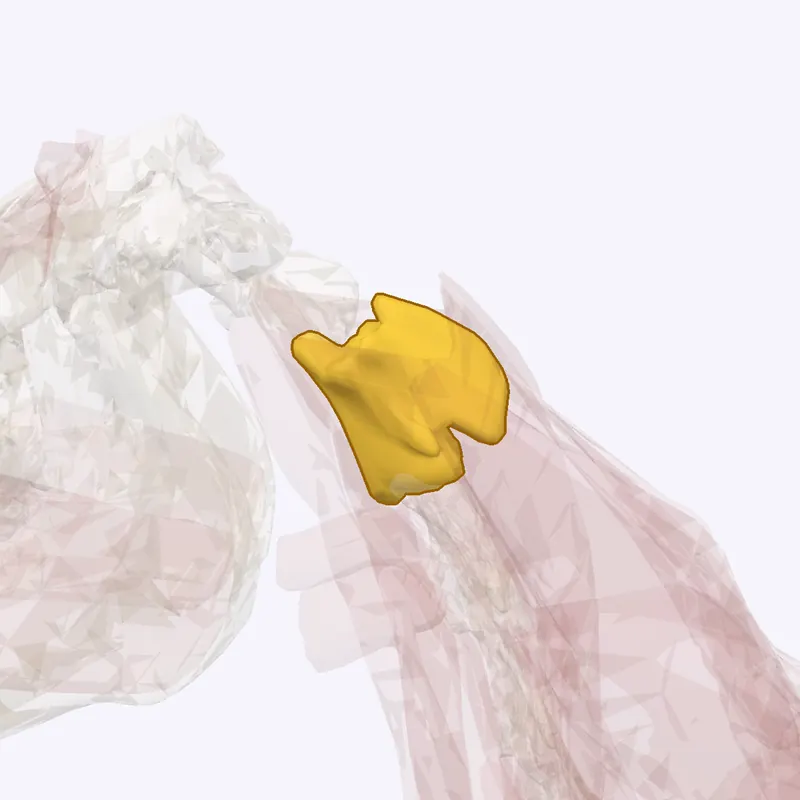
The second cervical vertebra, the longest in the horse's spine. Its broad, spade-shaped dens fits into the atlas and is the pivot for rotation of the head.
Key points
- The atlas, and with it the head, rotates around the dens.
- In the horse the dens is spade-shaped, not cylindrical as in the dog.
- The longitudinal ligament of the dens binds it firmly to the atlas.
- Its fractures occur mainly in foals and involve the dens or its physis.
Overview
The axis (axis) is the second cervical vertebra and the longest of the equine spine.
Its characteristic feature is the dens, a cranial projection of the body that sits in the ventral arch of the atlas. The atlas, and with it the head, rotates around it at the atlantoaxial joint.
Key features
- Dens. In the horse it is broad and spade-shaped, concave dorsally, rather than cylindrical as in the dog. A strong longitudinal ligament of the dens attaches it to the atlas.
- Spinous process. A long, high crest that widens caudally. It gives attachment to the nuchal ligament and neck muscles.
- Body. Long, with a marked ventral crest and a broad cranial head that continues into the dens.
- Transverse processes. Small and directed caudally, pierced by the transverse foramen.
- Caudal articular processes. They articulate with the third cervical vertebra.
Clinical relevance
- Fractures of the axis. Seen mainly in foals after falls or blows to the head. They usually involve the dens or the physis between the dens and the body, and can compress the spinal cord.
- Cervical stenotic myelopathy (wobbler syndrome). It affects the cervical vertebrae caudal to the axis, but radiographic examination of the neck always includes it.
Related structures
See it in 3D on your iPhone
Peel the layers, spin the model, quiz yourself on it and stand it on your desk in AR. AnatomyCompass is coming to iPhone, iPad and Mac: get one email when it’s out.
More of the Horse: Skeletal system
Text adapted from Vet Atlas (CC BY-SA 4.0). 3D model: "Horse Skeleton" by Diego Luján García (diegoluga on Sketchfab) (CC BY 4.0). Sources and licences. This veterinary text has not yet been reviewed by a veterinarian.