 AnatomyCompass
Thoracic vertebrae
Vertebrae thoracicae · Horse · Skeletal system · Axial skeleton
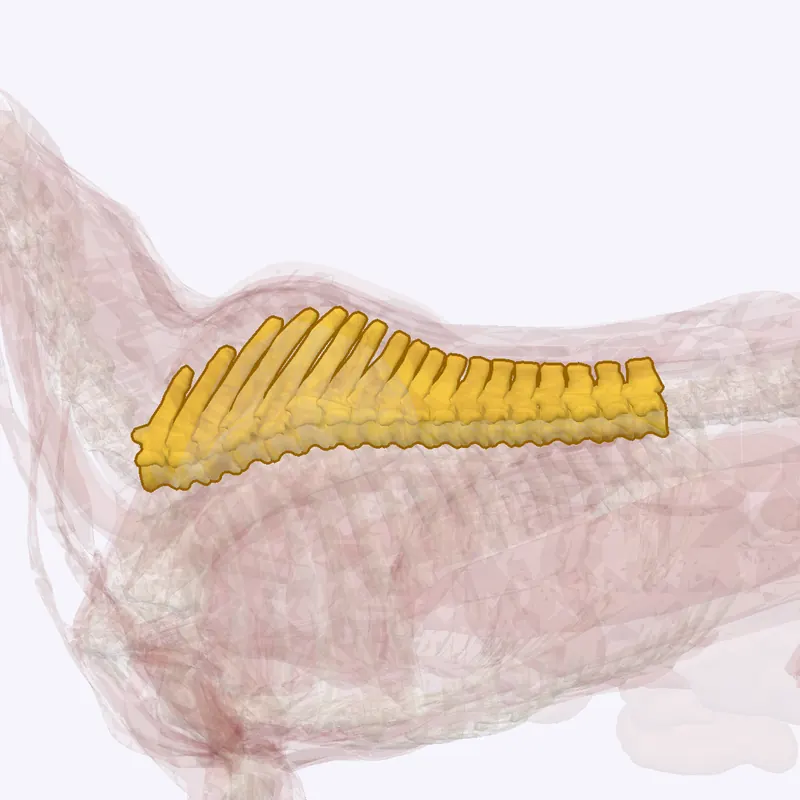
The eighteen vertebrae of the back, each articulating with a pair of ribs. The spinous processes of the first ones form the withers, and those of the last ones, under the saddle, can come into contact.
Key points
- The longest spinous processes, around T3–T5, form the highest point of the withers.
- The anticlinal vertebra is T16, with a vertical spinous process.
- The head of each rib articulates with two consecutive vertebrae.
- Overriding spinous processes, mainly between T13 and T18, are also found in horses without signs.
- Infection of the supraspinous bursa causes fistulous withers.
Overview
The horse has eighteen thoracic vertebrae, more than cattle (13) or the dog (13). Its vertebral formula is C7, T18, L6, S5, Cd15–21.
Together with the ribs and the sternum they form the rib cage.
Their spinous processes are long in the cranial part and form the withers, the bony base of the interscapular region. From there they shorten progressively towards the lumbar region, where the saddle sits.
Key features
- Body (corpus vertebrae). Short, with cranial and caudal costal foveae. The head of each rib articulates with two consecutive vertebrae.
- Spinous processes. The longest are around T3–T5 and form the highest point of the withers. Their tips are cartilaginous in the foal and ossify slowly. They slope caudally as far as the anticlinal vertebra (T16), whose process is vertical. The following ones slope cranially, like the lumbar ones.
- Transverse processes. Short, with a transverse costal fovea for the tubercle of the rib of the same number. In the last thoracic vertebrae they carry mamillary processes.
- Supraspinous ligament. Joins the tips of the spinous processes. At the withers the supraspinous bursa separates it from the bone.
- Mobility. The thoracic back of the horse is not very flexible. Most dorsoventral flexion takes place at the lumbosacral joint.
Clinical relevance
- Overriding spinous processes (kissing spines). Under the saddle, mainly between T13 and T18, the spinous processes lie too close, touch or overlap. It is a recognised cause of back pain, although the radiographic changes are also found in horses without signs.
- Fistulous withers. Inflammation and infection of the supraspinous bursa, with draining tracts at the withers. Historically associated with Brucella abortus.
- Fractures of the withers. They affect the spinous processes of the first thoracic vertebrae, in horses that rear and fall over backwards.
- Saddle fit. A saddle that presses on the withers or on the area of the last thoracic vertebrae causes pain, skin lesions and gait changes.
Related structures
See it in 3D on your iPhone
Peel the layers, spin the model, quiz yourself on it and stand it on your desk in AR. AnatomyCompass is coming to iPhone, iPad and Mac: get one email when it’s out.
More of the Horse: Skeletal system
Text adapted from Vet Atlas (CC BY-SA 4.0). 3D model: "Horse Skeleton" by Diego Luján García (diegoluga on Sketchfab) (CC BY 4.0). Sources and licences. This veterinary text has not yet been reviewed by a veterinarian.