 AnatomyCompass
Cervical vertebrae III–VII
Vertebrae cervicales III–VII · Horse · Skeletal system · Axial skeleton
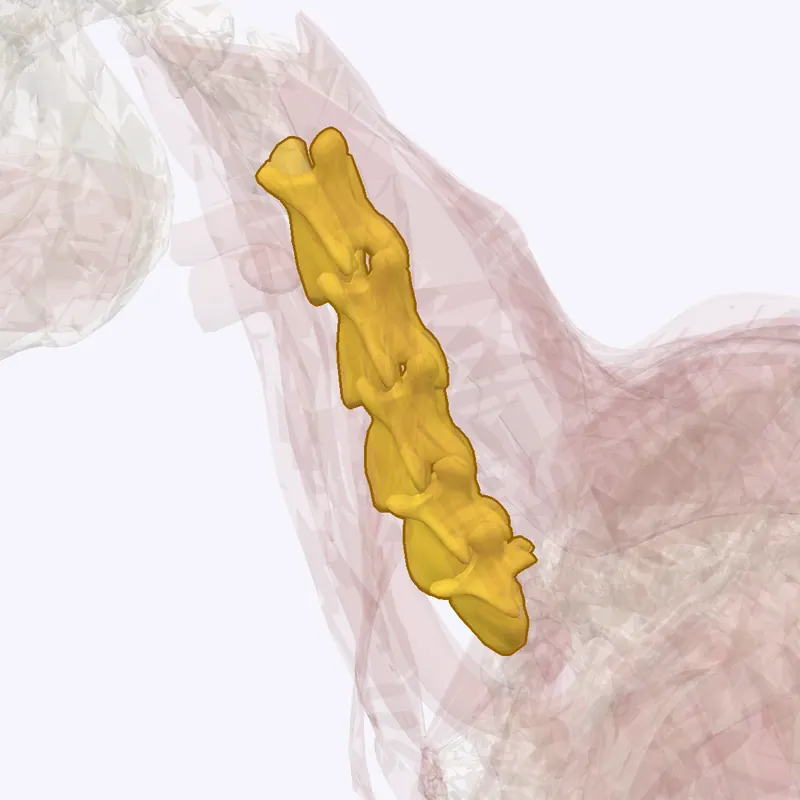
The five neck vertebrae caudal to the axis. In the horse they are long, with hardly any spinous processes except on the seventh, and they are the seat of cervical stenotic myelopathy.
Key points
- The equine vertebral formula is C7, T18, L6, S5, Cd15–21.
- The transverse processes of C6 carry a broad ventral lamina.
- C7 has no transverse foramen and has a caudal costal fovea for the first rib.
- Cervical stenotic myelopathy causes symmetrical ataxia, worse in the pelvic limbs.
- In the youngest horses compression is usually dynamic (C3–C5); in somewhat older ones, static (C5–C7).
Overview
The horse has seven cervical vertebrae. Its vertebral formula is C7, T18, L6, S5, Cd15–21. The typical ones, the third to seventh, are described here.
They are long and robust. They form the base of the long, mobile neck that the horse uses for grazing and for balancing the body in motion.
The cervical spine describes an S-shaped curve: it descends from the poll and rises again at the thoracic inlet.
Key features
- Body (corpus vertebrae). Long, with a convex cranial head and a concave caudal fossa, joined by intervertebral discs. Ventrally it carries a marked ventral crest.
- Spinous processes. Almost absent from C3 to C6, reduced to a low ridge. The nuchal ligament takes over their role in supporting the head. C7 has a short but distinct spinous process.
- Transverse processes. Divided into two tubercles and pierced by the transverse foramen, through which the vertebral artery and vein run. On C6 they carry a broad ventral lamina, sometimes palpable at the base of the neck.
- Articular processes. Large, with wide, almost horizontal surfaces that allow great lateral and dorsoventral mobility.
- C7. Lacks a transverse foramen and has a caudal costal fovea for the head of the first rib.
Clinical relevance
- Cervical stenotic myelopathy (wobbler syndrome). Compression of the spinal cord by stenosis of the vertebral canal, vertebral malformation or osteoarthritis of the articular processes. It causes symmetrical ataxia, worse in the pelvic limbs. It is most common in fast-growing young males, such as Thoroughbreds and sport horses. In the youngest animals compression is usually dynamic at the cranial segments (C3–C5); in somewhat older ones, static at the caudal segments (C5–C7).
- Osteoarthritis of the articular processes. In adult horses, mainly between C5 and C7. It causes neck stiffness and pain and can compress nerve roots.
- Intramuscular injections in the neck. Given in the triangle bounded by the nuchal ligament dorsally, the cervical vertebrae ventrally and the scapula caudally. This avoids the vertebrae and the ligament.
Diseases
- Cervical spondylomyelopathy (wobbler syndrome)Compression of the caudal cervical spinal cord and nerve roots by disc protrusion, ligament hypertrophy or…
Related structures
See it in 3D on your iPhone
Peel the layers, spin the model, quiz yourself on it and stand it on your desk in AR. AnatomyCompass is coming to iPhone, iPad and Mac: get one email when it’s out.
More of the Horse: Skeletal system
Text adapted from Vet Atlas (CC BY-SA 4.0). 3D model: "Horse Skeleton" by Diego Luján García (diegoluga on Sketchfab) (CC BY 4.0). Sources and licences. This veterinary text has not yet been reviewed by a veterinarian.