Femoral artery
Arteria femoralis · Lower limb · Artery
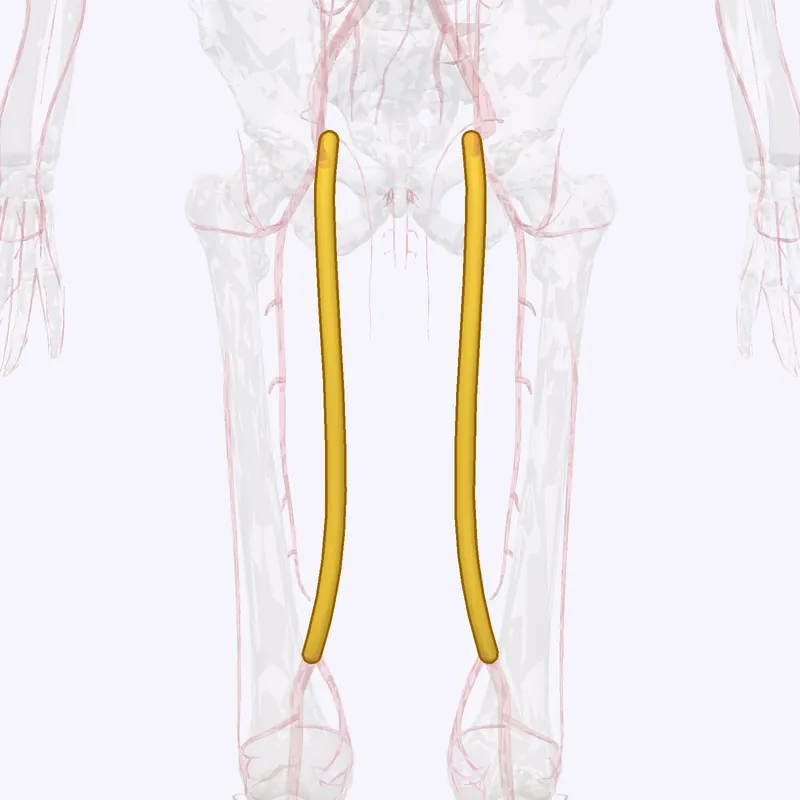
The main artery of the thigh, from the inguinal ligament to the adductor hiatus.
Quick facts
- Latin name
- Arteria femoralis
- Type
- Artery
- Body area
- Lower limb
Femoral artery: origin
Continues the external iliac artery behind the inguinal ligament at the mid-inguinal point.
Femoral artery: course
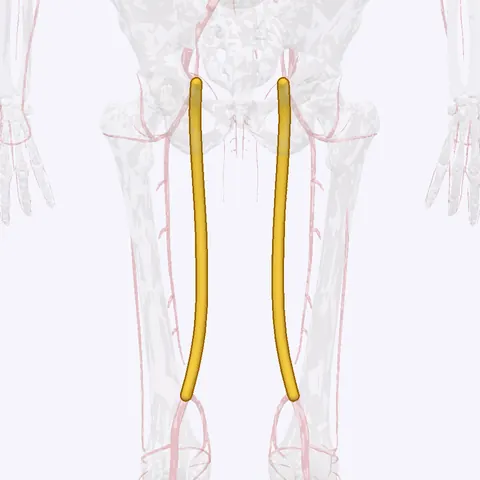
Down the femoral triangle (vein medial, nerve lateral), then through the adductor canal under sartorius to the adductor hiatus.
Femoral artery: branches
Superficial epigastric, superficial circumflex iliac, external pudendal, deep femoral (profunda femoris), descending genicular.
Femoral artery: supplies
Lower abdominal wall skin, external genitalia, and the whole lower limb.
3D views
Femoral artery: clinical note
The femoral pulse at the mid-inguinal point; the usual access for angiography.
Muscles fed by the femoral artery
- Quadratus femorisMedial circumflex femoral artery
- SartoriusMuscular branches of the femoral artery
- Rectus femorisLateral circumflex femoral artery
- Vastus lateralisLateral circumflex femoral artery
- Vastus medialisFemoral artery
- Vastus intermediusLateral circumflex femoral artery
- Adductor longusDeep femoral artery
- Adductor brevisDeep femoral artery
- Biceps femorisPerforating branches of the deep femoral artery
- SemitendinosusPerforating branches of the deep femoral artery
- SemimembranosusPerforating branches of the deep femoral artery
Questions about the femoral artery
What is the femoral artery?
The main artery of the thigh, from the inguinal ligament to the adductor hiatus.
What are the branches of the femoral artery?
Superficial epigastric, superficial circumflex iliac, external pudendal, deep femoral (profunda femoris), descending genicular.
See the femoral artery in 3D
Peel the layers, spin the model, quiz yourself on it and stand it on your desk in AR. AnatomyCompass is coming to iPhone, iPad and Mac: get one email when it’s out.
Other arteries: lower limb
Spotted something wrong? Tell us and we’ll fix it. This page is a study reference, not medical advice.