Maxilla
Maxilla · Head and neck · Bone
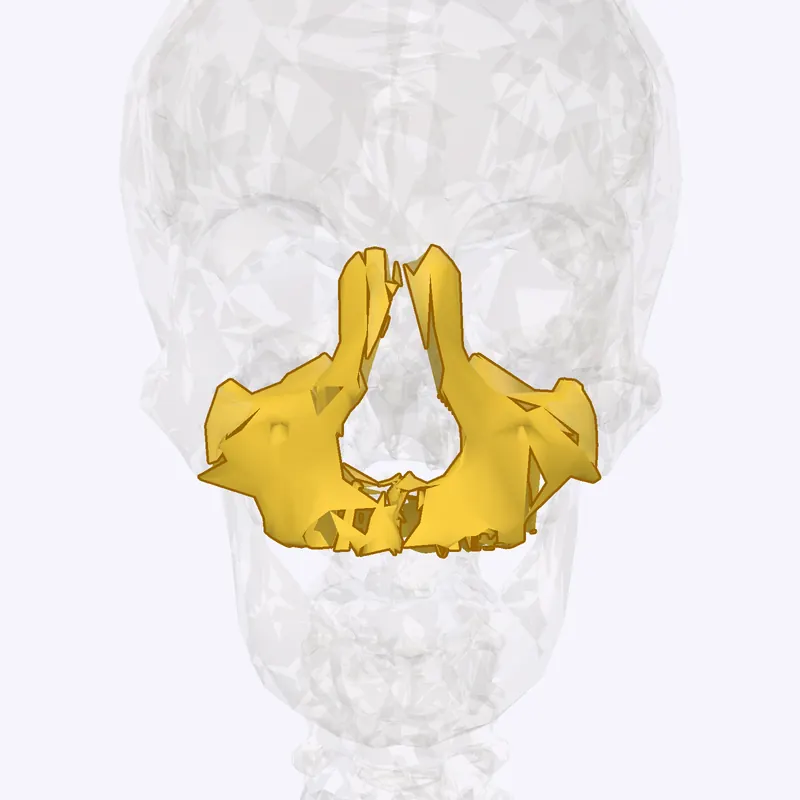
The upper jaw bone (one each side), carrying the upper teeth and forming much of the face, palate and orbit floor.
Quick facts
- Latin name
- Maxilla
- Also called
- upper jawbone, upper jaw
- Type
- Bone
- Body area
- Head and neck
Landmarks of the maxilla
- Alveolar process
- Ridge holding the upper teeth; buccinator arises over the molars.
- Infra-orbital foramen
- Below the orbit: infra-orbital nerve to the cheek and upper lip.
- Frontal process
- Rises beside the nose; orbicularis oculi arises.
- Maxillary sinus
- Largest paranasal sinus, above the upper molars.
- Maxillary tuberosity
- Back of the alveolar process: superficial head of medial pterygoid.
Joints of the maxilla
- The other maxilla
- Frontal, ethmoid, nasal, lacrimal, zygomatic, palatine bones and vomer
- Upper teeth
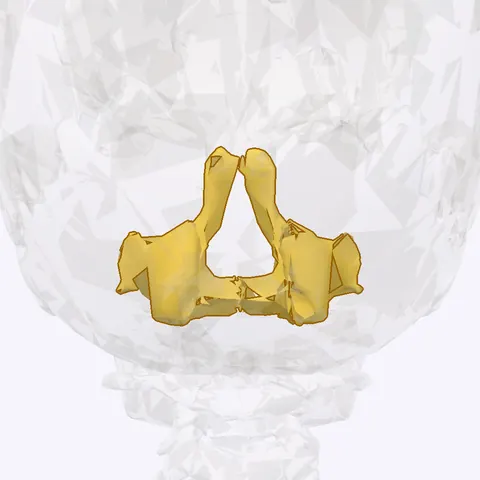
3D views
Muscles that attach to the maxilla
From the origin and insertion on each muscle’s page.
Questions about the maxilla
What is the maxilla?
The upper jaw bone (one each side), carrying the upper teeth and forming much of the face, palate and orbit floor.
See the maxilla in 3D
Peel the layers, spin the model, quiz yourself on it and stand it on your desk in AR. AnatomyCompass is coming to iPhone, iPad and Mac: get one email when it’s out.
Other bones: head and neck
Spotted something wrong? Tell us and we’ll fix it. This page is a study reference, not medical advice.