Buccinator
Musculus buccinator · Facial muscles · Head and neck
Buccinator (Musculus buccinator) is one of the facial muscles. Below: its origin and insertion, what it does and its nerve and blood supply, with 3D views.
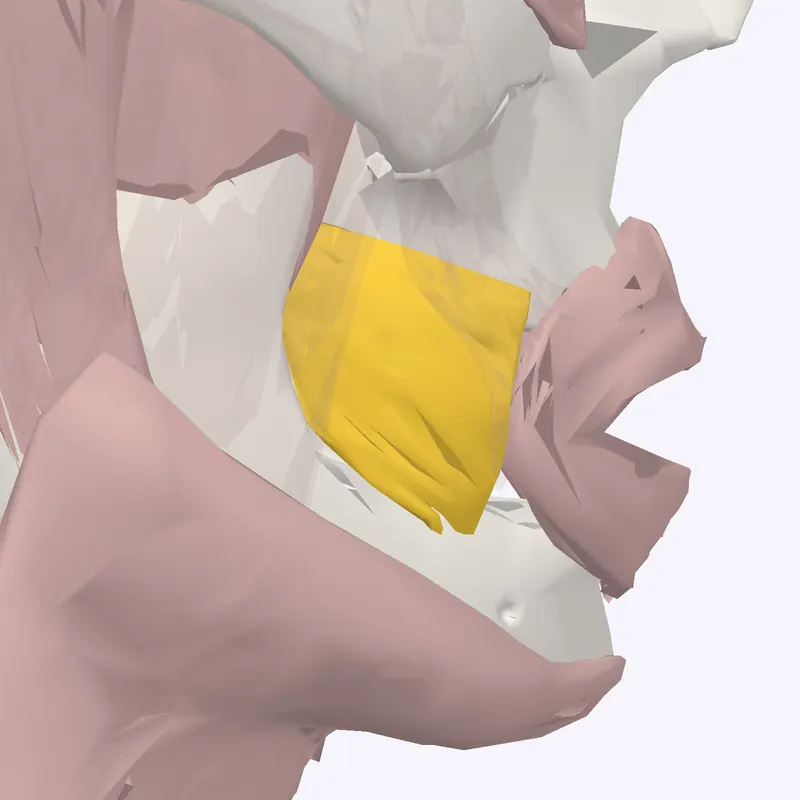
Quick facts
- Latin name
- Musculus buccinator
- Also called
- Bucinator muscle
- Muscle group
- Facial muscles
- Body region
- Head and neck
Buccinator: origin and insertion
- Origin
- Outer surfaces of the alveolar processes of the maxilla and mandible opposite the molars, and the pterygomandibular raphe.
- Insertion
- Modiolus and the lips.
Buccinator: function and action
Presses the cheek against the teeth, keeping food between them when chewing; blows air out.
Buccinator: nerve supply (innervation)
Buccal branch of the facial nerve (CN VII).
Buccinator: blood supply
Buccal artery (from the maxillary artery) and facial artery.
3D views
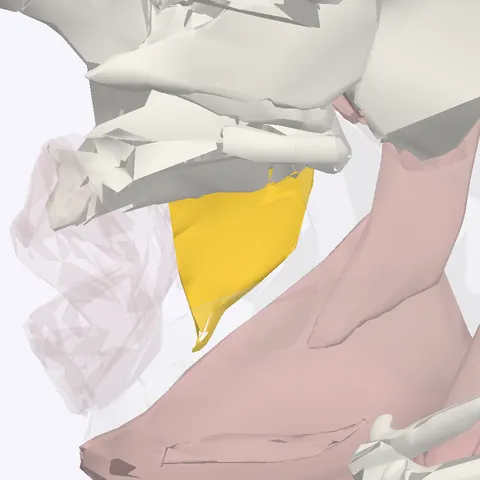
Buccinator: pain, injury and clinical notes
The parotid duct pierces it opposite the upper second molar.
Questions about the buccinator
Where does the buccinator attach?
It arises from: Outer surfaces of the alveolar processes of the maxilla and mandible opposite the molars, and the pterygomandibular raphe. It inserts into: Modiolus and the lips.
What does the buccinator do?
Presses the cheek against the teeth, keeping food between them when chewing; blows air out.
Which nerve supplies the buccinator?
Buccal branch of the facial nerve (CN VII).
What is the blood supply of the buccinator?
Buccal artery (from the maxillary artery) and facial artery.
See the buccinator in 3D
Peel the layers, spin the model, quiz yourself on it and stand it on your desk in AR. AnatomyCompass is coming to iPhone, iPad and Mac: get one email when it’s out.
Other muscles in this group: Facial muscles
Spotted something wrong? Tell us and we’ll fix it. This page is a study reference, not medical advice.