Puborectalis
Musculus puborectalis · Pelvic floor muscles · Trunk
Puborectalis (Musculus puborectalis) is one of the pelvic floor muscles. Below: its origin and insertion, what it does, its nerve and blood supply, how to find it, a stretch and an exercise, with 3D views.
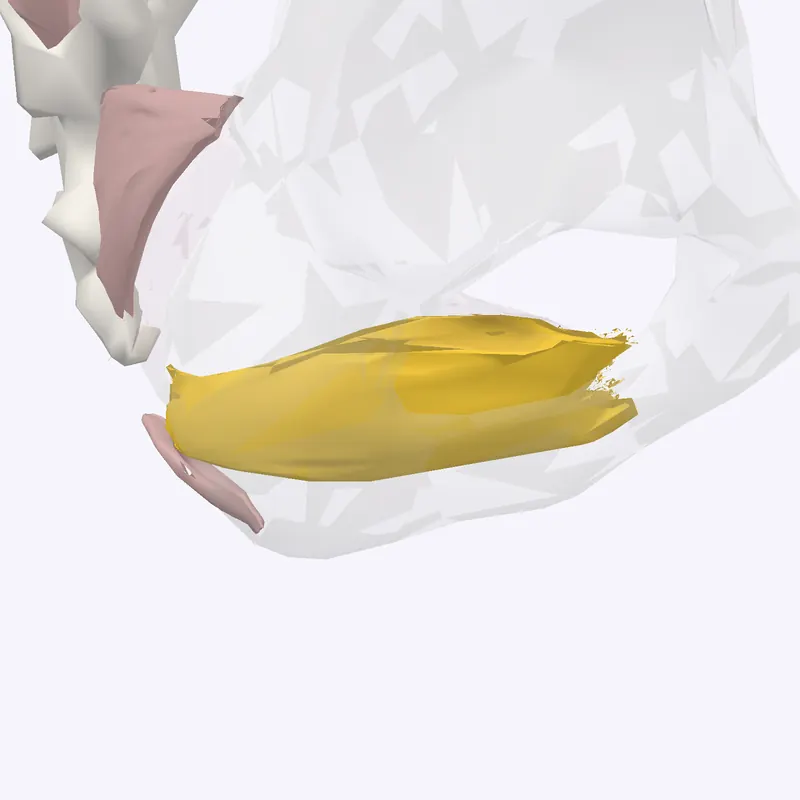
Quick facts
- Latin name
- Musculus puborectalis
- Muscle group
- Pelvic floor muscles
- Body region
- Trunk
- Movements
- Pelvic floor contraction
- Bones it attaches to
- Hip bone
Puborectalis: function and action
Pulls the anorectal junction forwards, keeping the anorectal angle (about 90°) that holds faeces in; relaxes to allow defaecation. Part of levator ani.
- Pelvic floor contraction Prime mover
Puborectalis: origin and insertion
- Origin
- Back of the body of the pubis on both sides of the pubic symphysis.
- Insertion
- Loops behind the anorectal junction, joining its partner from the other side in a U-shaped sling (no bony insertion).
Puborectalis: nerve supply (innervation)
Nerve to levator ani (S3–S4) from the sacral plexus, with the inferior rectal branch of the pudendal nerve (S2–S4).
Puborectalis: blood supply
Inferior gluteal, inferior vesical and internal pudendal arteries (branches of the internal iliac).
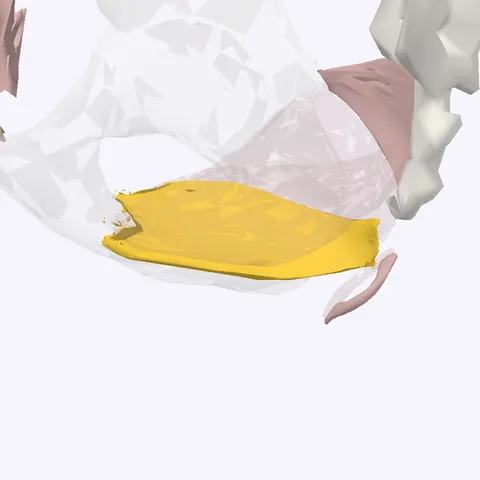
3D views
Puborectalis: exercises to strengthen it
Pelvic floor muscle training: squeeze and lift as if stopping wind and urine, hold up to 10 seconds, 10 times, plus 10 quick squeezes, three times a day.
How to find the puborectalis (palpation)
Felt on rectal examination as a firm band at the back of the anorectal junction that tightens when the patient squeezes.
Puborectalis: pain, injury and clinical notes
Failure to relax on straining (dyssynergic defaecation) causes obstructed constipation; avulsion from the pubis in childbirth is linked to prolapse.
Questions about the puborectalis
What does the puborectalis do?
Pulls the anorectal junction forwards, keeping the anorectal angle (about 90°) that holds faeces in; relaxes to allow defaecation. Part of levator ani.
How do you strengthen the puborectalis?
Pelvic floor muscle training: squeeze and lift as if stopping wind and urine, hold up to 10 seconds, 10 times, plus 10 quick squeezes, three times a day.
Where does the puborectalis attach?
It arises from: Back of the body of the pubis on both sides of the pubic symphysis. It inserts into: Loops behind the anorectal junction, joining its partner from the other side in a U-shaped sling (no bony insertion).
Which nerve supplies the puborectalis?
Nerve to levator ani (S3–S4) from the sacral plexus, with the inferior rectal branch of the pudendal nerve (S2–S4).
See the puborectalis in 3D
Peel the layers, spin the model, quiz yourself on it and stand it on your desk in AR. AnatomyCompass is coming to iPhone, iPad and Mac: get one email when it’s out.
Other muscles in this group: Pelvic floor muscles
Spotted something wrong? Tell us and we’ll fix it. This page is a study reference, not medical advice.