 AnatomyCompass
Axis
Axis · Cow · Skeletal system · Axial skeleton
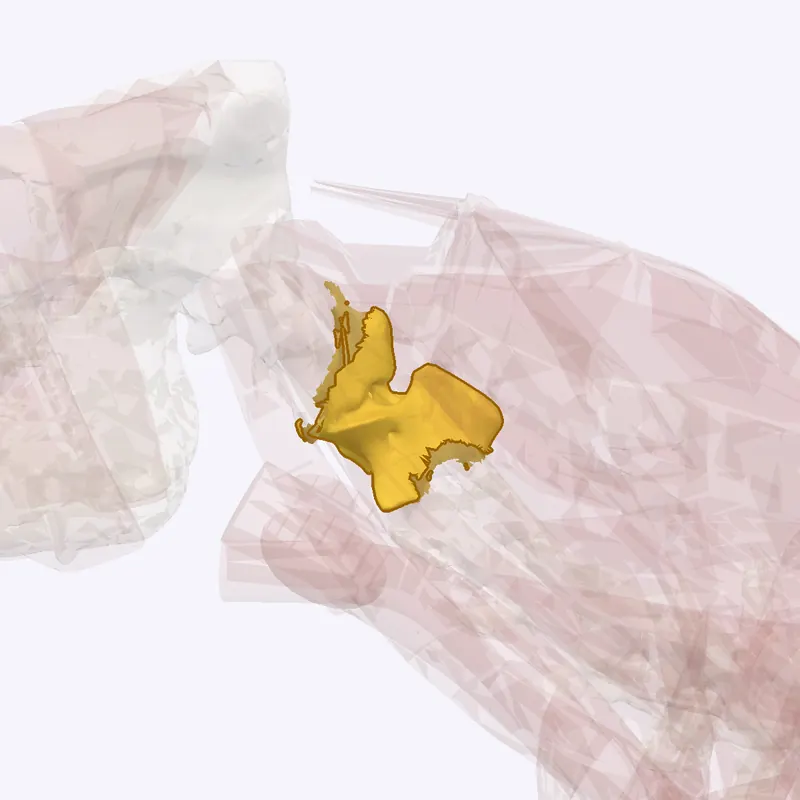
Second cervical vertebra (C2). Long body, a spout-shaped dens around which the atlas rotates, and a long crest-like spinous process.
Key points
- The dens rests in the fovea of the dens of the atlas, held by ligaments.
- In cattle, as in the horse, the dens is spout-shaped, not peg-shaped.
- The obliquus capitis caudalis originates on the spinous process.
- In calves, vertebral osteomyelitis can form cervical abscesses with stiffness and ataxia.
Overview
The axis is the second cervical vertebra.
Its body is long and extends cranially into the dens, the pivot around which the atlas rotates.
It articulates cranially with the atlas and caudally with the third cervical vertebra.
Features
- Dens. Cranial projection of the body that rests in the fovea of the dens of the atlas, held by ligaments. In cattle, as in the horse, it is spout-shaped, concave dorsally. In the dog and cat it is peg-shaped.
- Cranial articular surfaces. On each side of the dens, for the caudal foveae of the atlas.
- Spinous process. Long, shaped like a sagittal crest, thicker in its caudal part. Neck muscles such as the obliquus capitis caudalis originate on it.
- Transverse processes. Small, directed caudally.
- Caudal articular processes and fossa of the body. They articulate with the third cervical vertebra.
Clinical relevance
- Atlantoaxial joint. It concentrates the rotation of the head. Fractures of the dens and atlantoaxial luxations are rare in cattle and follow severe trauma.
- Vertebral osteomyelitis. In calves, blood-borne spread of bacteria can form abscesses in the vertebral bodies, including the cervical ones. It causes neck pain, stiffness and ataxia.
- Congenital malformations of the occipitoatlantoaxial region. Rare; described in calves.
Related structures
See it in 3D on your iPhone
Peel the layers, spin the model, quiz yourself on it and stand it on your desk in AR. AnatomyCompass is coming to iPhone, iPad and Mac: get one email when it’s out.
More of the Cow: Skeletal system
Text adapted from Vet Atlas (CC BY-SA 4.0). 3D model: "Skelet jonge koe | skeleton young cow (800-1000)" by Archeologiemuseum Huis van Hilde (Sketchfab) (CC BY-SA 4.0). Sources and licences. This veterinary text has not yet been reviewed by a veterinarian.