 AnatomyCompass
Sternum
Sternum · Cow · Skeletal system · Axial skeleton
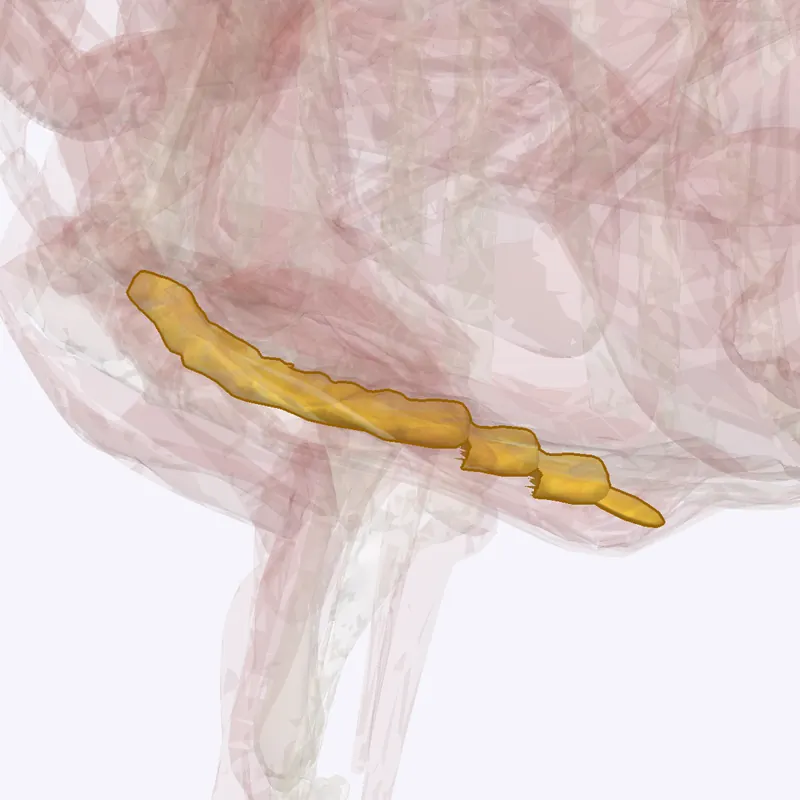
Unpaired bone of the floor of the thorax, formed in cattle by seven sternebrae. It receives the cartilages of the eight pairs of sternal ribs.
Key points
- Unlike the keel of the horse, the bovine sternum is broad and flat.
- The manubrium does not fuse with the body; the manubriosternal joint connects them.
- A downer cow should be kept in sternal recumbency so it can eructate rumen gas.
- Pressure under the xiphoid causes pain and a grunt in traumatic reticuloperitonitis.
- Brisket oedema appears in right-sided heart failure.
Overview
The sternum forms the floor of the rib cage. In cattle it consists of seven sternebrae (sternebrae):
- the first is the manubrium
- the following ones form the body
- the last is the xiphoid process
Unlike the keel-shaped sternum of the horse, the bovine sternum is broad and flattened dorsoventrally and widens caudally.
Parts
- Manubrium (manubrium sterni). First sternebra, at the thoracic inlet. The first pair of ribs articulates with it. In cattle it does not fuse with the body: a true joint, the manubriosternal joint (articulatio manubriosternalis), connects them and allows some movement.
- Body (corpus sterni). The intermediate sternebrae, joined by cartilage that ossifies with age. The cartilages of the remaining sternal ribs articulate at the costal notches, level with the spaces between sternebrae.
- Xiphoid process (processus xiphoideus). Last sternebra, extended by the xiphoid cartilage, a wide plate on which the linea alba inserts.
The pectoral muscles originate on the ventral surface of the sternum. The transversus thoracis originates on the dorsal surface.
Clinical relevance
- Sternal recumbency. The normal resting position of the cow, lying on the sternum with the limbs folded. A downer cow should be kept in sternal recumbency: prolonged lateral recumbency prevents eructation of rumen gas and favours bloat, regurgitation and aspiration pneumonia.
- Traumatic reticuloperitonitis. The reticulum rests on the xiphoid region, next to the diaphragm. When a metallic foreign body has perforated its wall, firm pressure with a fist or a bar under the xiphoid causes pain and a grunt.
- Brisket oedema. In right-sided heart failure, as in traumatic pericarditis or high-altitude disease, subcutaneous oedema accumulates over the sternal region and in the intermandibular space.
Related structures
See it in 3D on your iPhone
Peel the layers, spin the model, quiz yourself on it and stand it on your desk in AR. AnatomyCompass is coming to iPhone, iPad and Mac: get one email when it’s out.
More of the Cow: Skeletal system
Text adapted from Vet Atlas (CC BY-SA 4.0). 3D model: "Skelet jonge koe | skeleton young cow (800-1000)" by Archeologiemuseum Huis van Hilde (Sketchfab) (CC BY-SA 4.0). Sources and licences. This veterinary text has not yet been reviewed by a veterinarian.