Cerebrum
Cerebrum · Head and neck · Organ
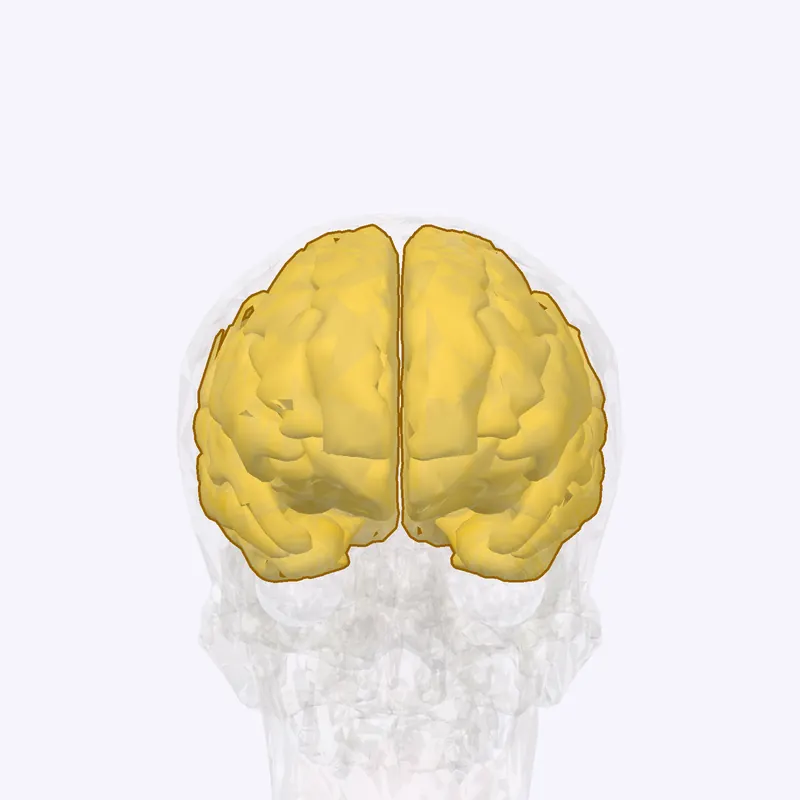
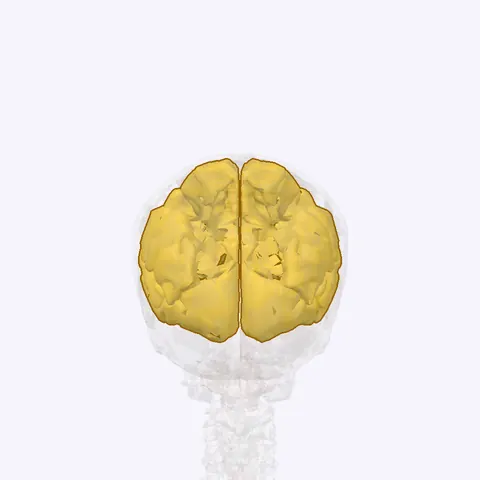
The two cerebral hemispheres: a folded cortex of grey matter (gyri and sulci) over white matter tracts, divided into frontal, parietal, temporal, occipital and insular lobes.
Quick facts
- Latin name
- Cerebrum
- Type
- Organ
- Body area
- Head and neck
Cerebrum: location
Fills the anterior and middle cranial fossae and rests on the tentorium cerebelli at the back.
Cerebrum: function
Frontal: movement, planning, speech production (Broca, left); parietal: sensation, spatial attention; temporal: hearing, memory, language comprehension (Wernicke); occipital: vision.
Cerebrum: blood supply
Anterior, middle and posterior cerebral arteries, linked by the circle of Willis.
Cerebrum: relations
Separated by the longitudinal fissure and joined by the corpus callosum; the central sulcus separates frontal from parietal lobes.
3D views
Cerebrum: clinical note
Each artery has a typical stroke pattern: middle cerebral (face and arm weakness, speech), anterior cerebral (leg), posterior cerebral (vision).
Questions about the cerebrum
What is the cerebrum?
The two cerebral hemispheres: a folded cortex of grey matter (gyri and sulci) over white matter tracts, divided into frontal, parietal, temporal, occipital and insular lobes.
What does the cerebrum do?
Frontal: movement, planning, speech production (Broca, left); parietal: sensation, spatial attention; temporal: hearing, memory, language comprehension (Wernicke); occipital: vision.
Where is the cerebrum?
Fills the anterior and middle cranial fossae and rests on the tentorium cerebelli at the back.
What is the blood supply of the cerebrum?
Anterior, middle and posterior cerebral arteries, linked by the circle of Willis.
See the cerebrum in 3D
Peel the layers, spin the model, quiz yourself on it and stand it on your desk in AR. AnatomyCompass is coming to iPhone, iPad and Mac: get one email when it’s out.
Other organs: head and neck
- Precentral gyrus
- Postcentral gyrus
- Corpus callosum
- Fornix and septum pellucidum
- Basal nuclei
- Internal capsule
- Thalamus
- Hypothalamus
- Pituitary gland
- Hippocampus
- Amygdala
- Ventricles of the brain
- Midbrain
- Pons
- Medulla oblongata
- Cerebellum
- Optic chiasm and tract
- Tentorium cerebelli
- Eyeball
- Cornea
- Iris and ciliary body
- Lens
- Vitreous body
- Lacrimal apparatus
- Eyelids
- Ear
- Nasal cartilages
- Tongue
- Lips
- Gums
- Submandibular and sublingual glands
- Thyroid cartilage
- Cricoid cartilage
- Arytenoid and small laryngeal cartilages
- Epiglottis
Spotted something wrong? Tell us and we’ll fix it. This page is a study reference, not medical advice.