Tongue
Lingua · Head and neck · Organ
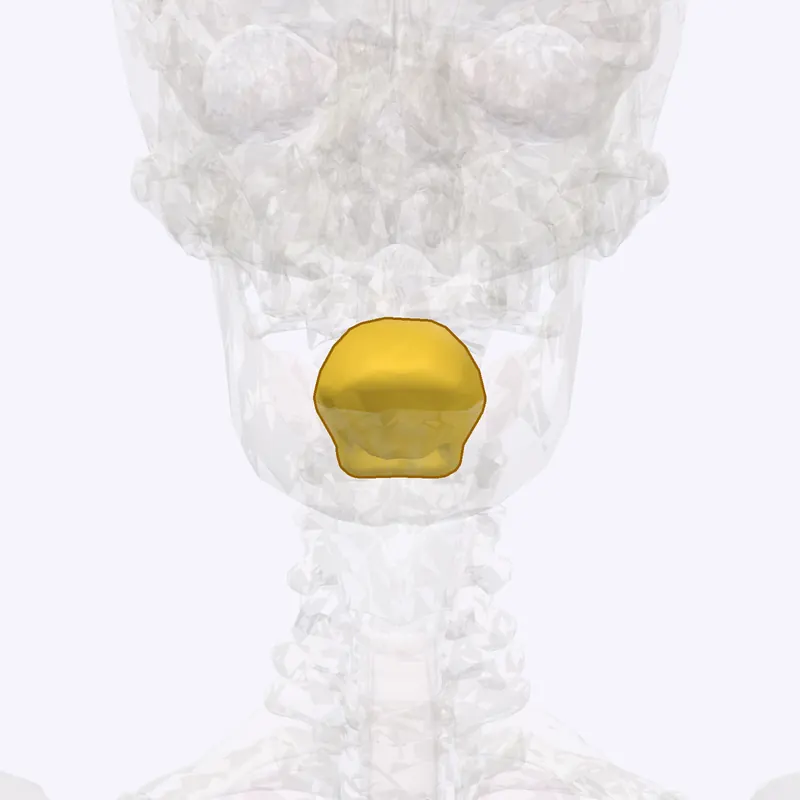
A muscular organ for taste, chewing, swallowing and speech.
Quick facts
- Latin name
- Lingua
- Type
- Organ
- Body area
- Head and neck
Tongue: location
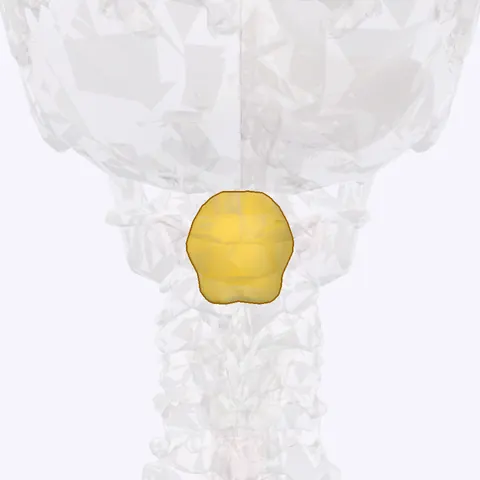
Floor of the mouth, its root in the oropharynx attached to the hyoid bone and mandible.
Tongue: function
Moves food, starts swallowing, shapes speech, carries taste buds.
Tongue: blood supply
Lingual artery (external carotid).
Tongue: nerve supply
Motor: hypoglossal nerve (all muscles but palatoglossus). Front two-thirds: lingual nerve (touch), chorda tympani (taste); back third: glossopharyngeal (both).
3D views
Tongue: clinical note
With a hypoglossal nerve palsy the tongue points towards the weak side when stuck out.
Questions about the tongue
What is the tongue?
A muscular organ for taste, chewing, swallowing and speech.
What does the tongue do?
Moves food, starts swallowing, shapes speech, carries taste buds.
Where is the tongue?
Floor of the mouth, its root in the oropharynx attached to the hyoid bone and mandible.
What is the blood supply of the tongue?
Lingual artery (external carotid).
See the tongue in 3D
Peel the layers, spin the model, quiz yourself on it and stand it on your desk in AR. AnatomyCompass is coming to iPhone, iPad and Mac: get one email when it’s out.
Other organs: head and neck
- Cerebrum
- Precentral gyrus
- Postcentral gyrus
- Corpus callosum
- Fornix and septum pellucidum
- Basal nuclei
- Internal capsule
- Thalamus
- Hypothalamus
- Pituitary gland
- Hippocampus
- Amygdala
- Ventricles of the brain
- Midbrain
- Pons
- Medulla oblongata
- Cerebellum
- Optic chiasm and tract
- Tentorium cerebelli
- Eyeball
- Cornea
- Iris and ciliary body
- Lens
- Vitreous body
- Lacrimal apparatus
- Eyelids
- Ear
- Nasal cartilages
- Lips
- Gums
- Submandibular and sublingual glands
- Thyroid cartilage
- Cricoid cartilage
- Arytenoid and small laryngeal cartilages
- Epiglottis
Spotted something wrong? Tell us and we’ll fix it. This page is a study reference, not medical advice.